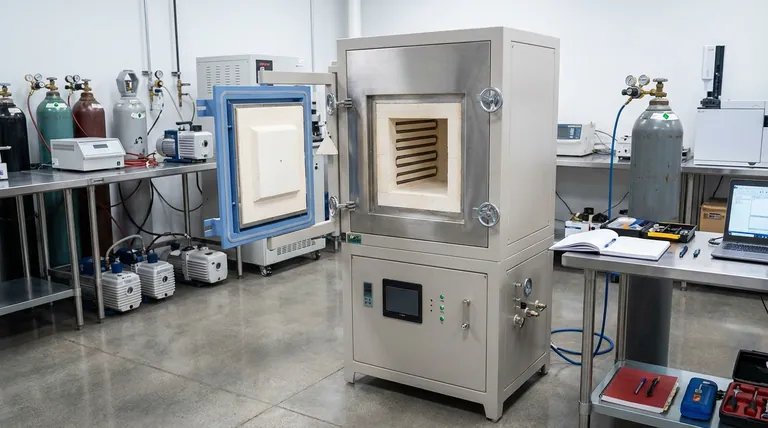
The Unseen Saboteur
Imagine a meticulously planned metallurgical process. The parameters are perfect, the materials are pure, but the result is a failure—discolored, oxidized, and useless. The culprit is invisible, silent, and relentless: a microscopic leak in the vacuum furnace.
The human mind craves simple causes for complex problems. We want to find a single, obvious flaw. But in the world of high-vacuum systems, failure often arrives as a whisper, not a bang. It’s a flaw in a seal measured in microns, an imperceptible crack in a weld.
The goal, then, is not the physicist's dream of a perfect, absolute vacuum. That is an impossibility. The engineer’s goal is one of controlled imperfection—ensuring the furnace's integrity is so high that any remaining atmospheric intrusion is mathematically insignificant to the process.
Why a Microscopic Leak Becomes a Catastrophic Failure
A vacuum furnace is a carefully constructed universe. A leak is a betrayal of that universe, introducing chaos that undermines its very purpose.
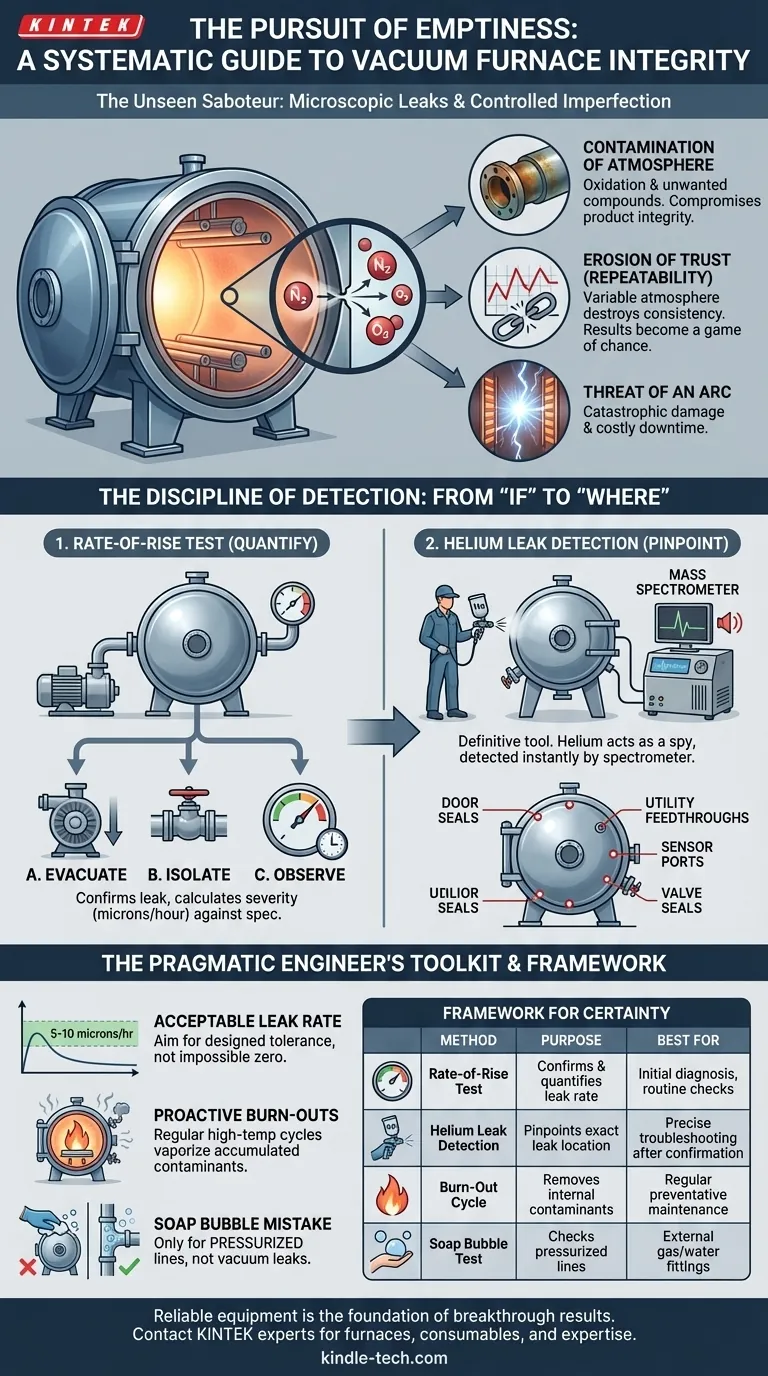
The Contamination of Atmosphere
The air we breathe, primarily nitrogen and oxygen, is a poison to sensitive high-temperature processes. When it seeps into the hot zone, it reacts with materials, causing oxidation and forming unwanted compounds. This contamination compromises the structural and chemical integrity of the final product.
The Erosion of Trust: Repeatability
In science and industry, the ultimate currency is trust in your results. A variable leak introduces a variable atmosphere. A process that works on Monday may fail on Tuesday because the vacuum level is fundamentally different. This inconsistency destroys repeatability, turning reliable production into a game of chance.
The Threat of an Arc
A poor vacuum doesn't just contaminate; it can actively destroy. As pressure rises, the environment becomes more conducive to electrical arcing between heating elements or components. An arc is a miniature lightning strike inside your furnace, capable of causing catastrophic damage and costly downtime.
The Discipline of Detection: From "If" to "Where"
Troubleshooting a vacuum leak is an exercise in discipline. It requires resisting the urge to guess and instead following a systematic path from confirming a problem to pinpointing its source.
Step 1: Quantifying the Problem with a Rate-of-Rise Test
Before you can find a leak, you must prove one exists. The rate-of-rise (or leak-up) test converts suspicion into hard data.
- Evacuate: Pump the chamber down to its normal operating vacuum.
- Isolate: Close the main valve, sealing the chamber off from the pumps.
- Observe: Record the initial pressure and monitor its increase over a set time (e.g., 30 minutes).
A significant pressure increase confirms a leak. More importantly, it calculates a rate (e.g., microns per hour), telling you the severity of the problem and whether it exceeds the manufacturer's specification.
Step 2: Following the Helium Whisper with a Mass Spectrometer
Once a leak is confirmed, the helium mass spectrometer is the definitive tool for finding its precise location. It is an instrument of incredible sensitivity.
The spectrometer is connected to the furnace's vacuum system. While the chamber is under vacuum, a fine stream of helium gas is sprayed over suspected weak points on the exterior. Helium is a tiny, inert atom—a perfect spy. If there is a leak path, helium atoms will be drawn into the chamber, and the spectrometer will instantly detect them, sounding an alarm.
To work efficiently, check the usual suspects first:
- Door Seals: The largest seal and the one subject to the most wear.
- Utility Feedthroughs: Entry points for power, water, and gas.
- Sensor Ports: Connections for gauges and thermocouples.
- Valve Seals: All seals on the furnace's various valves.
The Pragmatic Engineer's Toolkit
Effective vacuum management is about understanding nuance and using the right tool for the right job.
The Illusion of a Perfect Seal
No furnace is perfectly hermetic. Every system has a baseline, acceptable leak-up rate specified by the manufacturer (e.g., 5-10 microns per hour). The goal of maintenance is not to chase an impossible zero but to ensure the system performs reliably within its designed tolerance.
The Cleansing Ritual: Proactive Burn-Outs
Contaminants don't just enter through leaks; they can also outgas from the chamber walls or the materials themselves. A regular "burn-out" cycle—running the furnace empty at high temperature and high vacuum—is a critical maintenance ritual. It vaporizes and pumps away these accumulated contaminants, ensuring a purer starting environment for every run.
The Limited Role of the Soap Bubble
The classic soap bubble test is often misused. It cannot find a leak into a vacuum. Its proper role is for checking pressurized components connected to the furnace, like inert gas lines or water-cooling circuits. Applying a soap solution to a pressurized fitting will reveal bubbles if gas is leaking out.
A Framework for Certainty
Use this simple framework to guide your troubleshooting and maintenance efforts, ensuring your equipment delivers the consistency you depend on.
| Method | Purpose | Best For |
|---|---|---|
| Rate-of-Rise Test | Confirms and quantifies a leak rate | Initial diagnosis, routine performance checks |
| Helium Leak Detection | Pinpoints the exact leak location | Precise troubleshooting after a leak is confirmed |
| Burn-Out Cycle | Removes internal contaminants | Regular preventative maintenance (e.g., weekly) |
| Soap Bubble Test | Checks for leaks in pressurized lines | External gas/water fittings |
This disciplined approach transforms vacuum maintenance from a reactive chore into a proactive strategy for guaranteeing material integrity and process repeatability. At KINTEK, we understand that reliable equipment is the foundation of breakthrough results. We provide the high-quality furnaces, consumables, and expertise needed to maintain the integrity of your most critical processes.
If you are striving for purity and repeatability in your work, we can help. Contact Our Experts
Visual Guide
Related Products
- Vacuum Hot Press Furnace Heated Vacuum Press Machine Tube Furnace
- 600T Vacuum Induction Hot Press Furnace for Heat Treat and Sintering
- Vacuum Hot Press Furnace Machine Heated Vacuum Press
- Vacuum Heat Treat Furnace and Levitation Induction Melting Furnace
- 2200 ℃ Tungsten Vacuum Heat Treat and Sintering Furnace
Related Articles
- The Purity Paradox: Choosing the Heart of Your Vacuum Hot Press Furnace
- Comprehensive Guide to Vacuum Hot Press Furnace Application
- Vacuum Hot Press Furnace: A Comprehensive Guide
- Forging Perfection in a Void: The Physics of Ultra-Dense Materials
- Defeating the Void: The Quiet Power of Vacuum Hot Pressing



















