The Enemy We Breathe
At the microscopic level, the air we breathe is a relentless saboteur. For a materials engineer, oxygen, water vapor, and nitrogen are not life-giving elements; they are contaminants waiting to corrupt a perfect creation.
When you heat a high-performance alloy or a medical-grade implant in a conventional furnace, you are inviting these elements to a party. They react, they tarnish, they create weak oxide layers, and they subtly steal carbon from steel in a process called decarburization.
You are fighting a battle on a million fronts.
The profound insight behind the vacuum furnace is a psychological one: stop fighting the symptoms. Instead of trying to mitigate the damage caused by the atmosphere, what if you simply removed the atmosphere altogether?
A Philosophy of Absolute Control
A vacuum furnace is not merely a tool for heating. It is a self-contained universe where the laws of atmospheric chemistry are suspended. By creating a void, you gain absolute control over the environment.
This control allows for processes that are otherwise physically impossible, yielding materials with a purity, strength, and surface finish that standard methods can only dream of.
It’s a shift from reactive problem-solving to proactive environmental design.
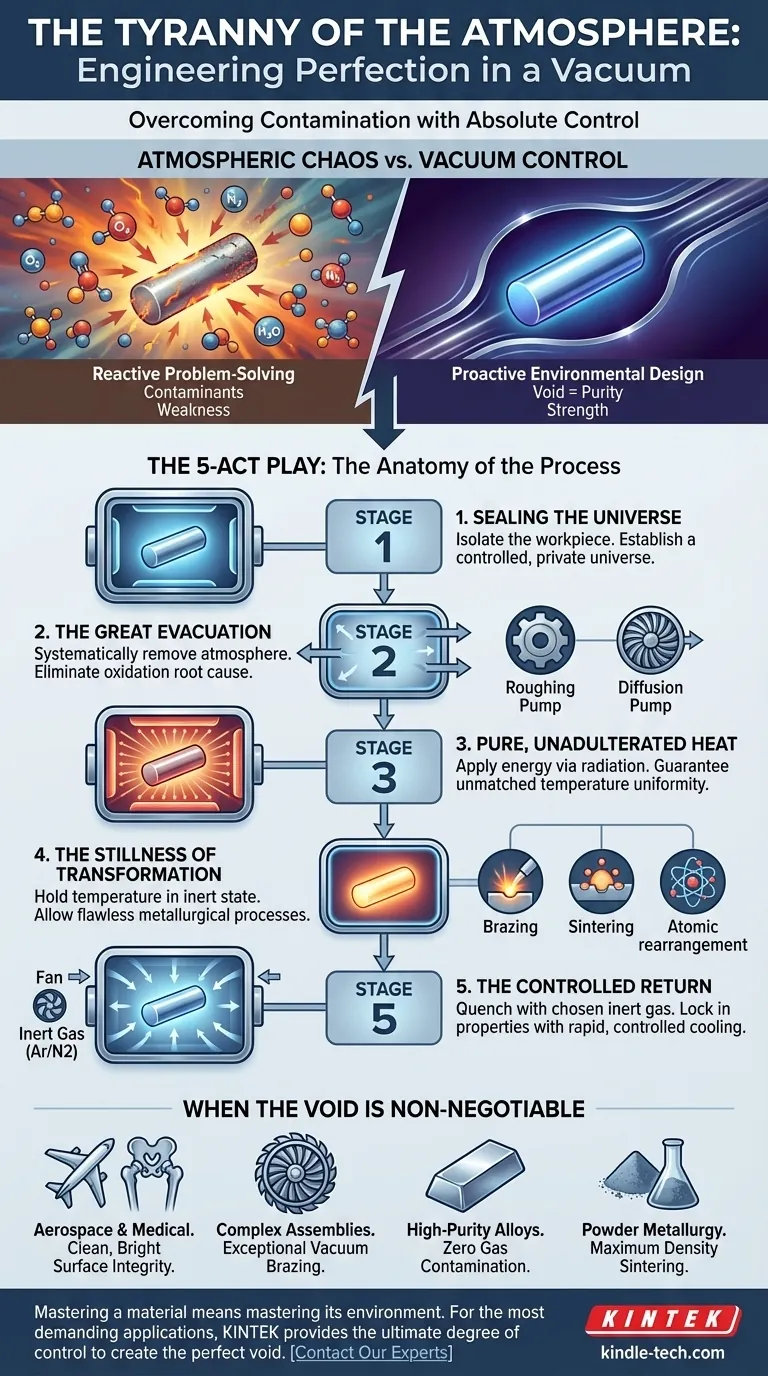
The Anatomy of the Process: A Five-Act Play
The operation of a vacuum furnace is a meticulously choreographed sequence. Each step is a deliberate act of imposing order over chaos.
Act 1: Sealing the Universe
First, the workpiece is loaded into the chamber. This isn't just a box; it's a robust, sealed vessel, often with double walls for water cooling. The act of sealing the door is the first step: creating a boundary between the chaotic outside world and the controlled world you are about to create inside.
Act 2: The Great Evacuation
This is where the magic begins. A powerful pump system engages in a two-stage process to methodically remove the atmosphere.
- A mechanical "roughing" pump removes the vast majority of the air. It’s the brute-force stage.
- Then, a diffusion or turbomolecular pump takes over. It hunts down the remaining stray molecules, achieving a high-level vacuum where the influence of reactive gases becomes statistically insignificant.
The chamber is now a void, a clean slate.
Act 3: Pure, Unadulterated Heat
In the absence of air, heat transfer changes fundamentally. Convection—the swirling, uneven movement of hot air—is gone.
Instead, heat is transferred primarily through radiation. Heating elements, made of graphite or refractory metals, glow with energy, bathing the workpiece in uniform, predictable heat from all sides. This minimizes internal stresses and prevents the warping that can plague complex parts.
Act 4: The Stillness of Transformation
The material is held, or "soaked," at a precise temperature. In this pristine, silent environment, the intended metallurgical transformation occurs flawlessly.
Brazing alloys flow cleanly into joints without the need for corrosive flux. Microscopic particles in powdered metals bond together during sintering, achieving full density. The atomic structure of an alloy rearranges itself for hardening, unimpeded by impurities. This is where the material achieves its ideal properties.
Act 5: The Controlled Return
Cooling is as critical as heating. Simply opening the door would be a catastrophe, causing instant oxidation on the hot surface.
Instead, the furnace is backfilled with a high-purity inert gas like argon or nitrogen. This is not a surrender to the atmosphere, but the introduction of a chosen, non-reactive one. A powerful fan circulates this gas, quenching the part rapidly and uniformly, locking in the new properties before it ever meets the outside air.
The Price of Perfection
This level of control doesn’t come without trade-offs.
Vacuum furnaces are more complex and expensive. The cycle times are longer due to the need to pump down the chamber. And maintaining the integrity of every seal and pump requires rigorous, proactive maintenance. A tiny leak can compromise an entire batch.
But this isn't a flaw; it's the cost of admission. For applications where failure is not an option, these trade-offs are not just acceptable; they are necessary.
When the Void is Non-Negotiable
You choose a vacuum furnace when the cost of atmospheric contamination is higher than the cost of the equipment.
- For Aerospace and Medical Implants: Surface integrity is paramount. A vacuum ensures a perfectly clean, bright finish with zero oxidation.
- For Complex Assemblies: Vacuum brazing creates joints of exceptional strength and purity, essential for parts like turbine blades or sensitive electronics.
- For High-Purity Alloys: Melting superalloys for jet engines or specialty metals requires a vacuum to prevent gas contamination and achieve an exact chemical composition.
- For Powder Metallurgy: Sintering materials like tungsten carbide or advanced ceramics in a vacuum is the only way to achieve maximum density and superior performance.
The following table summarizes this journey of control:
| Process Stage | The Act of Control | The Resulting Perfection |
|---|---|---|
| 1. Loading & Sealing | Isolating the workpiece in a sealed vessel | Establishes a controlled, private universe |
| 2. Evacuation | Systematically removing the atmosphere | Eliminates the root cause of oxidation & contamination |
| 3. Heating | Applying energy through pure radiation | Guarantees unmatched temperature uniformity |
| 4. Soaking | Holding temperature in an inert state | Allows metallurgical processes to complete flawlessly |
| 5. Cooling | Quenching with a chosen inert gas | Locks in properties with rapid, controlled cooling |
Mastering a material means mastering its environment. For the most demanding applications, this requires removing the environment entirely and building a new one from scratch. At KINTEK, we provide the high-performance vacuum furnaces that give engineers and scientists this ultimate degree of control. Our solutions are built to create the perfect void, enabling you to achieve the impossible.
If your work demands nothing less than absolute material perfection, Contact Our Experts.
Visual Guide
Related Products
- Vacuum Hot Press Furnace Heated Vacuum Press Machine Tube Furnace
- 600T Vacuum Induction Hot Press Furnace for Heat Treat and Sintering
- Vacuum Hot Press Furnace Machine Heated Vacuum Press
- Vacuum Heat Treat Furnace and Levitation Induction Melting Furnace
- 2200 ℃ Tungsten Vacuum Heat Treat and Sintering Furnace
Related Articles
- The Purity Paradox: Choosing the Heart of Your Vacuum Hot Press Furnace
- Comprehensive Guide to Vacuum Hot Press Furnace Application
- Vacuum Hot Press Furnace: A Comprehensive Guide
- Forging Perfection in a Void: The Physics of Ultra-Dense Materials
- Defeating the Void: The Quiet Power of Vacuum Hot Pressing