The Invisible Enemy in Heat Treatment
Imagine a single turbine blade in a jet engine. It spins thousands of times per minute, enduring temperatures that would melt steel and forces that could tear a building apart. Its survival depends on flawless metallurgy.
The greatest threat to this perfection isn't a dramatic failure. It's an invisible one, introduced during its creation. The enemy is the very air we breathe.
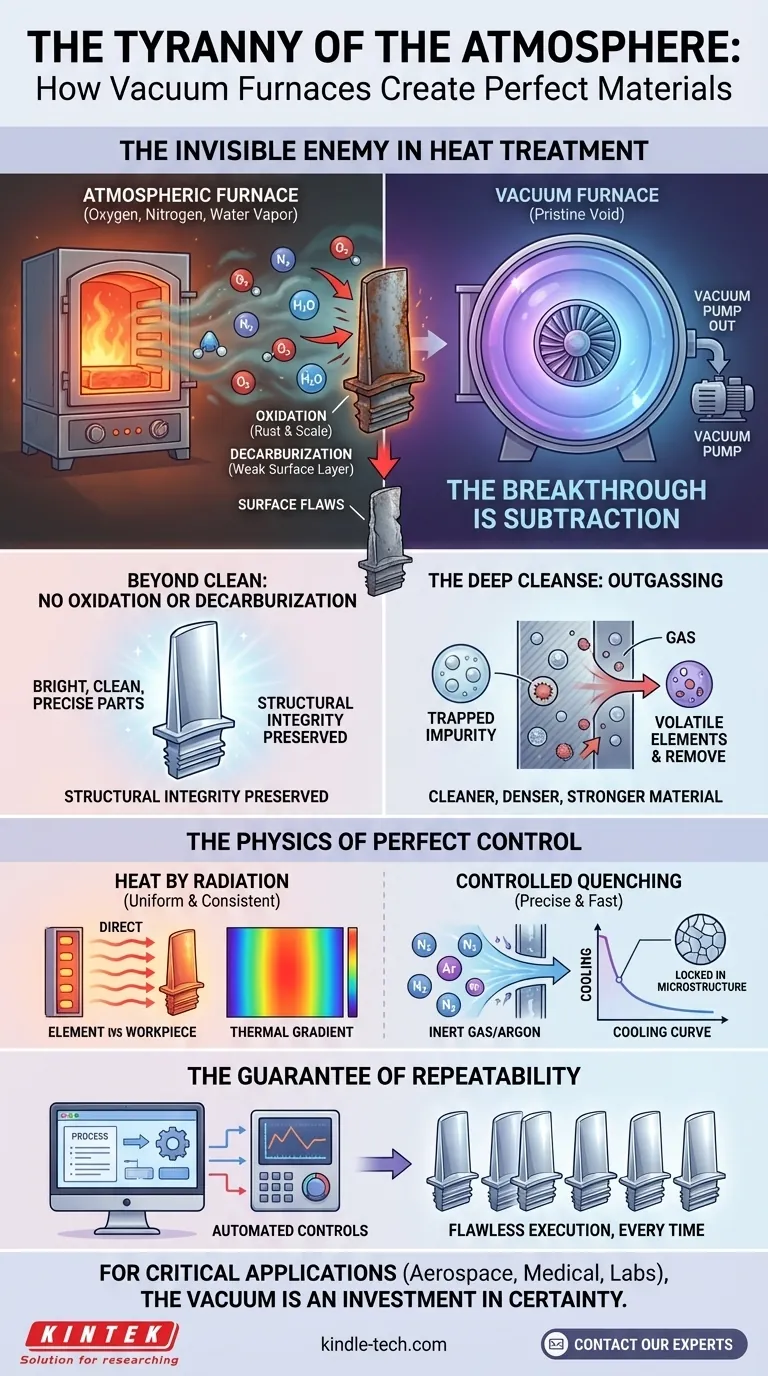
Traditional furnaces operate in an atmosphere filled with oxygen, nitrogen, and water vapor. At high temperatures, these aren't just passive gases; they are aggressive reactants, eager to contaminate and weaken the very materials we're trying to strengthen.
This is the tyranny of the atmosphere. And the solution is to remove it entirely.
The Breakthrough Is Subtraction, Not Addition
We instinctively think of furnaces as a tool for adding something: heat.
But the most profound leap in metallurgical quality comes from taking something away. A vacuum furnace works on this simple, yet powerful, principle. By evacuating a sealed chamber, it creates a pristine environment, an engineered void.
This act of subtraction changes everything.
Beyond Clean: The Brilliance of a Vacuum
By removing the atmosphere, you prevent destructive surface reactions before they can even begin.
- No Oxidation: Without oxygen, there is no rust or scale. Parts emerge from the furnace "bright," clean, and dimensionally precise, often eliminating the need for costly and harsh post-processing like chemical cleaning or grinding.
- No Decarburization: The furnace environment can't strip carbon from the surface of steel, a process that creates a soft, weak outer layer. The material's designed properties are preserved from its core to its skin.
The result isn't just a prettier part. It's a component with superior structural integrity, free from the microscopic surface flaws that can become catastrophic failure points.
The Deep Cleanse: Pulling Impurities from Within
A vacuum doesn't just prevent new contamination; it actively purifies the material itself.
Under low pressure, trapped gases and volatile elements deep within the metal—remnants from its initial production—are literally pulled to the surface and removed. This process, called outgassing, results in a material that is fundamentally cleaner, denser, and stronger.
It’s the difference between protecting a surface and purifying a soul.
The Physics of Perfect Control
In the absence of air, the rules of heat transfer change. This new environment allows for a level of precision that atmospheric furnaces can never match.
Heat by Radiation, Not by Chance
In an atmosphere furnace, heat moves unpredictably through convection currents, creating hot and cold spots. The process is a blunt instrument.
In a vacuum, heat is transferred primarily through radiation. Energy travels directly from the heating elements to the workpiece, blanketing it uniformly. Every part of the component, regardless of its shape or position in the furnace, receives the exact same thermal treatment.
This guarantees consistent metallurgical properties throughout the entire part, a non-negotiable for high-stress applications.
The Art of the Controlled Cooldown
Once the heating cycle is complete, the void can be instantly filled with a high-pressure, inert gas like nitrogen or argon.
This rapid gas quenching is precisely controlled by a computer, allowing metallurgists to cool the part at a calculated rate. This isn't just cooling; it's a critical step to lock in a specific hardness, grain structure, and performance characteristic. It's both incredibly fast and exquisitely precise.
The Guarantee of Repeatability
In fields like aerospace or medical implants, quality cannot be a matter of chance. It must be a guarantee.
Modern vacuum furnaces are fully automated systems. Every variable—vacuum level, temperature ramp rates, soak times, and cooling profiles—is dictated by a process recipe. The system executes that recipe flawlessly, every single time.
This removes the single greatest variable in complex manufacturing: human error. It creates a contract of consistency, ensuring that the thousandth part is identical to the first.
Is the Void Always the Answer?
Objectivity requires acknowledging that this level of control comes with trade-offs. Vacuum furnaces are not a universal solution.
- Higher Initial Investment: The technology behind creating and maintaining a perfect vacuum is complex and represents a significant capital cost.
- Cycle Time: Pumping down the chamber to a deep vacuum takes time, which can extend the overall process cycle for some applications.
- Maintenance: High-performance vacuum systems require specialized knowledge and upkeep to operate at peak efficiency.
The decision hinges on a single question: What is the cost of imperfection?
For high-volume, non-critical parts where minor surface oxidation is acceptable, a traditional atmosphere furnace is often the more cost-effective choice.
But for demanding laboratory applications working with reactive metals like titanium, producing medical implants where biocompatibility is paramount, or developing critical components where failure is not an option, the investment in a vacuum environment is an investment in certainty.
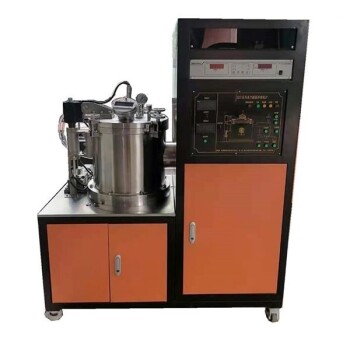
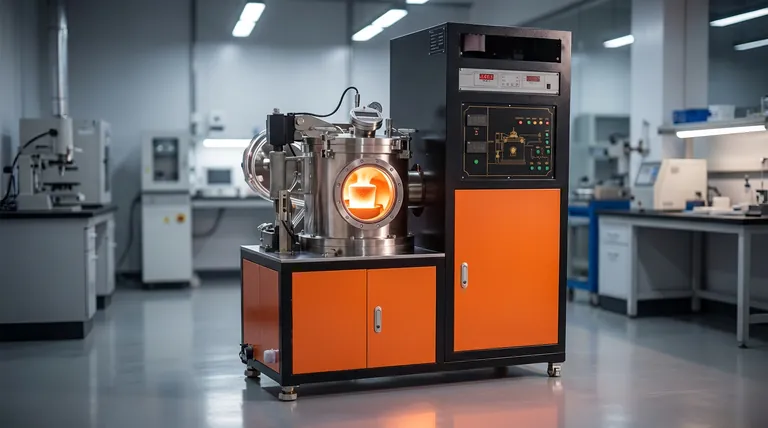
KINTEK specializes in providing advanced vacuum furnaces designed for laboratories that cannot compromise. Our systems deliver the purity, precision, and repeatability necessary to push the boundaries of material science. When your results depend on absolute environmental control, you need a partner who understands the power of the void.
If you are ready to eliminate the invisible enemies in your heat treatment process, Contact Our Experts.
Visual Guide
Related Products
- Vacuum Hot Press Furnace Heated Vacuum Press Machine Tube Furnace
- 600T Vacuum Induction Hot Press Furnace for Heat Treat and Sintering
- Vacuum Hot Press Furnace Machine Heated Vacuum Press
- Vacuum Heat Treat Furnace and Levitation Induction Melting Furnace
- 2200 ℃ Tungsten Vacuum Heat Treat and Sintering Furnace
Related Articles
- The Purity Paradox: Choosing the Heart of Your Vacuum Hot Press Furnace
- Comprehensive Guide to Vacuum Hot Press Furnace Application
- Vacuum Hot Press Furnace: A Comprehensive Guide
- Forging Perfection in a Void: The Physics of Ultra-Dense Materials
- Defeating the Void: The Quiet Power of Vacuum Hot Pressing