The Unseen Saboteur in Every Workshop
Imagine an engineer designing a turbine blade. The alloy is exotic, the geometry is perfect, and its performance depends on absolute material integrity. The design is flawless. But between the raw material and the finished part lies a hidden variable, an unseen saboteur present in every workshop on Earth: the air itself.
At room temperature, the atmosphere is benign. But at the high temperatures required for heat treatment, it becomes a chaotic and aggressive agent. The very air we breathe wages a chemical war on the surface of the material, introducing flaws that can lead to catastrophic failure down the line.
This is the fundamental problem that a vacuum furnace solves. It’s not just a tool for heating things; it's a tool for creating a sanctuary where materials can achieve their true potential, free from the tyranny of the atmosphere.
Why We Fear the Air: The Chemistry of Compromise
To appreciate the elegance of a vacuum, you must first understand the specific threats it neutralizes. When you heat metal in a conventional furnace, you are inviting several forms of chemical attack.
Oxidation: The Obvious Enemy
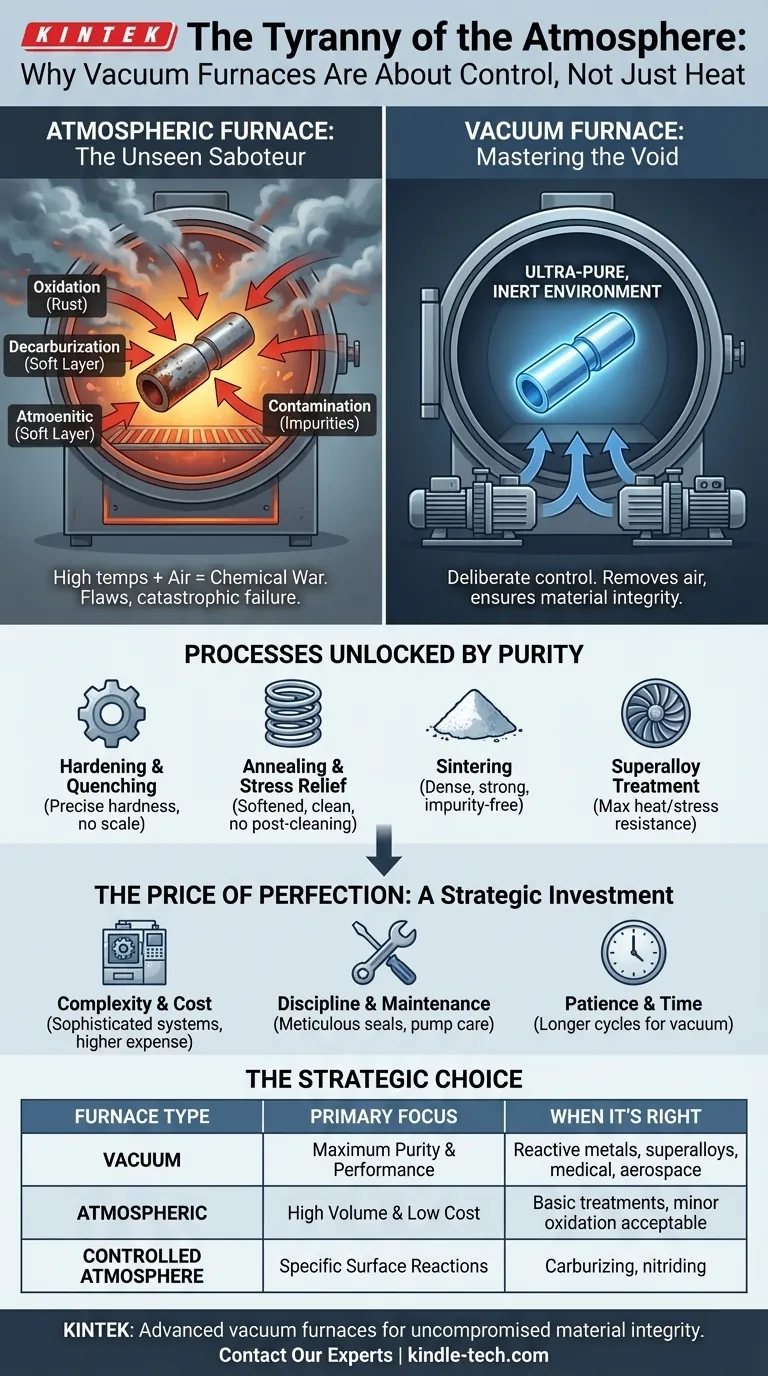
This is the most common reaction. Oxygen in the air aggressively bonds with the material's surface, creating oxide layers—rust, on a fundamental level. This not only ruins the surface finish but can also alter the dimensions and properties of the part.
Decarburization: The Silent Weakness
For steels, the atmosphere can pull carbon atoms directly out of the surface. This loss of carbon, known as decarburization, creates a soft, weak outer layer on a component that was designed to be hard and durable. It’s an invisible weakness that compromises the part's structural integrity from the outside in.
Contamination: The Hidden Flaw
Beyond oxygen, the atmosphere is a mix of nitrogen, water vapor, and other trace elements. At high temperatures, these can embed themselves into the material, creating impurities that degrade mechanical performance, especially in high-purity metals and superalloys.
Mastering the Void: The Logic of a Vacuum
A vacuum furnace is an act of deliberate control. It addresses the problem not by fighting the atmosphere, but by simply removing it.
The process begins by placing components inside a sealed chamber. A system of powerful pumps then evacuates the air, reducing the internal pressure to a near-perfect vacuum. This act of removal creates an ultra-pure, inert environment.
By processing parts in this void, we ensure the final product is pristine. Materials emerge with bright, clean surfaces, free of oxide layers. The chemistry of the material remains exactly as intended. It’s a transition from hoping for a good outcome to engineering one.
Processes Unlocked by Purity
This controlled environment is the key that unlocks a range of sensitive thermal processes, enabling a level of precision that is otherwise impossible.
- Hardening & Quenching: Rapid, uniform cooling can be achieved without the risk of surface contamination, delivering precise hardness for high-stress parts like gears and tools.
- Annealing & Stress Relief: Materials can be softened and made more workable without forming surface scale, which eliminates the need for costly and damaging post-processing cleaning.
- Sintering: Metal powders can be fused into a dense, solid part. The vacuum prevents trapped gases and impurities, resulting in stronger, more reliable components from powdered metallurgy.
- Superalloy Treatment: The complex heat treatments required for nickel-based superalloys in jet engines and medical implants can be performed in a contamination-free environment, ensuring they achieve maximum resistance to heat and stress.
The Price of Perfection
This level of control is a strategic investment, not a default choice. Vacuum furnaces represent a commitment to quality that comes with specific trade-offs.
- Complexity & Cost: The sophisticated vacuum systems, controls, and chamber engineering make them more expensive to purchase and operate than atmospheric furnaces.
- Discipline & Maintenance: The integrity of the vacuum is paramount. Seals, pumps, and gauges require meticulous, regular maintenance to prevent leaks that would compromise the entire process.
- Patience & Time: Pumping the chamber down to the required vacuum level adds significant time to each cycle, making them less suitable for high-volume processes where speed is the only metric.
The Strategic Choice: When a Vacuum is Non-Negotiable
Choosing the right furnace technology is a strategic decision about what you value most. The choice isn't between good and bad, but between different priorities.
| Furnace Type | Primary Focus | When It's the Right Choice |
|---|---|---|
| Vacuum Furnace | Maximum Purity & Performance | For reactive metals, superalloys, medical, and aerospace. |
| Atmospheric Furnace | High Volume & Low Cost | For basic treatments where minor surface oxidation is acceptable. |
| Controlled Atmosphere | Specific Surface Reactions | For processes like carburizing or nitriding. |
Ultimately, choosing a vacuum furnace is a declaration that material integrity and process control are your highest priorities. It's a decision to eliminate variables and invest in certainty, especially for applications where performance is critical and failure is not an option.
For laboratories and industries pushing the boundaries of material science, this control is not a luxury; it is a necessity. KINTEK's advanced vacuum furnaces provide this precise, ultra-pure environment, ensuring that your materials meet the most stringent performance and quality standards. If your work demands uncompromised material integrity, we can help you achieve it. Contact Our Experts
Visual Guide
Related Products
- Vacuum Hot Press Furnace Heated Vacuum Press Machine Tube Furnace
- 600T Vacuum Induction Hot Press Furnace for Heat Treat and Sintering
- Vacuum Hot Press Furnace Machine Heated Vacuum Press
- Vacuum Heat Treat Furnace and Levitation Induction Melting Furnace
- 2200 ℃ Tungsten Vacuum Heat Treat and Sintering Furnace
Related Articles
- The Purity Paradox: Choosing the Heart of Your Vacuum Hot Press Furnace
- Comprehensive Guide to Vacuum Hot Press Furnace Application
- Vacuum Hot Press Furnace: A Comprehensive Guide
- Forging Perfection in a Void: The Physics of Ultra-Dense Materials
- Defeating the Void: The Quiet Power of Vacuum Hot Pressing