The Seduction of a Single Number
In a laboratory, we are trained to trust the numbers on our equipment. A specification, like a furnace's maximum temperature, feels like a hard promise. It's an operational boundary, a limit we can push towards.
But this single number is often a dangerous simplification.
The reality is that a vacuum tube furnace is not a simple heater; it's an integrated system operating at the edge of material science. Its true temperature ceiling isn't determined by its strongest component, but by its weakest link. Misunderstanding this is the fastest way to a cracked tube, a contaminated sample, and a failed experiment.
The Engine and The Arena
Think of the furnace's performance as a duel between two key components: the heating element and the work tube.
The Engine: Heating Elements
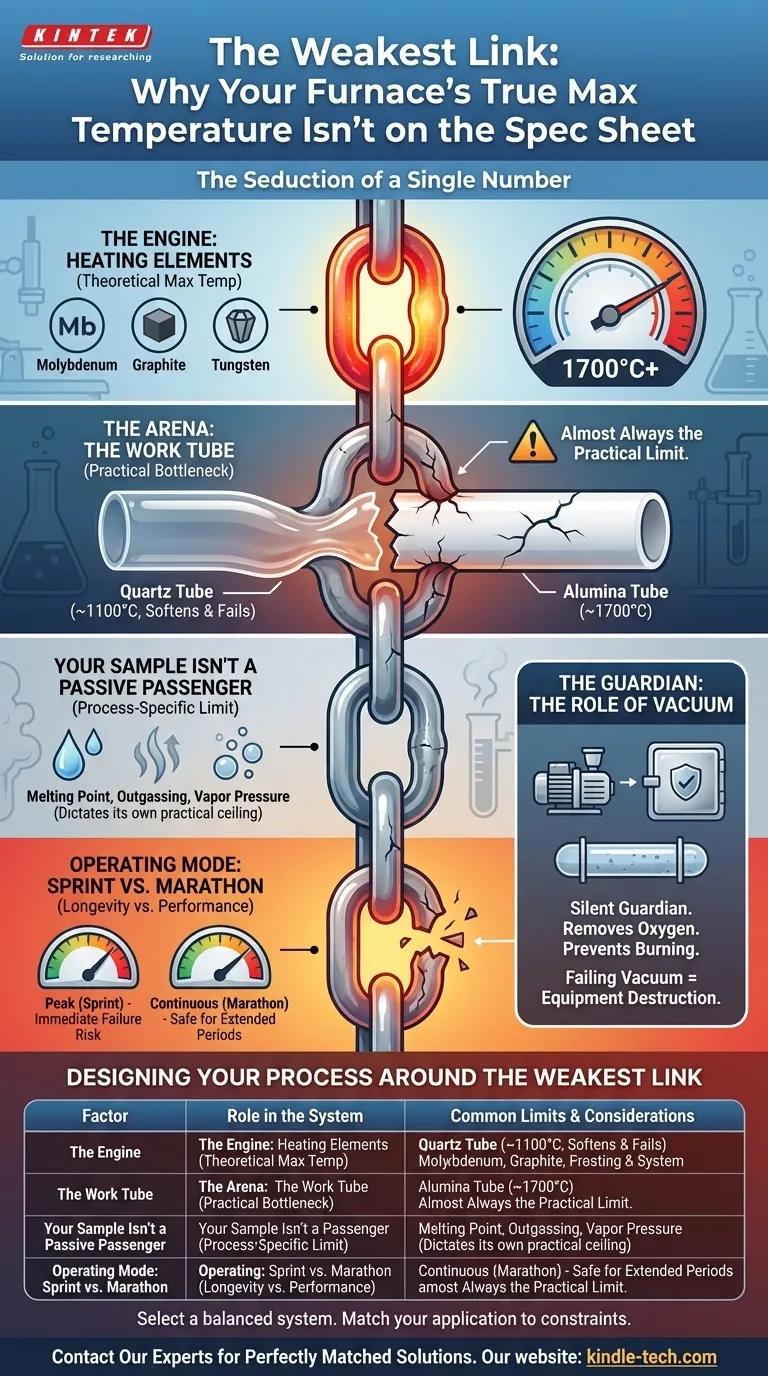
The heating elements—often made of molybdenum, graphite, or tungsten—are the engine of the furnace. They generate the raw thermal energy. Their material composition sets the theoretical maximum temperature.
This is the number that often makes it onto the brochure. It's the absolute peak the system could generate in a perfect, frictionless world.
The Arena: The Work Tube
But the experiment doesn't happen in a theoretical world. It happens inside the work tube. This tube is the arena. It must contain the sample, maintain the vacuum, and endure the brutal, direct heat from the elements.
This is almost always the practical bottleneck.
The material of the work tube has a non-negotiable temperature limit. A quartz tube, for instance, is a cost-effective workhorse for many applications, but it will soften and fail as you push past 1100°C. For higher temperatures, you enter the realm of advanced ceramics like alumina, which can withstand up to ~1700°C.
Pushing a quartz tube to an alumina-level temperature isn't a matter of risk; it's a matter of time until failure.
Your Sample Isn't a Passive Passenger
The furnace system has a third active player: the material you are heating.
Your sample has its own physical limits that can impose a ceiling far below what the furnace hardware can handle. As temperature climbs, materials can reach their melting point or, more subtly, their vapor pressure can rise dramatically.
This "outgassing" can overwhelm the vacuum pump, compromising the inert atmosphere needed to protect both the sample and the furnace's internal components from high-temperature oxidation. Your material, therefore, dictates its own practical temperature limit.
The Rules of Engagement
Beyond the core components, the operating environment itself sets crucial rules that affect the achievable and sustainable temperature.
Sprint vs. Marathon: Peak and Continuous Use
Manufacturers often list two temperatures. The maximum temperature is a sprint—a short-term rating the furnace can hit without immediate failure. The continuous operating temperature is the marathon—the highest temperature it can safely maintain for extended periods without causing premature wear on the elements and tube.
Consistently running at the peak temperature is like redlining an engine; it drastically shortens the equipment's lifespan.
The Guardian: The Role of Vacuum
The vacuum itself does not determine the temperature limit, but it is the silent guardian that makes high temperatures possible. By removing oxygen, a high vacuum prevents the heating elements (especially graphite) and the sample from literally burning up.
A failing vacuum doesn't just ruin the experiment; it can destroy the equipment.
Designing Your Process Around the Weakest Link
To achieve safe, repeatable results, you must stop looking at the furnace's max temperature and start thinking about the constraints of your specific process.
The right choice comes from matching your application to a system where all components are in harmony.
| Factor | Role in the System | Common Limits & Considerations |
|---|---|---|
| Heating Element | The Engine (Theoretical Max Temp) | Graphite, Molybdenum, Tungsten (1700°C+) |
| Work Tube | The Arena (Practical Max Temp) | Quartz (~1100°C), Alumina (~1700°C) |
| Sample Material | The Actor (Process-Specific Limit) | Melting point, outgassing, vapor pressure |
| Operating Mode | The Pace (Longevity vs. Performance) | Continuous rating is lower than peak |
Whether you need a robust, cost-effective system with a quartz tube for processes up to 1200°C or a high-performance furnace with an alumina tube for temperatures nearing 1700°C, the key is to select a balanced system. At KINTEK, we provide laboratory furnaces designed with these constraints in mind, ensuring the work tube, heating elements, and vacuum system are perfectly matched to your goals.
Understanding these trade-offs is the first step toward mastering your high-temperature applications. Contact Our Experts
Visual Guide
Related Products
- Vacuum Hot Press Furnace Heated Vacuum Press Machine Tube Furnace
- 600T Vacuum Induction Hot Press Furnace for Heat Treat and Sintering
- Vacuum Hot Press Furnace Machine Heated Vacuum Press
- Vacuum Heat Treat Furnace and Levitation Induction Melting Furnace
- 2200 ℃ Tungsten Vacuum Heat Treat and Sintering Furnace
Related Articles
- The Purity Paradox: Choosing the Heart of Your Vacuum Hot Press Furnace
- Comprehensive Guide to Vacuum Hot Press Furnace Application
- Vacuum Hot Press Furnace: A Comprehensive Guide
- Forging Perfection in a Void: The Physics of Ultra-Dense Materials
- Defeating the Void: The Quiet Power of Vacuum Hot Pressing