Knowledge Does PVD coating scratch? Unlocking the Truth About Its Exceptional Durability
Author avatar

Tech Team · Kintek Solution

Updated 6 days ago

Does PVD coating scratch? Unlocking the Truth About Its Exceptional Durability


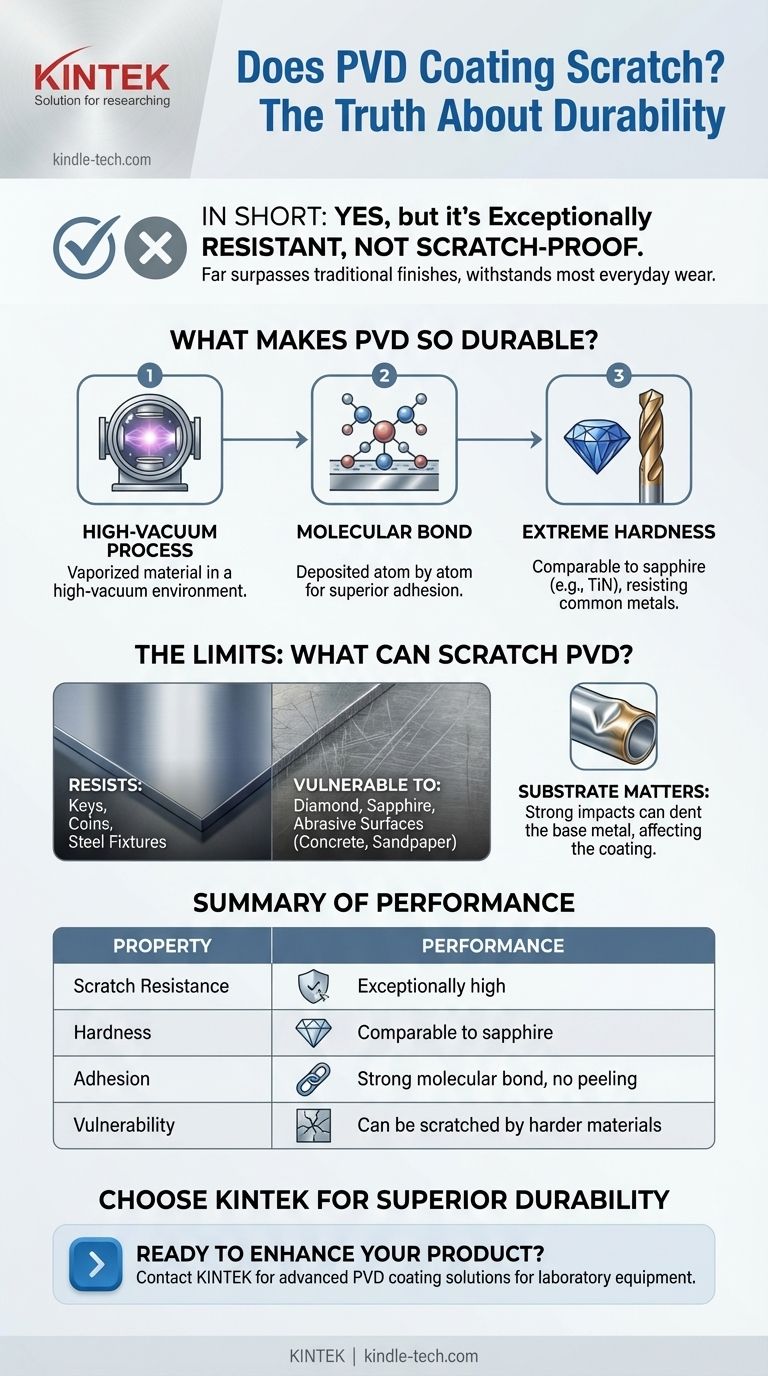
In short, yes, PVD coatings can be scratched. While PVD (Physical Vapor Deposition) is not scratch-proof, it is exceptionally scratch-resistant. Its durability and hardness far surpass traditional coating methods, but it is still vulnerable to damage from materials that are harder than it or from significant abrasive force.

The critical distinction is that PVD is not invincible, but rather highly resilient. Its value comes from its ability to withstand the vast majority of everyday wear and tear that would easily damage conventional finishes like paint or electroplating.

Does PVD coating scratch? Unlocking the Truth About Its Exceptional Durability

What Makes PVD So Durable?

To understand why PVD coatings are so tough, you have to look at the process itself and the materials used. It's fundamentally different from a simple layer of paint.

The "Physical Vapor Deposition" Process

PVD is a process conducted in a high-vacuum environment. A solid, high-purity coating material (like titanium or chromium) is vaporized into a plasma of atoms and ions. This vapor is then deposited onto the surface of the object, creating a thin film that is bonded at a molecular level.

Extreme Hardness

This process creates a surface that is incredibly hard. For example, a Titanium Nitride (TiN) PVD coating has a hardness comparable to sapphire. This means it can resist being scratched by most common metals you would encounter, such as keys, steel fixtures, or door handles.

Superior Adhesion

Because the coating is bonded atom by atom, it adheres to the base material with exceptional strength. This molecular bond makes PVD coatings highly resistant to the chipping, flaking, and peeling that are common failure points for traditional finishes.

Understanding the Trade-offs: The Limits of PVD

Building trust requires understanding not just the strengths, but also the limitations. No coating is indestructible, and PVD is no exception.

Scratch-Resistant vs. Scratch-Proof

A PVD finish will easily shrug off accidental scuffs from daily life. However, it is not proof against any and all damage. Materials with a higher hardness value can and will scratch it.

What Can Scratch PVD?

A PVD coating can be damaged by materials like diamond, sapphire, or extremely abrasive surfaces like rough concrete or coarse sandpaper. A concentrated, high-pressure scrape against a sharp, hard edge could also compromise the finish.

The Substrate Still Matters

The durability of the final product also depends on the material underneath the PVD coating. A strong impact can dent the softer base metal (like stainless steel). While the PVD coating itself might not have been scratched through, the underlying dent will cause the coating to deform, resulting in visible damage.

Making the Right Choice for Your Application

Your decision to choose a PVD-coated product should be based on a realistic expectation of its performance in your specific environment.

  • If your primary focus is everyday wear (watches, jewelry, faucets): PVD offers outstanding protection against the common scuffs and minor abrasions that quickly degrade traditional finishes.
  • If your primary focus is high-impact or extreme use (tools, industrial parts): While PVD is a top-tier choice for surface hardness and wear resistance, understand that direct, forceful impacts can still cause damage to the underlying material.

Ultimately, choosing PVD means investing in one of the most resilient and long-lasting finishes available, providing superior durability for most real-world scenarios.

Summary Table:

Property PVD Coating Performance
Scratch Resistance Exceptionally high, far superior to traditional finishes
Hardness Comparable to sapphire (e.g., TiN coatings)
Adhesion Strong molecular bond, resists chipping and peeling
Vulnerability Can be scratched by harder materials (diamond, sapphire, abrasive surfaces)

Ready to enhance your product's durability with a superior finish? KINTEK specializes in advanced PVD coating solutions for laboratory equipment and consumables. Our coatings provide exceptional scratch and wear resistance, ensuring your products last longer and perform better. Contact our experts today to discuss how we can meet your specific laboratory needs!

Visual Guide
Does PVD coating scratch? Unlocking the Truth About Its Exceptional Durability Visual Guide

Related Products

People Also Ask

Related Products

2200 ℃ Graphite Vacuum Heat Treat Furnace

2200 ℃ Graphite Vacuum Heat Treat Furnace

Discover the power of the KT-VG Graphite Vacuum Furnace - with a maximum working temperature of 2200℃, it's perfect for vacuum sintering of various materials. Learn more now.

Vacuum Heat Treat and Molybdenum Wire Sintering Furnace for Vacuum Sintering

Vacuum Heat Treat and Molybdenum Wire Sintering Furnace for Vacuum Sintering

A vacuum molybdenum wire sintering furnace is a vertical or bedroom structure, which is suitable for withdrawal, brazing, sintering and degassing of metal materials under high vacuum and high temperature conditions. It is also suitable for dehydroxylation treatment of quartz materials.

High Pressure Laboratory Vacuum Tube Furnace Quartz Tubular Furnace

High Pressure Laboratory Vacuum Tube Furnace Quartz Tubular Furnace

KT-PTF High Pressure Tube Furnace: Compact split tube furnace with strong positive pressure resistance. Working temp up to 1100°C and pressure up to 15Mpa. Also works under controller atmosphere or high vacuum.

Small Vacuum Heat Treat and Tungsten Wire Sintering Furnace

Small Vacuum Heat Treat and Tungsten Wire Sintering Furnace

The small vacuum tungsten wire sintering furnace is a compact experimental vacuum furnace specially designed for universities and scientific research institutes. The furnace features a CNC welded shell and vacuum piping to ensure leak-free operation. Quick-connect electrical connections facilitate relocation and debugging, and the standard electrical control cabinet is safe and convenient to operate.

Custom PTFE Teflon Parts Manufacturer for PTFE Tweezers

Custom PTFE Teflon Parts Manufacturer for PTFE Tweezers

PTFE tweezers inherit the excellent physical and chemical properties of PTFE, such as high temperature resistance, cold resistance, acid and alkali resistance, and corrosion resistance to most organic solvents.

Vacuum Dental Porcelain Sintering Furnace

Vacuum Dental Porcelain Sintering Furnace

Get precise and reliable results with KinTek's Vacuum Porcelain Furnace. Suitable for all porcelain powders, it features hyperbolic ceramic furnace function, voice prompt, and automatic temperature calibration.

1400℃ Controlled Atmosphere Furnace with Nitrogen and Inert Atmosphere

1400℃ Controlled Atmosphere Furnace with Nitrogen and Inert Atmosphere

Achieve precise heat treatment with KT-14A controlled atmosphere furnace. Vacuum sealed with a smart controller, it's ideal for lab and industrial use up to 1400℃.

1200℃ Controlled Atmosphere Furnace Nitrogen Inert Atmosphere Furnace

1200℃ Controlled Atmosphere Furnace Nitrogen Inert Atmosphere Furnace

Discover our KT-12A Pro Controlled atmosphere furnace - high precision, heavy duty vacuum chamber, versatile smart touch screen controller, and excellent temperature uniformity up to 1200C. Ideal for both laboratory and industrial application.

Graphite Vacuum Continuous Graphitization Furnace

Graphite Vacuum Continuous Graphitization Furnace

High-temperature graphitization furnace is a professional equipment for graphitization treatment of carbon materials. It is a key equipment for the production of high-quality graphite products. It has high temperature, high efficiency and uniform heating. It is suitable for various high-temperature treatments and graphitization treatments. It is widely used in metallurgy, electronics, aerospace, etc. industry.

1700℃ Controlled Atmosphere Furnace Nitrogen Inert Atmosphere Furnace

1700℃ Controlled Atmosphere Furnace Nitrogen Inert Atmosphere Furnace

KT-17A Controlled atmosphere furnace: 1700℃ heating, vacuum sealing technology, PID temperature control, and versatile TFT smart touch screen controller for laboratory and industrial use.

Dental Porcelain Zirconia Sintering Ceramic Vacuum Press Furnace

Dental Porcelain Zirconia Sintering Ceramic Vacuum Press Furnace

Get precise dental results with Dental Vacuum Press Furnace. Automatic temperature calibration, low noise tray, and touch screen operation. Order now!

Vacuum Sealed Continuous Working Rotary Tube Furnace Rotating Tube Furnace

Vacuum Sealed Continuous Working Rotary Tube Furnace Rotating Tube Furnace

Experience efficient material processing with our vacuum-sealed rotary tube furnace. Perfect for experiments or industrial production, equipped with optional features for controlled feeding and optimized results. Order now.

Graphite Vacuum Furnace IGBT Experimental Graphitization Furnace

Graphite Vacuum Furnace IGBT Experimental Graphitization Furnace

IGBT experimental graphitization furnace, a tailored solution for universities and research institutions, with high heating efficiency, user-friendliness, and precise temperature control.

Graphite Vacuum Furnace High Thermal Conductivity Film Graphitization Furnace

Graphite Vacuum Furnace High Thermal Conductivity Film Graphitization Furnace

The high thermal conductivity film graphitization furnace has uniform temperature, low energy consumption and can operate continuously.

Vertical High Temperature Graphite Vacuum Graphitization Furnace

Vertical High Temperature Graphite Vacuum Graphitization Furnace

Vertical high temperature graphitization furnace for carbonization and graphitization of carbon materials up to 3100℃.Suitable for shaped graphitization of carbon fiber filaments and other materials sintered in a carbon environment.Applications in metallurgy, electronics, and aerospace for producing high-quality graphite products like electrodes and crucibles.

Ultra-High Temperature Graphite Vacuum Graphitization Furnace

Ultra-High Temperature Graphite Vacuum Graphitization Furnace

The ultra-high temperature graphitization furnace utilizes medium frequency induction heating in a vacuum or inert gas environment. The induction coil generates an alternating magnetic field, inducing eddy currents in the graphite crucible, which heats up and radiates heat to the workpiece, bringing it to the desired temperature. This furnace is primarily used for graphitization and sintering of carbon materials, carbon fiber materials, and other composite materials.

1200℃ Split Tube Furnace with Quartz Tube Laboratory Tubular Furnace

1200℃ Split Tube Furnace with Quartz Tube Laboratory Tubular Furnace

KT-TF12 split tube furnace: high-purity insulation, embedded heating wire coils, and max. 1200C. Widely used for new materials and chemical vapour deposition.

Silicon Carbide (SIC) Ceramic Sheet Wear-Resistant Engineering Advanced Fine Ceramics

Silicon Carbide (SIC) Ceramic Sheet Wear-Resistant Engineering Advanced Fine Ceramics

Silicon carbide (sic) ceramic sheet is composed of high-purity silicon carbide and ultra-fine powder, which is formed by vibration molding and high-temperature sintering.

Vertical Laboratory Quartz Tube Furnace Tubular Furnace

Vertical Laboratory Quartz Tube Furnace Tubular Furnace

Elevate your experiments with our Vertical Tube Furnace. Versatile design allows for operation under various environments and heat treatment applications. Order now for precise results!

Isostatic Molding Pressing Molds for Lab

Isostatic Molding Pressing Molds for Lab

Explore high-performance isostatic pressing molds for advanced material processing. Ideal for achieving uniform density and strength in manufacturing.


Leave Your Message