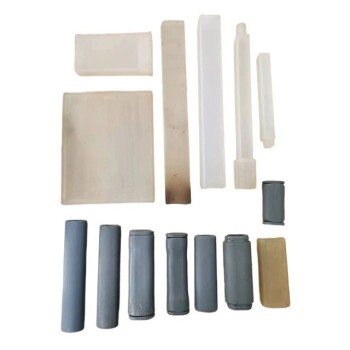
Semi-isostatic pressing is particularly optimized for manufacturing tubular and cylindrical components such as pistons, cylinders, tubes, sleeves, and seats. This process is most effective when working with high-performance technical ceramics—specifically aluminum oxide (alumina) and Y-TZP zirconium oxide (zirconia)—in medium to large production volumes.
Core Takeaway While general isostatic pressing handles complex shapes, semi-isostatic (or dry-bag) pressing is engineered for speed and automation. It is the definitive choice for mass-producing simple, long, and thin-walled hollow parts using advanced ceramic materials.
Matching Geometry to Process
To determine if semi-isostatic pressing is right for your project, you must first evaluate component geometry. This method does not offer the geometric freedom of other techniques; it is highly specialized.
Cylindrical and Tubular Shapes
The process is designed for parts with a high length-to-diameter ratio.
It is the standard for producing tubes, sleeves, and cylinders. Because the mold is semi-fixed, it excels at forming shapes that can be easily ejected or removed axially.
Thin-Walled Components
Semi-isostatic pressing is ideal for long, thin-walled products.
The uniform pressure applied during the process ensures consistent density even in delicate, hollow structures. This makes it a preferred method for manufacturing precision components like pistons and valve seats.
Material Compatibility
While isostatic pressing generally covers a wide range of powders (including metals and plastics), semi-isostatic pressing is distinctively aligned with high-grade technical ceramics.
Aluminum Oxide (Alumina)
Alumina is a primary material for this process.
It is widely used for its hardness and wear resistance. Semi-isostatic pressing ensures that alumina parts achieve high density and structural integrity, which is critical for industrial wear parts.
Y-TZP Zirconium Oxide (Zirconia)
The process is also heavily utilized for Y-TZP zirconia.
This material is known for its fracture toughness. The isostatic nature of the pressure minimizes internal defects, which is essential for maximizing the performance characteristics of zirconia components.
Production Scale and Efficiency
The decision to use semi-isostatic pressing is often driven by production volume rather than just material properties.
Geared for Mass Production
This method is suited for medium to large quantities.
Unlike "wet-bag" isostatic pressing, which is a batch process, semi-isostatic (dry-bag) pressing allows the mold to remain in the vessel. This setup supports continuous automated production, significantly reducing cycle times.
The Automation Advantage
Because the filling and removal processes are conducted in a dry state, the workflow can be easily mechanized.
This makes it economically viable for parts that require the material properties of isostatic pressing but the throughput speeds of traditional pressing.
Understanding the Trade-offs
To provide a complete technical assessment, you must recognize where this method fails.
Simplicity is Mandatory
Semi-isostatic pressing is generally restricted to simple shapes.
If your component requires undercuts, complex lateral geometries, or asymmetrical features, this method is likely unsuitable. The fixed nature of the tooling limits design flexibility compared to fully immersed wet-bag pressing.
Tooling Costs
While faster per part, the setup for semi-isostatic pressing is more complex than simple die pressing.
It requires a specialized pressurizing station and cooling systems. Therefore, it is rarely cost-effective for prototyping or low-volume runs.
Making the Right Choice for Your Goal
Select the manufacturing method that aligns with your specific constraints regarding geometry and throughput.
- If your primary focus is high-volume efficiency: Choose semi-isostatic pressing for automated production of standard cylindrical ceramic parts.
- If your primary focus is geometric complexity: Avoid this method; opt for wet-bag isostatic pressing or injection molding for intricate shapes.
Leverage semi-isostatic pressing when you need the density of isostatic forming combined with the speed of an assembly line.
Summary Table:
| Feature | Suitable Applications & Materials |
|---|---|
| Ideal Geometries | Tubes, cylinders, sleeves, pistons, and thin-walled hollow parts |
| Key Materials | Aluminum Oxide (Alumina), Y-TZP Zirconium Oxide (Zirconia) |
| Production Volume | Medium to large-scale automated mass production |
| Core Advantages | High density, uniform structural integrity, and fast cycle times |
| Limitations | Restricted to simple shapes; not suitable for complex undercuts |
Elevate Your Manufacturing with KINTEK Precision Solutions
Are you looking to scale your production of high-performance ceramic components? KINTEK specializes in advanced laboratory and industrial equipment, including state-of-the-art isostatic presses and hydraulic systems tailored for technical ceramics, metal powders, and composite materials.
Whether you need precision cold isostatic presses (CIP), specialized pellet presses, or high-durability ceramic crucibles, our team provides the technical expertise and robust hardware required to achieve superior material density and consistency. From battery research tools to industrial-scale crushing and milling systems, KINTEK is your partner in material science innovation.
Ready to optimize your workflow? Contact our experts today to find the perfect pressing solution for your application!
Related Products
- Custom-Made Alumina Zirconia Special-Shaped Ceramic Plates for Engineering Advanced Fine Ceramics Processing
- Cylindrical Press Mold for Lab Applications
- Cylindrical Press Mold with Scale for Lab
- Dental Porcelain Zirconia Sintering Ceramic Vacuum Press Furnace
- Assemble Lab Cylindrical Press Mold
People Also Ask
- What function do alumina ceramic plates serve as supports in the preparation of molecular sieve membranes?
- Why are ceramics more resistant to corrosion? Unlock the Secret to Unmatched Chemical Stability
- What are the process advantages of selecting an alumina plate for CuO nanofilm synthesis? Achieve Superior Purity
- How is alumina ceramic made? A Guide to Manufacturing Methods and Material Properties
- What are the applications of zirconia ceramics? Unlock High-Performance Solutions for Extreme Environments