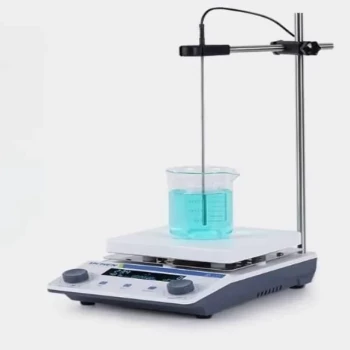
Laboratory hot plates serve as the catalytic engine for preparing silicon-rich solutions by accelerating the dissolution of silica powder (SiO2) into sodium hydroxide (NaOH). This thermal energy drives the reaction at the solid-liquid interface, enabling researchers to achieve precise concentrations, such as 15 ppm or 40 ppm, rapidly.
By controlling thermal input, hot plates transform standard chemical mixtures into supersaturated environments essential for simulating and studying the specific mechanisms that inhibit glass dissolution.
The Mechanics of Solution Preparation
Accelerating Reaction Kinetics
The primary function of the hot plate is to provide the necessary thermal energy to dissolve solid silicon dioxide (SiO2) into a liquid sodium hydroxide (NaOH) base.
Heat significantly increases reaction rates at the solid-liquid interface. This thermal acceleration is critical for reducing the time required to turn silica powder into a fully dissolved solute.
Achieving Precise Saturation Levels
Researchers utilize this heating method to reach specific, pre-determined silicon concentrations.
Common target concentrations in these studies include levels such as 15 ppm or 40 ppm. Without controlled heating, achieving these specific targets from silica powder would be inefficient or practically impossible within a viable experimental timeframe.
The Role in Glass Dissolution Studies
Creating Supersaturated Environments
The ultimate goal of this heating process is to generate supersaturated or specifically saturated solutions.
These tailored chemical environments are distinct from standard solutions. They are manufactured to replicate specific conditions necessary for testing glass durability.
Studying Inhibition Mechanisms
By preparing these silicon-rich fluids, researchers can isolate and observe the factors that slow down glass corrosion.
The pre-saturated solution acts as a controlled variable. It allows scientists to specifically study the mechanisms that inhibit glass dissolution, rather than simply observing general corrosion.
Critical Operational Considerations
Managing Thermal Input
While heat accelerates dissolution, reliance on temperature introduces a variable that must be carefully managed.
Users must ensure the hot plate provides consistent thermal regulation. Inconsistent heating can lead to incomplete dissolution or variations in concentration that compromise the study's baseline.
The Stability of Supersaturation
Creating supersaturated solutions carries the inherent technical challenge of stability.
Because these solutions are forced into high concentrations via heat, they must be handled carefully to prevent the silicon from precipitating back out of the solution before the inhibition study is conducted.
Application for Experimental Success
To effectively utilize laboratory hot plates for glass dissolution research, align your heating protocols with your specific analytical goals.
- If your primary focus is Rapid Preparation: Utilize the hot plate to maximize the reaction rate at the solid-liquid interface to dissolve silica powder quickly.
- If your primary focus is Mechanism Analysis: Use the resulting supersaturated solution to simulate specific environmental conditions that inhibit glass breakdown.
Precise thermal control is the key to converting raw silica powder into a valuable tool for understanding glass durability.
Summary Table:
| Feature | Role in Silicon-Rich Solution Preparation |
|---|---|
| Primary Function | Accelerates SiO2 dissolution in NaOH via thermal energy |
| Interface Impact | Increases reaction kinetics at the solid-liquid interface |
| Precision Control | Enables target concentrations (e.g., 15 ppm, 40 ppm) |
| Study Application | Simulates environments to observe glass inhibition mechanisms |
| Critical Requirement | Consistent thermal regulation to prevent precipitation |
Elevate Your Laboratory Precision with KINTEK
Achieving perfect saturation levels in glass dissolution studies requires more than just heat—it requires absolute thermal control. At KINTEK, we specialize in high-performance laboratory equipment designed for the most demanding research environments.
Whether you are preparing supersaturated silicon solutions or conducting complex material analysis, our extensive portfolio supports your workflow with:
- Advanced Laboratory Hot Plates & Shakers for precise thermal regulation.
- High-Temperature Furnaces (Muffle, Vacuum, Tube) and Crushing & Milling Systems for material preparation.
- High-Pressure Autoclaves & Reactors for specialized chemical synthesis.
- Precision Consumables, including ceramics, crucibles, and PTFE products.
Ready to optimize your experimental outcomes? Contact us today to discover how KINTEK’s comprehensive range of laboratory solutions can enhance your research efficiency and accuracy.
References
- Loryelle Sessegolo, Anne Chabas. Alteration rate of medieval potash-lime silicate glass as a function of pH and temperature: A low pH-dependent dissolution. DOI: 10.1016/j.chemgeo.2020.119704
This article is also based on technical information from Kintek Solution Knowledge Base .
Related Products
- 30T 40T Split Automatic Heated Hydraulic Press Machine with Heated Plates for Laboratory Hot Press
- Automatic Heated Hydraulic Press Machine with Heated Plates for Laboratory Hot Press
- Laboratory Small Constant Temperature Heated Magnetic Stirrer Heater and Stirrer
- Automatic Heated Hydraulic Press Machine with Heated Plates for Laboratory Hot Press 25T 30T 50T
- Manual Heated Hydraulic Press Machine with Heated Plates for Laboratory Hot Press
People Also Ask
- What are the advantages of using a laboratory hydraulic press for hot pressing? Achieve Peak Nano-Composite Density
- What are the core advantages of using a laboratory hot press to produce Bi2Se3? Achieve 93% Density & High Conductivity
- Why is a laboratory hydraulic hot press essential for high-density, additive-free Silicon Carbide? Unlock Pure SiC.
- How does a laboratory hydraulic hot press ensure the quality of PHBV/natural fiber composites? Expert Guide
- What is the function of a laboratory hydraulic hot press in the assembly of solid-state photoelectrochemical cells?