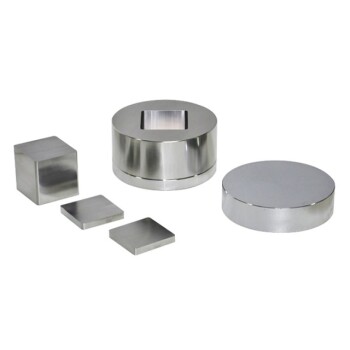
Precision pressure dies fundamentally dictate the structural integrity of high-loading cathodes by enforcing geometric exactness during the pressing process. They influence microscopic morphology by ensuring the cathode pellet achieves a perfectly flat, smooth surface and uniform thickness, which are prerequisites for effective solid-solid interfaces.
Core Takeaway While material chemistry defines potential, the pressure die defines connectivity. By eliminating surface roughness and thickness variations, precision dies ensure uniform pressure transmission, preventing stress concentrations and high interfacial impedance that otherwise cripple the performance of thick, high-loading electrodes.
The Mechanics of Morphological Control
Achieving Surface Smoothness
The primary role of a precision die is to create a cathode surface that is microscopically flat and smooth.
Rough surfaces create voids between the cathode and the solid electrolyte layer. By smoothing these asperities, the die maximizes the active contact area needed for ionic transport.
Ensuring Uniform Thickness
For high-loading cathodes, thickness consistency is critical.
A precision die ensures that the powder bed compresses evenly across the entire diameter of the pellet. This prevents localized variations in current density, which can lead to hotspots or uneven utilization of the active material.
Uniform Pressure Transmission
High-quality dies are designed to withstand massive axial pressure without elastic deformation.
If a die deforms during pressing, pressure is not applied uniformly to the powder. A rigid, precision die ensures force is distributed equally, creating a homogeneous density throughout the "green body" (the compacted powder) and preventing microscopic density gradients.
Impact on Electrochemical Performance
Optimizing Interfacial Contact
The performance of all-solid-state batteries hinges on the interface between the Solid Electrolyte (SE) and the Cathode Active Material (CAM).
Precision dies facilitate superior interfacial contact by creating a flat mating surface. This direct physical contact lowers interfacial impedance, allowing for efficient ion transfer even in thick electrode layers.
Mitigating Stress Concentration
Irregular surfaces or uneven thicknesses act as stress concentrators during battery operation (expansion and contraction).
By enforcing geometric uniformity, precision dies distribute internal stresses evenly. This reduces the likelihood of mechanical failure, such as the cracking or pulverization of the electrode material over time.
Preventing Structural Defects
A lack of precision in the die often leads to macroscopic defects rooted in microscopic failures.
Uneven pressure distribution causes issues like delamination (layer separation) and edge damage. Precision tooling prevents these defects, ensuring the cathode remains a cohesive structural unit.
Common Pitfalls and Limitations
The Limits of Mechanical Shaping
While a precision die ensures geometric uniformity, it cannot correct issues arising from poor material preparation.
If the SE and CAM powders are not mixed homogeneously (e.g., via ball milling) before pressing, the die will simply compress a poor mixture into a perfect shape. The morphological structure relies on both the mix quality and the die precision.
Rigidity vs. Elasticity
A common oversight is using dies that lack sufficient hardness for high-pressure applications.
Under the immense pressures required for dense all-solid-state pellets, standard dies may undergo elastic deformation. This subtle warping results in pellets that are thicker in the center or edges, undermining the goal of uniformity regardless of the surface finish.
Making the Right Choice for Your Goal
- If your primary focus is maximizing cycle life: Prioritize dies with ultra-high rigidity to ensure uniform density, which prevents stress fractures and delamination during expansion cycles.
- If your primary focus is lowering internal resistance: Focus on the surface finish quality of the die plungers to ensure maximum contact area with the solid electrolyte layer.
Ultimately, the precision pressure die is not just a shaping tool; it is a critical instrument that establishes the foundational ionic pathways of your battery cell.
Summary Table:
| Feature | Impact on Cathode Morphology | Benefit to Battery Performance |
|---|---|---|
| Surface Smoothness | Eliminates microscopic voids/asperities | Maximizes ionic contact area & lowers impedance |
| Thickness Uniformity | Prevents localized density variations | Ensures even current distribution & prevents hotspots |
| Rigid Construction | Distributes axial pressure equally | Prevents delamination and internal density gradients |
| Geometric Exactness | Minimizes mechanical stress concentrations | Enhances structural integrity during cycling |
| High Hardness | Resists elastic deformation | Maintains flat mating surfaces for solid-solid contact |
Elevate Your Battery Research with KINTEK Precision Engineering
Achieving the perfect solid-solid interface requires more than chemistry—it requires mechanical precision. KINTEK specializes in high-performance laboratory equipment designed for the rigorous demands of all-solid-state battery (ASSB) development.
From ultra-rigid hydraulic presses (pellet, hot, isostatic) and precision pressure dies to advanced crushing and milling systems for homogeneous powder mixing, we provide the tools necessary to eliminate structural defects and optimize electrochemical performance. Our portfolio also includes high-temperature furnaces, vacuum solutions, and battery research consumables tailored to help you scale from lab-scale pellets to commercial-grade prototypes.
Ready to eliminate interfacial impedance and boost your cathode loading? Contact KINTEK today to find the perfect tooling solution for your lab!
Related Products
- Special Heat Press Mold for Lab Use
- Ring Press Mold for Lab Applications
- Special Shape Press Mold for Lab
- Cylindrical Press Mold for Lab Applications
- Ball Press Mold for Lab
People Also Ask
- How to use a press mold? Master the Art of Creating Consistent Ceramic Forms
- What is the press mould method? A Guide to Consistent, Detailed Ceramic Forms
- What is a press mold used for? Achieve Repeatable Precision and Efficiency
- What is the function of press molds during the preparation of SiCf/Ti-43Al-9V composites? Achieve Structural Precision
- What is the purpose of specialized pressure devices in sulfide solid-state batteries? Ensure Chemo-Mechanical Stability