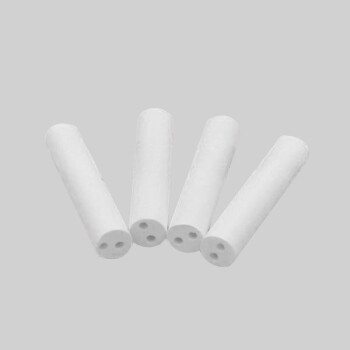
Thermocouples and their controllers function as the critical feedback loop for wet oxidation reactors, providing real-time monitoring and immediate regulation of internal temperatures. Because wet oxidation involves simultaneous hydrothermal hydrolysis and heat-releasing (exothermic) oxidation, the system must actively counteract natural temperature spikes to maintain stability. By keeping thermal deviations within a tight margin—specifically within 2 degrees Celsius—this hardware ensures the reaction environment remains consistent enough for valid scientific analysis.
Scientific accuracy in wet oxidation relies on maintaining preset kinetic conditions despite the volatile nature of the reaction. Precision thermal control prevents runaway exothermic effects, ensuring that the resulting data on activation energy and conversion efficiency is statistically reliable.
Managing Complex Reaction Dynamics
Handling Simultaneous Processes
Wet oxidation is not a static heating process; it involves complex, dynamic chemical changes. The reactor must manage hydrothermal hydrolysis and exothermic oxidation occurring at the same time.
Counteracting Exothermic Heat
The oxidation component of the reaction naturally releases heat. Without an automated controller reacting to thermocouple data, this internal heat generation would cause temperatures to spiral upward, ruining the experimental parameters.
Real-Time Regulation
The control system adjusts heating power instantaneously based on sensor feedback. This ensures that the environment inside the reactor stays stable, regardless of the energy being released by the breaking down of organic matter.
The Link Between Temperature and Data Integrity
Ensuring Reliable Kinetic Data
To calculate activation energy—a key metric in chemical research—scientists must assume the reaction occurs under specific, constant conditions. If the temperature fluctuates, the kinetic baseline shifts, rendering the calculated data unreliable.
Controlling Product Selectivity
The specific temperature of the reaction dictates which chemical byproducts are formed. A deviation of just 2 degrees Celsius can significantly alter the product selectivity, changing the chemical makeup of the final output.
Maximizing Conversion Efficiency
Beyond the type of product formed, temperature stability dictates how much organic matter is actually destroyed or converted. Precision control ensures that the conversion rates recorded are due to the chemistry itself, not artifacts of unstable heating.
Understanding the Trade-offs
The Challenge of Sensitivity
To maintain a window of less than 2 degrees Celsius, controllers must be highly sensitive. However, if the system is overly aggressive, it may lead to oscillation, where the heater constantly overshoots and undershoots the target.
Sensor Placement Limitations
The scientific accuracy is only as good as the thermocouple's position. If the sensor is not in direct contact with the core reaction zone, there will be a thermal lag, meaning the controller reacts to old data rather than the current state of the exothermic reaction.
Making the Right Choice for Your Goal
To derive meaningful data from your wet oxidation process, align your control strategy with your specific research objectives.
- If your primary focus is Fundamental Kinetics: Prioritize a control system capable of keeping deviations below 2°C to ensure your calculated activation energy is accurate.
- If your primary focus is Process Optimization: Focus on the controller's response time to exothermic spikes to maximize organic matter conversion efficiency without safety risks.
Ultimately, the rigor of your thermal control system dictates the reproducibility of your scientific findings.
Summary Table:
| Feature | Impact on Wet Oxidation Accuracy |
|---|---|
| Feedback Loop | Real-time monitoring and regulation of exothermic heat spikes |
| Temperature Margin | Maintains stability within ±2°C to prevent kinetic data deviation |
| Dynamic Control | Balances hydrothermal hydrolysis and oxidation processes |
| Data Integrity | Ensures reliable calculations for activation energy and selectivity |
| Efficiency | Maximizes organic matter conversion through consistent heating |
Precision Control for Your Advanced Chemical Research
Maintaining a stable reaction environment is critical for reproducible scientific findings. KINTEK specializes in high-performance laboratory solutions designed for the most demanding applications. Whether you are conducting fundamental kinetics or process optimization, our high-temperature high-pressure reactors and autoclaves provide the thermal stability and precision control required for accurate wet oxidation studies.
From advanced electrolytic cells and electrodes to robust crushing and milling systems, KINTEK offers a comprehensive range of equipment to support your lab's success. Ensure your data's integrity with hardware that counteracts volatile reaction dynamics effortlessly.
Ready to upgrade your lab's thermal precision? Contact our technical experts today to find the perfect reactor or controller system for your specific research needs.
References
- Kaiyu Fang, Chanjuan Qu. Wet Oxidation of Pharmaceutical Sludge for the Treatment and Production of Value-Added Materials. DOI: 10.3390/pr11092747
This article is also based on technical information from Kintek Solution Knowledge Base .
Related Products
People Also Ask
- Why are Boron Nitride Tubes selected as reaction vessels for Na3SbS4? Ensure Purity in High-Temp Synthesis
- What are the symptoms of a bad thermocouple? Diagnose a Pilot Light That Won't Stay Lit
- What information does a thermocouple at the substrate bottom provide in LCVD? Master Precise Temperature Control
- What are the specific temperature control requirements for high-precision thermocouples? Achieve ±0.3°C Precision
- What is the most common type of temperature sensor? The Unmatched Versatility of Thermocouples