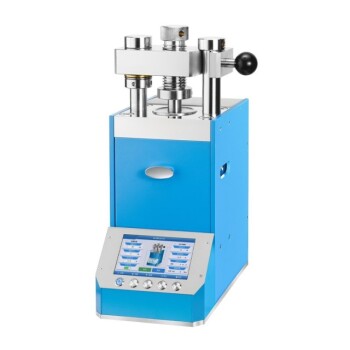
Hot Isostatic Pressing (HIP) fundamentally transforms the densification process by introducing an external, high-pressure driving force that far exceeds natural physical laws. While traditional infiltration relies passively on gravity and capillary action to fill voids, HIP utilizes high-pressure inert gas—typically argon at pressures around 98 MPa—to forcibly drive molten copper into the microscopic pores of the tungsten skeleton. This active pressurization ensures that even the smallest, most resistant voids are filled, resulting in a composite structure that is significantly denser than what is achievable through conventional sintering methods.
By treating pressure as a controllable variable rather than a constant, HIP overcomes the physical limitations of capillary action. It creates a compressive environment that forces liquid metal into every available micro-void, shifting the final product from a porous aggregation to a fully dense, near-theoretical solid.
The Mechanics of Pressure-Assisted Infiltration
The core advantage of HIP lies in how it changes the physics of fluid flow within the composite matrix.
Overcoming Capillary Resistance
In standard infiltration, molten copper enters the tungsten skeleton largely due to surface tension (capillary action).
However, as pore size decreases, the resistance to fluid flow increases. Capillary action alone is often insufficient to penetrate minute, complex pore structures, leaving behind microscopic voids.
The Power of Isotropic Force
HIP introduces a massive pressure differential to solve this flow restriction.
By applying an isostatic pressure of approximately 98 MPa (roughly 1,000 atmospheres), the process creates an overwhelming mechanical force. This force effectively "pushes" the molten copper into the tungsten skeleton, overcoming the surface tension and friction that typically prevent complete infiltration.
Uniform Density Distribution
Unlike uniaxial pressing, which applies force from a single direction, HIP applies pressure equally from all sides (isostatic).
This ensures that the driving force is uniform across the entire geometry of the part. The result is the elimination of density gradients, ensuring the core of the component is just as dense as the surface.
Achieving Near-Theoretical Density
The ultimate goal of using HIP on W-Cu composites is to eliminate porosity that compromises mechanical integrity.
Plastic Deformation and Void Collapse
At the elevated temperatures within the HIP unit, the material exhibits plasticity.
The external gas pressure compresses the material, forcing internal voids to collapse. Because the pressure is applied essentially uniformly, the material yields and flows to fill these empty spaces, effectively "healing" internal defects.
Diffusion Bonding
Once the voids collapse and the internal surfaces are brought into intimate contact, diffusion bonding occurs.
This mechanism permanently fuses the interface between the tungsten and copper at the atomic level. The result is a material that achieves near-theoretical density, often exceeding 99% of the solid material's potential density.
Understanding the Trade-offs
While HIP offers superior technical results, it introduces operational considerations that must be weighed against project requirements.
Process Complexity
HIP adds a significant layer of complexity compared to standard sintering.
It requires a specialized pressure vessel capable of managing extreme pressures (up to 100 MPa) and high temperatures simultaneously. This demands precise control over thermal and pressure cycles to avoid accidents or equipment failure.
Cost vs. Performance
The operational costs of HIP—driven by energy consumption, gas usage, and cycle time—are higher than conventional atmospheric furnaces.
However, this cost is often offset by a reduction in scrap rates. Because HIP creates consistent, defect-free parts, it minimizes the rejection rate and the need for rework, which can make it economically viable for critical, high-value components.
Making the Right Choice for Your Goal
To determine if HIP is the correct solution for your W-Cu application, evaluate your specific performance targets.
- If your primary focus is maximum mechanical integrity: HIP is essential, as it provides the driving force necessary to eliminate microscopic porosity and ensure near-theoretical density.
- If your primary focus is geometric complexity: The isostatic nature of HIP is ideal, as it applies uniform pressure to irregular shapes without creating density gradients or warping.
Ultimately, HIP is not just a densification step; it is a quality assurance mechanism that guarantees the internal structure of your composite matches its theoretical design.
Summary Table:
| Feature | Conventional Infiltration | Hot Isostatic Pressing (HIP) |
|---|---|---|
| Driving Force | Capillary action & gravity | 98 MPa Isostatic gas pressure |
| Density Level | Standard (limited by pore size) | Near-theoretical (>99%) |
| Void Removal | Passive filling | Active collapse & diffusion bonding |
| Uniformity | Potential density gradients | Perfectly uniform isotropic density |
| Ideal For | Simple geometries/Standard parts | High-performance, complex components |
Elevate Your Material Performance with KINTEK
Maximize the density and integrity of your W-Cu composites with KINTEK’s advanced laboratory solutions. As specialists in high-performance equipment, we offer a comprehensive range of hot isostatic presses (HIP), vacuum and atmosphere furnaces, and isostatic presses designed to eliminate internal defects and achieve near-theoretical solid density. Whether you are performing critical battery research or developing high-temperature composites, our precision-engineered systems—including high-pressure reactors, crushing systems, and cooling solutions—provide the reliability your lab demands.
Ready to eliminate porosity and optimize your material properties? Contact KINTEK today to discuss your project requirements!
References
- Jiří Matějíček. Preparation of W-Cu composites by infiltration of W skeletons – review. DOI: 10.37904/metal.2021.4248
This article is also based on technical information from Kintek Solution Knowledge Base .
Related Products
- Warm Isostatic Press for Solid State Battery Research
- Electric Split Lab Cold Isostatic Press CIP Machine for Cold Isostatic Pressing
- Manual Cold Isostatic Pressing Machine CIP Pellet Press
- Automatic High Temperature Heated Hydraulic Press Machine with Heated Plates for Lab
- Isostatic Molding Pressing Molds for Lab
People Also Ask
- What is the temperature of a warm isostatic press? Achieve Optimal Densification for Your Materials
- What is the function of a Warm Isostatic Press (WIP) in all-solid-state pouch cells? Optimize Battery Density
- Why are Warm Isostatic Presses (WIP) necessary for solid-state batteries? Achieve Atomic-Level Contact
- What advantages does a warm isostatic press offer over a traditional uniaxial press for Li6PS5Cl electrolyte sheets?
- How do warm isostatic presses improve dry electrode performance? Enhance ASSB Conductivity with Heat & Pressure