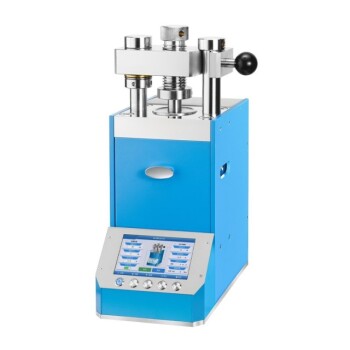
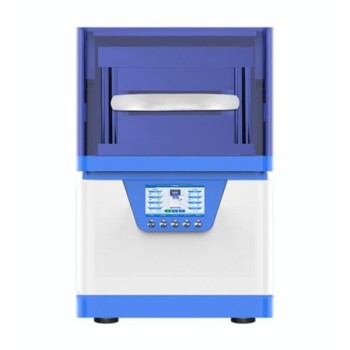
Hot Isostatic Pressing (HIP) fundamentally transforms the microstructure of Ga-LLZO by subjecting pre-sintered samples to simultaneous high temperature and high pressure. By applying an inert gas like argon at 120 MPa and temperatures around 1160°C, the machine forces the closure of residual internal pores and drives diffusion bonding between grains, raising the material's relative density from roughly 90.5% to a superior 97.5%.
Core Takeaway HIP is a densification strategy that eliminates structural voids without altering chemical composition. It bridges the gap between a porous, pre-sintered ceramic and a fully dense, translucent electrolyte capable of suppressing lithium filament growth.
The Mechanism of Densification
Synergistic Heat and Pressure
The HIP process relies on the combined effect of thermal energy and isotropic pressure. While standard sintering uses heat to fuse particles, HIP adds high-pressure gas (typically argon) to mechanically force material consolidation.
Eliminating Residual Porosity
The primary function of this process is the reduction of internal voids. Under conditions such as 120 MPa of pressure, the material yields, effectively squeezing shut the pores that remain after standard sintering.
Achieving Near-Theoretical Density
This mechanism significantly improves the relative density of Ga-LLZO. Experimental data shows an increase from a baseline of approximately 90.5% in pre-sintered samples to a highly dense state of 97.5% following HIP treatment.
Structural and Electrochemical Gains
Promoting Diffusion Bonding
Beyond simply closing holes, HIP promotes stronger connections between individual grains. The pressure enhances diffusion bonding, resulting in tighter grain boundaries which are critical for ionic conductivity.
Visual Indicators of Quality
The microstructural improvements are often visible to the naked eye. An opaque pellet can transform into a translucent material after treatment, signaling a reduction in light-scattering pores and an increase in grain size.
Maintaining Chemical Integrity
Crucially, this physical alteration does not degrade the chemical structure. For garnet-type electrolytes, HIP treatment maintains phase purity, causing no additional decomposition peaks or lithium loss.
Understanding the Trade-offs and Prerequisites
The Importance of the Green Body
HIP is a finishing step, not a replacement for initial processing quality. You must still use a laboratory hydraulic press to ensure the initial powder reaches optimal packing density before the first sintering stage.
Managing Initial Defects
If the initial "green body" has significant defects, HIP may not fully resolve them. A uniform molding pressure initially is vital to prevent micro-crack propagation sites that HIP might not be able to fully heal later.
Process Tuning Requirements
While HIP improves density, parameters must be carefully tuned to optimize grain growth. Correct optimization can minimize the need for sacrificial "mother powder" during sintering, but incorrect settings may lead to inefficient material usage.
Making the Right Choice for Your Goal
To maximize the performance of your solid electrolyte, apply these guidelines:
- If your primary focus is maximizing ionic conductivity: Utilize HIP to achieve translucency and >97% density, as tighter grain boundaries improve transport properties.
- If your primary focus is mechanical stability: Ensure you use a hydraulic press for the green body first, as HIP reinforces structure but relies on a uniform foundation to prevent filament propagation.
- If your primary focus is chemical consistency: Proceed with HIP confidence, as it increases density without introducing decomposition or phase impurities.
By combining high pressure with thermal processing, you evolve Ga-LLZO from a porous ceramic into a robust, high-performance electrolyte.
Summary Table:
| Parameter | Pre-Sintered State | Post-HIP Treatment | Improvement Effect |
|---|---|---|---|
| Relative Density | ~90.5% | ~97.5% | Near-theoretical densification |
| Visual Appearance | Opaque | Translucent | Significant reduction in light-scattering pores |
| Microstructure | Residual internal pores | Closed voids & diffusion bonding | Enhanced ionic conductivity paths |
| Chemical Phase | Phase Pure | Phase Pure (Unchanged) | Maintains chemical integrity without Li-loss |
Elevate Your Solid-State Battery Research with KINTEK
Precision in microstructure is the key to high-performance Ga-LLZO electrolytes. KINTEK specializes in advanced laboratory equipment designed to help researchers achieve maximum material density and electrochemical stability. Whether you need high-performance Hot Isostatic Pressing (HIP) systems for final densification or precision hydraulic pellet presses for green body preparation, our equipment ensures uniform results and superior material integrity.
Our comprehensive lab solutions include:
- High-Pressure Systems: HIP machines and isostatic presses for eliminating structural voids.
- Sample Preparation: Precision crushing, milling, and hydraulic pellet presses.
- Thermal Processing: Muffle, tube, and vacuum furnaces for consistent sintering.
- Battery Research Tools: Specialized consumables, electrolytic cells, and cooling solutions.
Don't let residual porosity limit your battery's potential. Contact KINTEK today to discover how our high-temperature and high-pressure solutions can transform your material performance!
Related Products
- Warm Isostatic Press for Solid State Battery Research
- Electric Split Lab Cold Isostatic Press CIP Machine for Cold Isostatic Pressing
- Electric Lab Cold Isostatic Press CIP Machine for Cold Isostatic Pressing
- Manual Cold Isostatic Pressing Machine CIP Pellet Press
- Automatic High Temperature Heated Hydraulic Press Machine with Heated Plates for Lab
People Also Ask
- What is the temperature of a warm isostatic press? Achieve Optimal Densification for Your Materials
- What is the function of a Warm Isostatic Press (WIP) in all-solid-state pouch cells? Optimize Battery Density
- Why are Warm Isostatic Presses (WIP) necessary for solid-state batteries? Achieve Atomic-Level Contact
- What advantages does a warm isostatic press offer over a traditional uniaxial press for Li6PS5Cl electrolyte sheets?
- How do warm isostatic presses improve dry electrode performance? Enhance ASSB Conductivity with Heat & Pressure