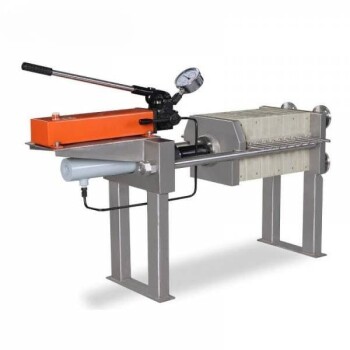
The laboratory hydraulic press ensures quality by applying extreme uniaxial pressure to transform loose sulfide powder into a unified, dense solid. By exerting forces often reaching or exceeding 300 MPa, the press mechanically forces particles together to eliminate void spaces, a critical step for the successful operation of all-solid-state sodium metal batteries.
Core Takeaway The hydraulic press is not merely a shaping tool; it is an instrument of microstructural engineering. Its primary function is to maximize relative density and minimize grain boundary resistance, thereby creating the continuous physical pathways required for efficient ion transport and mechanical stability.
The Mechanics of Densification
Eliminating Particle Porosity
The primary challenge with sulfide electrolytes is their starting state as loose, porous powders. The hydraulic press applies massive force to collapse the gaps between these particles.
This process significantly reduces internal porosity, forcing the material into a tightly packed arrangement. Without this densification, the electrolyte would remain full of voids, rendering it useless for energy storage.
Achieving Critical Relative Density
To function correctly, solid-state electrolytes typically require a high relative density. The press drives the material toward this goal, often achieving relative densities of approximately 82% or higher depending on the specific pressure and material.
High pressure ensures that the "green body" (the compacted pellet) possesses sufficient mass per unit volume to mimic the intrinsic properties of the bulk material.
Optimizing Electrochemical Performance
Reducing Grain Boundary Resistance
The interface where two powder particles touch is known as a grain boundary. In a loose powder, these boundaries create high resistance that blocks ion flow.
By compressing the material at pressures up to 300 MPa, the press maximizes the contact area between particles. This directly lowers grain boundary resistance, allowing sodium ions to move freely through the pellet.
Establishing Continuous Ion Pathways
For a battery to charge and discharge, ions must have a continuous road to travel. The densification process creates these continuous ion transport channels.
If the pressure is insufficient, the pathways remain broken or narrow. High-pressure consolidation ensures the macroscopic ionic conductivity measured during testing reflects the true capabilities of the material.
Mechanical Integrity and Stability
Preventing Microstructural Defects
Low-pressure compaction often results in pellets with surface cracks or internal fractures. The hydraulic press mitigates this by forcing a uniform distribution of particles.
This eliminates surface and internal cracks, ensuring the pellet is mechanically robust enough to withstand handling and cell assembly without crumbling.
Inhibiting Dendrite Penetration
A dense, defect-free electrolyte layer acts as a physical barrier. By minimizing porosity, the press helps create a shield that inhibits the penetration of metal dendrites.
In sodium metal batteries, this barrier is essential to prevent short circuits and ensure safe, long-term operation.
Common Pitfalls to Avoid
Inconsistent Pressure Application
If pressure is not applied uniformly or is too low (below the material's specific threshold), the pellet will suffer from high interfacial resistance. This leads to inaccurate impedance spectroscopy readings that falsely suggest the material is poor, when the processing was actually at fault.
Over-reliance on "Green" Strength
While the press creates a strong "green" pellet, it is effectively a compacted powder. For certain hybrid or oxide materials, this is a precursor to sintering. However, for malleable sulfide electrolytes, the cold-pressed density is often the final state; therefore, the precision of the initial press is the single most important factor in determining final quality.
Making the Right Choice for Your Goal
To ensure the best results for your sodium battery assembly, align your pressing parameters with your specific testing objectives:
- If your primary focus is Ion Conductivity: Prioritize pressures near 300–350 MPa to maximize particle contact and minimize grain boundary resistance.
- If your primary focus is Mechanical Handling: Ensure the press can sustain a hold time that allows the material to relax and bond, preventing elastic rebound and cracking.
- If your primary focus is Dendrite Resistance: Aim for the highest uniform density possible to eliminate pore space that could serve as a nucleation site for metal filaments.
The quality of your data is directly proportional to the density of your pellet.
Summary Table:
| Parameter | Influence on Pellet Quality | Target Benefit |
|---|---|---|
| Pressure Level | Typically 300 - 350 MPa | Maximizes relative density and particle contact |
| Porosity Control | Eliminates internal voids | Prevents dendrite penetration and short circuits |
| Grain Boundaries | Increases contact area | Lowers resistance for efficient sodium ion flow |
| Mechanical Force | Uniaxial compression | Prevents surface cracks and ensures structural integrity |
| Hold Time | Material relaxation | Reduces elastic rebound and prevents crumbling |
Elevate Your Battery Research with KINTEK Precision
Achieving the critical relative density for sulfide electrolytes requires more than just force—it requires precision. KINTEK specializes in advanced laboratory equipment designed for the rigorous demands of all-solid-state battery assembly. From high-performance hydraulic presses (pellet, hot, and isostatic) to specialized crushing and milling systems, we provide the tools necessary to eliminate grain boundary resistance and ensure continuous ion pathways.
Our value to your lab:
- Unmatched Densification: Our presses reach the extreme pressures (300MPa+) needed for superior sulfide electrolyte pellets.
- Comprehensive Solutions: Explore our range of high-temperature furnaces, vacuum systems, and essential consumables like PTFE products and ceramics.
- Expert Support: We help you select the right equipment to minimize microstructural defects and maximize ionic conductivity.
Ready to enhance your lab's efficiency and data accuracy? Contact KINTEK today to find your perfect pressing solution!
Related Products
- Heated Hydraulic Press Machine with Heated Plates for Vacuum Box Laboratory Hot Press
- Automatic High Temperature Heated Hydraulic Press Machine with Heated Plates for Lab
- Manual High Temperature Heated Hydraulic Press Machine with Heated Plates for Lab
- Heated Hydraulic Press Machine with Integrated Manual Heated Plates for Lab Use
- 24T 30T 60T Heated Hydraulic Press Machine with Heated Plates for Laboratory Hot Press
People Also Ask
- Why is a heated laboratory hydraulic press necessary for composite laminates? Achieve Void-Free Structural Integrity
- What technical conditions does a heated hydraulic press provide for PEO batteries? Optimize Solid-State Interfaces
- How is a heated hydraulic press used for Li-LLZO batteries? Optimize Interfacial Bonding with Thermal-Pressure
- What are heated hydraulic presses used for? Molding Composites, Vulcanizing Rubber, and More
- What is the core function of a laboratory heated hydraulic press in CSP? Revolutionize Low-Temp Ceramic Sintering