Knowledge Vacuum Furnace How does an industrial furnace work? A Guide to Heat Treatment Processes
Author avatar

Tech Team · Kintek Solution

Updated 2 months ago

How does an industrial furnace work? A Guide to Heat Treatment Processes


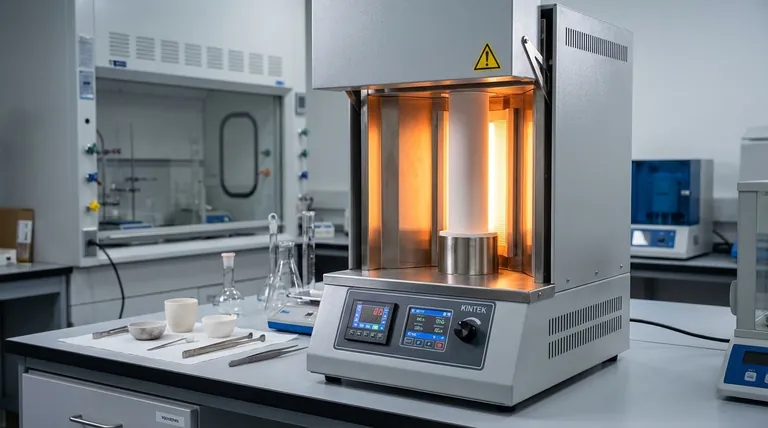
At their core, all industrial furnaces operate on a simple principle: they use a controlled source of energy to generate heat within an insulated chamber. This process raises the temperature of materials to specific levels, inducing desired physical changes like hardening or chemical changes like sintering, all while maintaining precise control over the environment.

The term "industrial furnace" is broad. The key to understanding them is realizing the design is not about generating heat, but about how that heat is transferred and what kind of atmosphere the material is heated in. The specific method chosen depends entirely on the material and the desired outcome.
How does an industrial furnace work? A Guide to Heat Treatment Processes

The Pillars of Furnace Operation

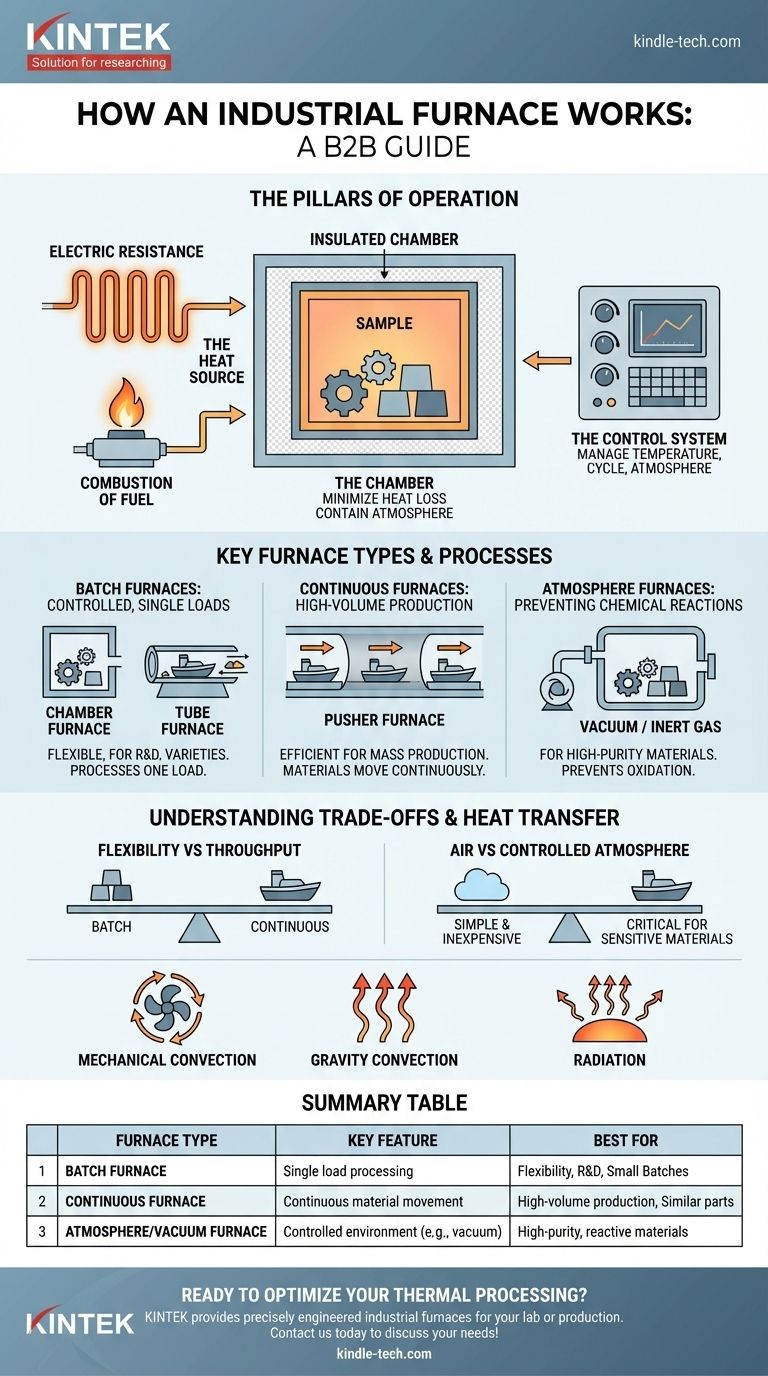
Every furnace, regardless of its specific type, is built upon three fundamental components working in concert. Understanding these pillars is the first step to mastering the technology.

The Heat Source

This is the engine of the furnace. Most commonly, heat is generated by electric resistance elements, which glow hot when current is passed through them, or by the combustion of fuel, like natural gas. The choice impacts operating cost, temperature range, and atmospheric control.

The Chamber

The chamber is the insulated enclosure that contains the heat and the material being processed. Its primary jobs are to minimize heat loss (efficiency) and to contain a specific atmosphere, whether that's normal air, a vacuum, or a specialized mix of inert gases.

The Control System

This is the brain of the operation. Modern furnace controllers precisely manage temperature, cycle duration, and atmospheric conditions. This ensures the process is repeatable, accurate, and safe, delivering consistent results batch after batch.

Key Furnace Types and Their Processes

The "how" of a furnace is defined by its process: is it heating a single batch, a continuous stream of parts, or operating in a special atmosphere?

Batch Furnaces: For Controlled, Single Loads

These furnaces process one load, or "batch," at a time. A chamber furnace is the most common example, where parts are loaded into a simple heated box. A tube furnace is a variation where parts are placed inside a work tube that is then heated externally, providing a more isolated and controlled environment for the sample.

Continuous Furnaces: For High-Volume Production

Designed for mass production, these furnaces move materials through the heat continuously. A pusher furnace, for example, operates with a train of "boats" or trays. As a new tray is pushed into the entrance, the entire train moves forward, and a finished tray is removed from the exit. This maximizes throughput.

Atmosphere Furnaces: For Preventing Chemical Reactions

Many materials react negatively with oxygen at high temperatures, leading to oxidation (scaling or rust). A vacuum furnace solves this by first using pumps to remove all the air from the chamber. Once in a vacuum, the parts are heated. This is critical for high-purity metals, aerospace components, and medical implants.

Understanding the Trade-offs

Choosing or operating a furnace involves balancing competing priorities. There is no single "best" type, only the right type for a specific job.

Batch vs. Continuous Processing

The fundamental trade-off is flexibility versus throughput. Batch furnaces are highly flexible, able to handle different parts and processes easily. Continuous furnaces are far more efficient for producing large quantities of the same part but are expensive and difficult to change over.

Air vs. Controlled Atmosphere

Heating in ambient air is simple and inexpensive. However, for sensitive materials, a vacuum or inert gas atmosphere is non-negotiable to preserve the material's integrity. This adds significant complexity and cost, from the vacuum pumps to the need for a perfectly sealed chamber.

Heat Transfer and Uniformity

The method of heat transfer impacts speed and evenness. Mechanical convection, which uses fans to circulate hot air, provides fast and highly uniform heating. Gravity convection, where hot air naturally rises, is simpler but slower and less uniform. Furnaces in a vacuum rely primarily on radiation, which can be less uniform depending on part geometry and placement.

Making the Right Choice for Your Application

Selecting the correct furnace technology is a strategic decision based on your end goal.

  • If your primary focus is high-volume manufacturing of similar parts: A continuous furnace, like a pusher type, is designed for maximum throughput and efficiency.
  • If your primary focus is treating high-purity or reactive materials: A vacuum or controlled atmosphere furnace is essential to prevent oxidation and ensure material integrity.
  • If your primary focus is flexibility for research or varied small batches: A chamber or tube batch furnace offers the most versatility for single-load processing.

Understanding these core principles moves you from simply using a furnace to strategically controlling your material outcomes.

Summary Table:

Furnace Type Key Feature Best For
Batch Furnace Processes one load at a time Flexibility, R&D, varied small batches
Continuous Furnace Materials move through heat continuously High-volume production of similar parts
Atmosphere/Vacuum Furnace Controlled environment (e.g., vacuum, inert gas) High-purity, reactive materials, preventing oxidation

Ready to optimize your thermal processing? The right industrial furnace is critical for achieving consistent, high-quality results in your lab or production line. At KINTEK, we specialize in providing precisely engineered lab equipment, including a wide range of industrial furnaces tailored to your specific material and process requirements. Our experts can help you select the perfect solution for your application, ensuring efficiency, reliability, and performance. Contact us today to discuss your needs and discover the KINTEK difference!

Visual Guide
How does an industrial furnace work? A Guide to Heat Treatment Processes Visual Guide

Related Products

People Also Ask

Related Products

Rotary Tube Furnace Split Multi Heating Zone Rotating Tube Furnace

Rotary Tube Furnace Split Multi Heating Zone Rotating Tube Furnace

Multi zone rotary furnace for high-precision temperature control with 2-8 independent heating zones. Ideal for lithium ion battery electrode materials and high-temperature reactions. Can work under vacuum and controlled atmosphere.

High Temperature Muffle Oven Furnace for Laboratory Debinding and Pre Sintering

High Temperature Muffle Oven Furnace for Laboratory Debinding and Pre Sintering

KT-MD High temperature debinding and pre-sintering furnace for ceramic materials with various molding processes. Ideal for electronic components such as MLCC and NFC.

Multi Heating Zones CVD Tube Furnace Machine Chemical Vapor Deposition Chamber System Equipment

Multi Heating Zones CVD Tube Furnace Machine Chemical Vapor Deposition Chamber System Equipment

KT-CTF14 Multi Heating Zones CVD Furnace - Precise Temperature Control and Gas Flow for Advanced Applications. Max temp up to 1200℃, 4 channels MFC mass flow meter, and 7" TFT touch screen controller.

Vertical High Temperature Graphite Vacuum Graphitization Furnace

Vertical High Temperature Graphite Vacuum Graphitization Furnace

Vertical high temperature graphitization furnace for carbonization and graphitization of carbon materials up to 3100℃.Suitable for shaped graphitization of carbon fiber filaments and other materials sintered in a carbon environment.Applications in metallurgy, electronics, and aerospace for producing high-quality graphite products like electrodes and crucibles.

Ultra-High Temperature Graphite Vacuum Graphitization Furnace

Ultra-High Temperature Graphite Vacuum Graphitization Furnace

The ultra-high temperature graphitization furnace utilizes medium frequency induction heating in a vacuum or inert gas environment. The induction coil generates an alternating magnetic field, inducing eddy currents in the graphite crucible, which heats up and radiates heat to the workpiece, bringing it to the desired temperature. This furnace is primarily used for graphitization and sintering of carbon materials, carbon fiber materials, and other composite materials.

1200℃ Split Tube Furnace with Quartz Tube Laboratory Tubular Furnace

1200℃ Split Tube Furnace with Quartz Tube Laboratory Tubular Furnace

KT-TF12 split tube furnace: high-purity insulation, embedded heating wire coils, and max. 1200C. Widely used for new materials and chemical vapour deposition.

Large Vertical Graphite Vacuum Graphitization Furnace

Large Vertical Graphite Vacuum Graphitization Furnace

A large vertical high-temperature graphitization furnace is a type of industrial furnace used for the graphitization of carbon materials, such as carbon fiber and carbon black. It is a high-temperature furnace that can reach temperatures of up to 3100°C.

Laboratory Muffle Oven Furnace Bottom Lifting Muffle Furnace

Laboratory Muffle Oven Furnace Bottom Lifting Muffle Furnace

Efficiently produce batches with excellent temperature uniformity using our Bottom Lifting Furnace. Features two electric lifting stages and advanced temperature control up to 1600℃.

Graphite Vacuum Furnace Bottom Discharge Graphitization Furnace for Carbon Materials

Graphite Vacuum Furnace Bottom Discharge Graphitization Furnace for Carbon Materials

Bottom-out graphitization furnace for carbon materials, ultra-high temperature furnace up to 3100°C, suitable for graphitization and sintering of carbon rods and carbon blocks. Vertical design, bottom discharging, convenient feeding and discharging, high temperature uniformity, low energy consumption, good stability, hydraulic lifting system, convenient loading and unloading.

1700℃ Controlled Atmosphere Furnace Nitrogen Inert Atmosphere Furnace

1700℃ Controlled Atmosphere Furnace Nitrogen Inert Atmosphere Furnace

KT-17A Controlled atmosphere furnace: 1700℃ heating, vacuum sealing technology, PID temperature control, and versatile TFT smart touch screen controller for laboratory and industrial use.

600T Vacuum Induction Hot Press Furnace for Heat Treat and Sintering

600T Vacuum Induction Hot Press Furnace for Heat Treat and Sintering

Discover the 600T Vacuum Induction Hot Press Furnace, designed for high-temperature sintering experiments in vacuum or protected atmospheres. Its precise temperature and pressure control, adjustable working pressure, and advanced safety features make it ideal for nonmetal materials, carbon composites, ceramics, and metal powders.

Vacuum Heat Treat and Pressure Sintering Furnace for High Temperature Applications

Vacuum Heat Treat and Pressure Sintering Furnace for High Temperature Applications

Vacuum pressure sintering furnaces are designed for high temperature hot pressing applications in metal and ceramic sintering. Its advanced features ensure precise temperature control, reliable pressure maintenance, and a robust design for seamless operation.

1200℃ Controlled Atmosphere Furnace Nitrogen Inert Atmosphere Furnace

1200℃ Controlled Atmosphere Furnace Nitrogen Inert Atmosphere Furnace

Discover our KT-12A Pro Controlled atmosphere furnace - high precision, heavy duty vacuum chamber, versatile smart touch screen controller, and excellent temperature uniformity up to 1200C. Ideal for both laboratory and industrial application.

1400℃ Controlled Atmosphere Furnace with Nitrogen and Inert Atmosphere

1400℃ Controlled Atmosphere Furnace with Nitrogen and Inert Atmosphere

Achieve precise heat treatment with KT-14A controlled atmosphere furnace. Vacuum sealed with a smart controller, it's ideal for lab and industrial use up to 1400℃.

Vacuum Hot Press Furnace Machine Heated Vacuum Press

Vacuum Hot Press Furnace Machine Heated Vacuum Press

Discover the advantages of Vacuum Hot Press Furnace! Manufacture dense refractory metals & compounds, ceramics, and composites under high temp and pressure.

1700℃ Muffle Oven Furnace for Laboratory

1700℃ Muffle Oven Furnace for Laboratory

Get superior heat control with our 1700℃ Muffle Furnace. Equipped with intelligent temperature microprocessor, TFT touch screen controller & advanced insulation materials for precise heating up to 1700C. Order now!

Horizontal High Temperature Graphite Vacuum Graphitization Furnace

Horizontal High Temperature Graphite Vacuum Graphitization Furnace

Horizontal Graphitization Furnace: This type of furnace is designed with the heating elements placed horizontally, allowing for uniform heating of the sample. It's well-suited for graphitizing large or bulky samples that require precise temperature control and uniformity.

Controlled Nitrogen Inert Hydrogen Atmosphere Furnace

Controlled Nitrogen Inert Hydrogen Atmosphere Furnace

KT-AH Hydrogen atmosphere furnace - induction gas furnace for sintering/annealing with built-in safety features, dual housing design, and energy-saving efficiency. Ideal for lab and industrial use.

Electric Rotary Kiln Pyrolysis Furnace Plant Machine Calciner Small Rotary Kiln Rotating Furnace

Electric Rotary Kiln Pyrolysis Furnace Plant Machine Calciner Small Rotary Kiln Rotating Furnace

Electric rotary kiln - precisely controlled, it's ideal for calcination and drying of materials like lithium cobalate, rare earths, and non-ferrous metals.

Vacuum Sealed Continuous Working Rotary Tube Furnace Rotating Tube Furnace

Vacuum Sealed Continuous Working Rotary Tube Furnace Rotating Tube Furnace

Experience efficient material processing with our vacuum-sealed rotary tube furnace. Perfect for experiments or industrial production, equipped with optional features for controlled feeding and optimized results. Order now.


Leave Your Message