Knowledge How does heat treating affect the strength of a metal? A Guide to Tailoring Metal Properties
Author avatar

Tech Team · Kintek Solution

Updated 6 days ago

How does heat treating affect the strength of a metal? A Guide to Tailoring Metal Properties


At its core, heat treatment modifies a metal's strength by altering its internal crystal structure, known as its microstructure. Through controlled heating and cooling cycles, you can make a metal significantly harder and more resistant to deformation, or conversely, softer and more ductile. The specific outcome depends entirely on the chosen process and the intended application of the part.

The central purpose of heat treating is not simply to "increase strength," but to precisely engineer a metal's mechanical properties. It is a strategic manipulation of the trade-off between hardness (resistance to wear) and toughness (resistance to fracture) to achieve a desired performance characteristic.
How does heat treating affect the strength of a metal? A Guide to Tailoring Metal Properties

The Core Principle: Changing the Microstructure

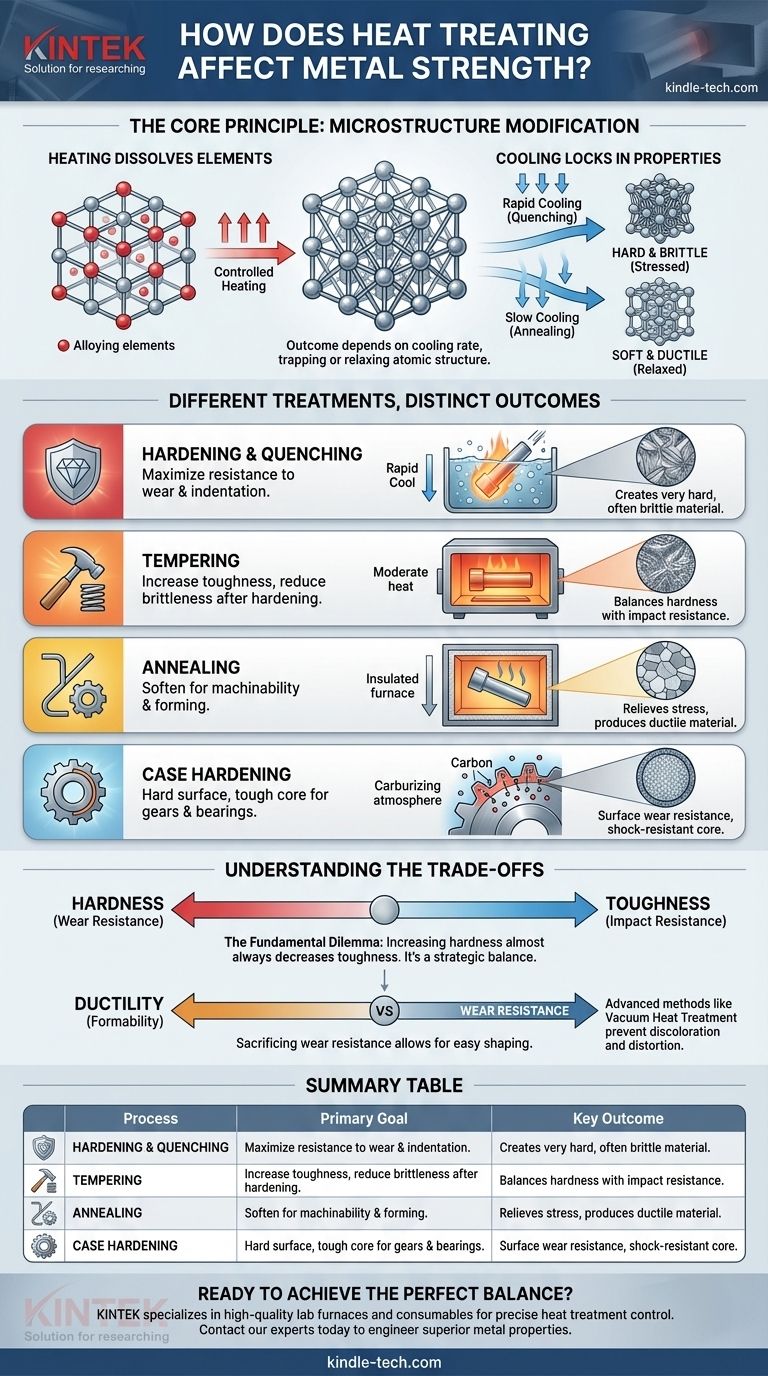
Heat treatment works by manipulating the arrangement of atoms within a metal's crystalline lattice. The process generally involves heating the metal to a specific temperature, holding it there, and then cooling it at a controlled rate.

Heating Dissolves Elements

Heating a metal above a critical transformation temperature allows the atoms in its crystal structure to rearrange. Carbon and other alloying elements, which are normally locked in place, can dissolve and distribute more evenly throughout the material.

Cooling Locks in New Properties

The rate of cooling is what determines the final properties. This step locks the rearranged atomic structure in place, creating different microstructures with distinct mechanical characteristics.

  • Rapid cooling (quenching) traps the atomic structure in a highly stressed, distorted state. This results in a very hard but often brittle material.
  • Slow cooling (annealing) allows the atoms to settle into a more relaxed, organized state. This creates a softer, more ductile material that is easier to machine or form.

Different Treatments for Different Outcomes

The term "strength" can be misleading because it encompasses several distinct properties. Different heat treatments are designed to optimize for one property, often at the expense of another.

Increasing Hardness (Hardening & Quenching)

This is what most people think of when they hear about strengthening metal. The goal is to maximize the metal's resistance to indentation, scratching, and wear. It is achieved through rapid cooling, or quenching, from a high temperature.

Increasing Toughness (Tempering)

A metal that has been hardened is often too brittle for practical use, meaning it can shatter under impact. Tempering is a secondary, lower-temperature heat treatment performed after quenching to reduce some of that brittleness and increase toughness, which is the ability to absorb energy and deform without fracturing.

Softening for Workability (Annealing)

Sometimes, the goal is to make a metal weaker and more workable. Annealing involves heating a metal and then letting it cool very slowly. This process relieves internal stresses and produces a soft, ductile material that can be easily machined, stamped, or formed.

Surface-Level Strength (Case Hardening)

For parts like gears or bearings, you need a very hard, wear-resistant surface but a softer, tougher core that can withstand shock. Case hardening (or carburising) is a process that introduces carbon into the surface layer of a low-carbon steel, allowing the surface to be hardened while the core remains tough and ductile.

Understanding the Trade-offs

Choosing a heat treatment process is always an exercise in balancing competing properties. It is impossible to maximize every desirable characteristic at once.

The Hardness vs. Toughness Dilemma

This is the most fundamental trade-off in metallurgy. As you increase a metal's hardness, you almost always decrease its toughness, making it more brittle. A file is extremely hard and holds an edge, but it will shatter if dropped on a concrete floor.

Sacrificing Wear Resistance for Ductility

Conversely, a very soft and ductile metal (like one that has been annealed) can be bent and shaped easily without cracking. However, it will have very poor resistance to wear and abrasion.

Process Benefits and Complexity

Advanced methods like vacuum heat treatment offer significant advantages, such as preventing surface discoloration and reducing part distortion. This can eliminate the need for costly secondary cleaning or finishing operations, but the process itself can be more complex and expensive.

Matching the Treatment to Your Goal

The right heat treatment is the one that produces the ideal balance of properties for the component's specific function.

  • If your primary focus is wear resistance and cutting edges: Hardening through quenching is the primary choice, followed by a light temper.
  • If your primary focus is impact resistance and preventing fracture: Tempering after hardening is essential to impart the necessary toughness.
  • If your primary focus is easy machining or forming: Annealing is the correct process to soften the metal before any fabrication work begins.
  • If your primary focus is a durable surface with a shock-resistant core: Case hardening is the ideal solution for components like gears and shafts.

Ultimately, heat treatment transforms a simple piece of metal into a highly engineered component with properties tailored for its precise purpose.

Summary Table:

Heat Treatment Process Primary Goal Key Outcome
Hardening & Quenching Increase Hardness & Wear Resistance Creates a very hard, but brittle, material.
Tempering Increase Toughness Reduces brittleness in a hardened metal, improving impact resistance.
Annealing Soften for Workability Produces a soft, ductile metal that is easy to machine or form.
Case Hardening Surface Hardness with Tough Core Creates a hard, wear-resistant surface layer over a tough, ductile core.

Ready to achieve the perfect balance of strength, hardness, and toughness for your metal components? The right lab equipment is critical for precise heat treatment processes. KINTEK specializes in high-quality lab furnaces and consumables that deliver the exact temperature control and uniform heating your R&D or production needs. Contact our experts today to discuss how our solutions can help you engineer superior metal properties.

Visual Guide
How does heat treating affect the strength of a metal? A Guide to Tailoring Metal Properties Visual Guide

Related Products

People Also Ask

Related Products

Vacuum Heat Treat Furnace with Ceramic Fiber Liner

Vacuum Heat Treat Furnace with Ceramic Fiber Liner

Vacuum furnace with polycrystalline ceramic fiber insulation liner for excellent heat insulation and uniform temperature field. Choose from 1200℃ or 1700℃ max. working temperature with high vacuum performance and precise temperature control.

2200 ℃ Tungsten Vacuum Heat Treat and Sintering Furnace

2200 ℃ Tungsten Vacuum Heat Treat and Sintering Furnace

Experience the ultimate refractory metal furnace with our Tungsten vacuum furnace. Capable of reaching 2200℃, perfect for sintering advanced ceramics and refractory metals. Order now for high-quality results.

2200 ℃ Graphite Vacuum Heat Treat Furnace

2200 ℃ Graphite Vacuum Heat Treat Furnace

Discover the power of the KT-VG Graphite Vacuum Furnace - with a maximum working temperature of 2200℃, it's perfect for vacuum sintering of various materials. Learn more now.

Molybdenum Vacuum Heat Treat Furnace

Molybdenum Vacuum Heat Treat Furnace

Discover the benefits of a high-configuration molybdenum vacuum furnace with heat shield insulation. Ideal for high-purity, vacuum environments like sapphire crystal growth and heat treatment.

Vacuum Heat Treat Sintering Brazing Furnace

Vacuum Heat Treat Sintering Brazing Furnace

A vacuum brazing furnace is a type of industrial furnace used for brazing, a metalworking process that joins two pieces of metal using a filler metal that melts at a lower temperature than the base metals. Vacuum brazing furnaces are typically used for high-quality applications where a strong, clean joint is required.

Vacuum Heat Treat and Molybdenum Wire Sintering Furnace for Vacuum Sintering

Vacuum Heat Treat and Molybdenum Wire Sintering Furnace for Vacuum Sintering

A vacuum molybdenum wire sintering furnace is a vertical or bedroom structure, which is suitable for withdrawal, brazing, sintering and degassing of metal materials under high vacuum and high temperature conditions. It is also suitable for dehydroxylation treatment of quartz materials.

Graphite Vacuum Furnace High Thermal Conductivity Film Graphitization Furnace

Graphite Vacuum Furnace High Thermal Conductivity Film Graphitization Furnace

The high thermal conductivity film graphitization furnace has uniform temperature, low energy consumption and can operate continuously.

1200℃ Controlled Atmosphere Furnace Nitrogen Inert Atmosphere Furnace

1200℃ Controlled Atmosphere Furnace Nitrogen Inert Atmosphere Furnace

Discover our KT-12A Pro Controlled atmosphere furnace - high precision, heavy duty vacuum chamber, versatile smart touch screen controller, and excellent temperature uniformity up to 1200C. Ideal for both laboratory and industrial application.

Vacuum Hot Press Furnace Heated Vacuum Press Machine Tube Furnace

Vacuum Hot Press Furnace Heated Vacuum Press Machine Tube Furnace

Reduce forming pressure & shorten sintering time with Vacuum Tube Hot Press Furnace for high-density, fine-grain materials. Ideal for refractory metals.

1400℃ Controlled Atmosphere Furnace with Nitrogen and Inert Atmosphere

1400℃ Controlled Atmosphere Furnace with Nitrogen and Inert Atmosphere

Achieve precise heat treatment with KT-14A controlled atmosphere furnace. Vacuum sealed with a smart controller, it's ideal for lab and industrial use up to 1400℃.

Vacuum Heat Treat and Sintering Furnace with 9MPa Air Pressure

Vacuum Heat Treat and Sintering Furnace with 9MPa Air Pressure

The air pressure sintering furnace is a high-tech equipment commonly used for the sintering of advanced ceramic materials. It combines vacuum sintering and pressure sintering techniques to achieve high-density and high-strength ceramics.

600T Vacuum Induction Hot Press Furnace for Heat Treat and Sintering

600T Vacuum Induction Hot Press Furnace for Heat Treat and Sintering

Discover the 600T Vacuum Induction Hot Press Furnace, designed for high-temperature sintering experiments in vacuum or protected atmospheres. Its precise temperature and pressure control, adjustable working pressure, and advanced safety features make it ideal for nonmetal materials, carbon composites, ceramics, and metal powders.

Small Vacuum Heat Treat and Tungsten Wire Sintering Furnace

Small Vacuum Heat Treat and Tungsten Wire Sintering Furnace

The small vacuum tungsten wire sintering furnace is a compact experimental vacuum furnace specially designed for universities and scientific research institutes. The furnace features a CNC welded shell and vacuum piping to ensure leak-free operation. Quick-connect electrical connections facilitate relocation and debugging, and the standard electrical control cabinet is safe and convenient to operate.

Vacuum Dental Porcelain Sintering Furnace

Vacuum Dental Porcelain Sintering Furnace

Get precise and reliable results with KinTek's Vacuum Porcelain Furnace. Suitable for all porcelain powders, it features hyperbolic ceramic furnace function, voice prompt, and automatic temperature calibration.

Ultra-High Temperature Graphite Vacuum Graphitization Furnace

Ultra-High Temperature Graphite Vacuum Graphitization Furnace

The ultra-high temperature graphitization furnace utilizes medium frequency induction heating in a vacuum or inert gas environment. The induction coil generates an alternating magnetic field, inducing eddy currents in the graphite crucible, which heats up and radiates heat to the workpiece, bringing it to the desired temperature. This furnace is primarily used for graphitization and sintering of carbon materials, carbon fiber materials, and other composite materials.

Graphite Vacuum Furnace IGBT Experimental Graphitization Furnace

Graphite Vacuum Furnace IGBT Experimental Graphitization Furnace

IGBT experimental graphitization furnace, a tailored solution for universities and research institutions, with high heating efficiency, user-friendliness, and precise temperature control.

Vertical High Temperature Graphite Vacuum Graphitization Furnace

Vertical High Temperature Graphite Vacuum Graphitization Furnace

Vertical high temperature graphitization furnace for carbonization and graphitization of carbon materials up to 3100℃.Suitable for shaped graphitization of carbon fiber filaments and other materials sintered in a carbon environment.Applications in metallurgy, electronics, and aerospace for producing high-quality graphite products like electrodes and crucibles.

Non Consumable Vacuum Arc Induction Melting Furnace

Non Consumable Vacuum Arc Induction Melting Furnace

Explore the benefits of Non-Consumable Vacuum Arc Furnace with high melting point electrodes. Small, easy to operate & eco-friendly. Ideal for laboratory research on refractory metals & carbides.

Dental Porcelain Zirconia Sintering Ceramic Vacuum Press Furnace

Dental Porcelain Zirconia Sintering Ceramic Vacuum Press Furnace

Get precise dental results with Dental Vacuum Press Furnace. Automatic temperature calibration, low noise tray, and touch screen operation. Order now!

Electric Heated Hydraulic Vacuum Heat Press for Lab

Electric Heated Hydraulic Vacuum Heat Press for Lab

The Electric Vacuum Heat Press is a specialized heat press equipment that operates in a vacuum environment, utilizing advanced infrared heating and precise temperature control for high quality, rugged and reliable performance.


Leave Your Message