Knowledge Vacuum Furnace How does vacuum brazing work? Achieve Superior, Flux-Free Metal Joining
Author avatar

Tech Team · Kintek Solution

Updated 2 months ago

How does vacuum brazing work? Achieve Superior, Flux-Free Metal Joining


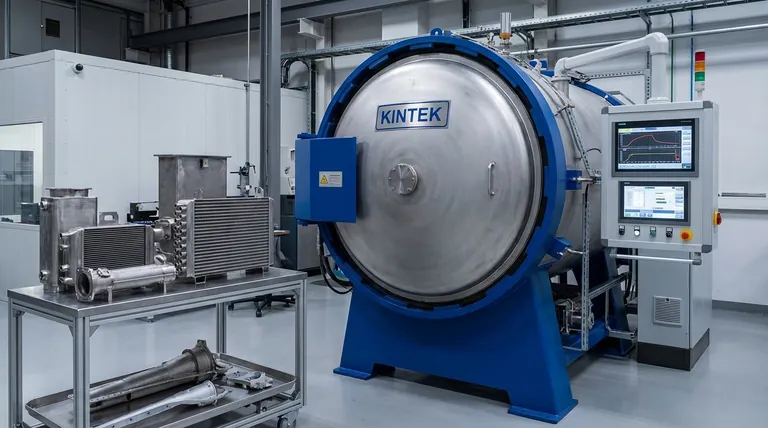
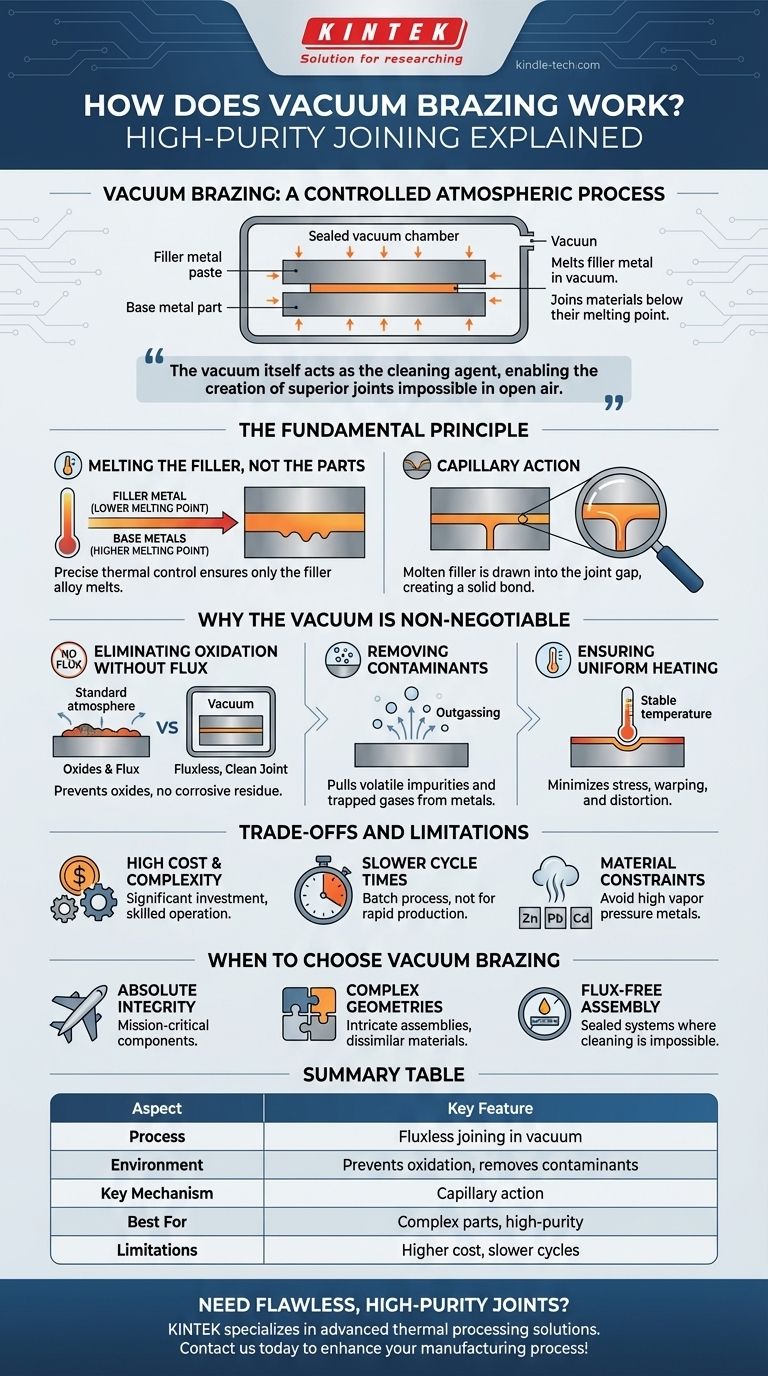
At its core, vacuum brazing is a high-purity method for joining materials by melting a filler metal between them inside a vacuum chamber. The process heats an assembly to a temperature high enough to melt the filler metal, but below the melting point of the components being joined. The vacuum environment prevents oxidation and removes contaminants, resulting in an exceptionally strong, clean, and flux-free bond.

The critical insight is that vacuum brazing isn't just a joining technique; it's a controlled atmospheric process. The vacuum itself acts as the cleaning agent, enabling the creation of superior joints that would be impossible to achieve in open air.
How does vacuum brazing work? Achieve Superior, Flux-Free Metal Joining

The Fundamental Principle: Melting the Filler, Not the Parts

Vacuum brazing operates on a simple but precise thermal principle. The success of the entire process hinges on the distinct melting points of the materials involved.

The Role of the Filler Metal

The filler metal (also called a brazing alloy) is the key ingredient. It is specifically chosen to have a melting point significantly lower than the base metals (the parts being joined).

This filler metal, often in the form of a paste, foil, or wire, is placed at the joint before the heating process begins.

The Importance of Temperature Control

The entire assembly is heated uniformly inside a vacuum furnace. The temperature is carefully raised above the melting point of the filler metal but is kept safely below the melting point of the base metals.

This ensures the components being joined remain solid and dimensionally stable, while only the filler alloy becomes liquid.

Capillary Action: The Driving Force

Once the filler metal melts, a natural phenomenon called capillary action takes over. The liquid alloy is automatically drawn into the tight gap between the base metal parts, much like a paper towel wicks up water.

This action ensures the joint is completely filled, creating a solid, continuous metallic bond once the assembly cools.

Why the Vacuum is Non-Negotiable

The use of a vacuum chamber is what elevates this process beyond standard brazing. The low-pressure environment is not passive; it actively contributes to the quality of the joint.

Eliminating Oxidation Without Flux

In a normal atmosphere, heating metals causes them to form oxides on their surfaces, which prevent a strong bond. Traditional brazing fights this with a chemical flux, which leaves behind a corrosive residue that must be cleaned.

Vacuum brazing is fluxless. By removing nearly all the oxygen from the chamber, the vacuum prevents oxides from forming in the first place. It can even remove existing light oxides from the metal surfaces.

Removing Contaminants

The vacuum actively pulls volatile impurities and trapped gases out of the base metals as they are heated. This process, known as outgassing, purifies the joint area and eliminates potential sources of weakness or porosity.

Ensuring Uniform Heating

A vacuum furnace provides extremely even and stable heating. This controlled thermal environment minimizes stress on the components, reducing the risk of warping or distortion, which is especially critical for complex or delicate assemblies.

Understanding the Trade-offs and Limitations

While powerful, vacuum brazing is a specialized process with specific considerations. It is not the right solution for every application.

High Initial Cost and Complexity

Vacuum furnaces represent a significant capital investment. They are complex machines that require skilled operators and rigorous maintenance schedules, making the process more expensive than conventional joining methods.

Slower Cycle Times

Heating an entire furnace chamber, allowing the components to "soak" at the brazing temperature, and then cooling it back down is a time-consuming batch process. This makes it less suitable for high-volume, rapid production compared to methods like automated welding.

Material Constraints

Certain materials are not suitable for vacuum brazing. Metals with high vapor pressures, such as zinc, lead, or cadmium, can vaporize in the vacuum at brazing temperatures. This can contaminate the furnace and compromise the joint integrity of the part itself.

When to Choose Vacuum Brazing

The decision to use vacuum brazing should be driven by the demands of the final application.

  • If your primary focus is absolute joint integrity and cleanliness: It is the ideal choice for mission-critical components in aerospace, medical implants, and high-performance scientific equipment where failure is not an option.
  • If your primary focus is joining complex geometries or dissimilar materials: It excels at creating strong bonds in intricate assemblies or between materials like metal and ceramic that cannot be welded.
  • If your primary focus is creating a flux-free assembly: It is essential for internal components of sealed systems, such as vacuum tubes or sensors, where post-braze cleaning is impossible.

Ultimately, vacuum brazing is the definitive choice when process control, purity, and metallurgical quality are more important than cost or production speed.

Summary Table:

Aspect Key Feature
Process Fluxless joining in a vacuum chamber
Environment Prevents oxidation, removes contaminants
Key Mechanism Capillary action draws molten filler metal
Best For Complex geometries, dissimilar materials, high-purity applications
Limitations Higher cost, slower cycle times, material constraints (e.g., zinc, cadmium)

Need flawless, high-purity joints for your critical components? KINTEK specializes in advanced thermal processing solutions, including vacuum brazing systems tailored for aerospace, medical, and laboratory equipment. Our expertise ensures superior bond integrity, cleanliness, and performance for your most demanding applications. Contact us today to discuss how we can enhance your manufacturing process!

Visual Guide
How does vacuum brazing work? Achieve Superior, Flux-Free Metal Joining Visual Guide

Related Products

People Also Ask

Related Products

Vacuum Heat Treat Sintering Brazing Furnace

Vacuum Heat Treat Sintering Brazing Furnace

A vacuum brazing furnace is a type of industrial furnace used for brazing, a metalworking process that joins two pieces of metal using a filler metal that melts at a lower temperature than the base metals. Vacuum brazing furnaces are typically used for high-quality applications where a strong, clean joint is required.

Ultra-High Temperature Graphite Vacuum Graphitization Furnace

Ultra-High Temperature Graphite Vacuum Graphitization Furnace

The ultra-high temperature graphitization furnace utilizes medium frequency induction heating in a vacuum or inert gas environment. The induction coil generates an alternating magnetic field, inducing eddy currents in the graphite crucible, which heats up and radiates heat to the workpiece, bringing it to the desired temperature. This furnace is primarily used for graphitization and sintering of carbon materials, carbon fiber materials, and other composite materials.

Vacuum Heat Treat and Pressure Sintering Furnace for High Temperature Applications

Vacuum Heat Treat and Pressure Sintering Furnace for High Temperature Applications

Vacuum pressure sintering furnaces are designed for high temperature hot pressing applications in metal and ceramic sintering. Its advanced features ensure precise temperature control, reliable pressure maintenance, and a robust design for seamless operation.

Vacuum Hot Press Furnace Heated Vacuum Press Machine Tube Furnace

Vacuum Hot Press Furnace Heated Vacuum Press Machine Tube Furnace

Reduce forming pressure & shorten sintering time with Vacuum Tube Hot Press Furnace for high-density, fine-grain materials. Ideal for refractory metals.

Vacuum Sealed Continuous Working Rotary Tube Furnace Rotating Tube Furnace

Vacuum Sealed Continuous Working Rotary Tube Furnace Rotating Tube Furnace

Experience efficient material processing with our vacuum-sealed rotary tube furnace. Perfect for experiments or industrial production, equipped with optional features for controlled feeding and optimized results. Order now.

600T Vacuum Induction Hot Press Furnace for Heat Treat and Sintering

600T Vacuum Induction Hot Press Furnace for Heat Treat and Sintering

Discover the 600T Vacuum Induction Hot Press Furnace, designed for high-temperature sintering experiments in vacuum or protected atmospheres. Its precise temperature and pressure control, adjustable working pressure, and advanced safety features make it ideal for nonmetal materials, carbon composites, ceramics, and metal powders.

Vacuum Hot Press Furnace Machine Heated Vacuum Press

Vacuum Hot Press Furnace Machine Heated Vacuum Press

Discover the advantages of Vacuum Hot Press Furnace! Manufacture dense refractory metals & compounds, ceramics, and composites under high temp and pressure.

Vertical High Temperature Graphite Vacuum Graphitization Furnace

Vertical High Temperature Graphite Vacuum Graphitization Furnace

Vertical high temperature graphitization furnace for carbonization and graphitization of carbon materials up to 3100℃.Suitable for shaped graphitization of carbon fiber filaments and other materials sintered in a carbon environment.Applications in metallurgy, electronics, and aerospace for producing high-quality graphite products like electrodes and crucibles.

Vacuum Hot Press Furnace Machine for Lamination and Heating

Vacuum Hot Press Furnace Machine for Lamination and Heating

Experience clean and precise lamination with Vacuum Lamination Press. Perfect for wafer bonding, thin-film transformations, and LCP lamination. Order now!

2200 ℃ Graphite Vacuum Heat Treat Furnace

2200 ℃ Graphite Vacuum Heat Treat Furnace

Discover the power of the KT-VG Graphite Vacuum Furnace - with a maximum working temperature of 2200℃, it's perfect for vacuum sintering of various materials. Learn more now.

Vacuum Heat Treat Furnace with Ceramic Fiber Liner

Vacuum Heat Treat Furnace with Ceramic Fiber Liner

Vacuum furnace with polycrystalline ceramic fiber insulation liner for excellent heat insulation and uniform temperature field. Choose from 1200℃ or 1700℃ max. working temperature with high vacuum performance and precise temperature control.

Vacuum Heat Treat and Sintering Furnace with 9MPa Air Pressure

Vacuum Heat Treat and Sintering Furnace with 9MPa Air Pressure

The air pressure sintering furnace is a high-tech equipment commonly used for the sintering of advanced ceramic materials. It combines vacuum sintering and pressure sintering techniques to achieve high-density and high-strength ceramics.

Vacuum Dental Porcelain Sintering Furnace

Vacuum Dental Porcelain Sintering Furnace

Get precise and reliable results with KinTek's Vacuum Porcelain Furnace. Suitable for all porcelain powders, it features hyperbolic ceramic furnace function, voice prompt, and automatic temperature calibration.

Lab-Scale Vacuum Induction Melting Furnace

Lab-Scale Vacuum Induction Melting Furnace

Get precise alloy composition with our Vacuum Induction Melting Furnace. Ideal for aerospace, nuclear energy, and electronic industries. Order now for effective smelting and casting of metals and alloys.

Horizontal High Temperature Graphite Vacuum Graphitization Furnace

Horizontal High Temperature Graphite Vacuum Graphitization Furnace

Horizontal Graphitization Furnace: This type of furnace is designed with the heating elements placed horizontally, allowing for uniform heating of the sample. It's well-suited for graphitizing large or bulky samples that require precise temperature control and uniformity.

Dental Porcelain Zirconia Sintering Ceramic Vacuum Press Furnace

Dental Porcelain Zirconia Sintering Ceramic Vacuum Press Furnace

Get precise dental results with Dental Vacuum Press Furnace. Automatic temperature calibration, low noise tray, and touch screen operation. Order now!

Molybdenum Vacuum Heat Treat Furnace

Molybdenum Vacuum Heat Treat Furnace

Discover the benefits of a high-configuration molybdenum vacuum furnace with heat shield insulation. Ideal for high-purity, vacuum environments like sapphire crystal growth and heat treatment.

Vacuum Heat Treat Furnace and Levitation Induction Melting Furnace

Vacuum Heat Treat Furnace and Levitation Induction Melting Furnace

Experience precise melting with our Vacuum Levitation Melting Furnace. Ideal for high melting point metals or alloys, with advanced technology for effective smelting. Order now for high-quality results.

Vacuum Arc Induction Melting Furnace

Vacuum Arc Induction Melting Furnace

Discover the power of Vacuum Arc Furnace for melting active & refractory metals. High-speed, remarkable degassing effect, and free of contamination. Learn more now!

Small Vacuum Heat Treat and Tungsten Wire Sintering Furnace

Small Vacuum Heat Treat and Tungsten Wire Sintering Furnace

The small vacuum tungsten wire sintering furnace is a compact experimental vacuum furnace specially designed for universities and scientific research institutes. The furnace features a CNC welded shell and vacuum piping to ensure leak-free operation. Quick-connect electrical connections facilitate relocation and debugging, and the standard electrical control cabinet is safe and convenient to operate.


Leave Your Message