Knowledge vacuum induction melting furnace How hot does a furnace need to be to melt copper? Achieve a Perfect Pour at 1150-1200°C
Author avatar

Tech Team · Kintek Solution

Updated 2 months ago

How hot does a furnace need to be to melt copper? Achieve a Perfect Pour at 1150-1200°C


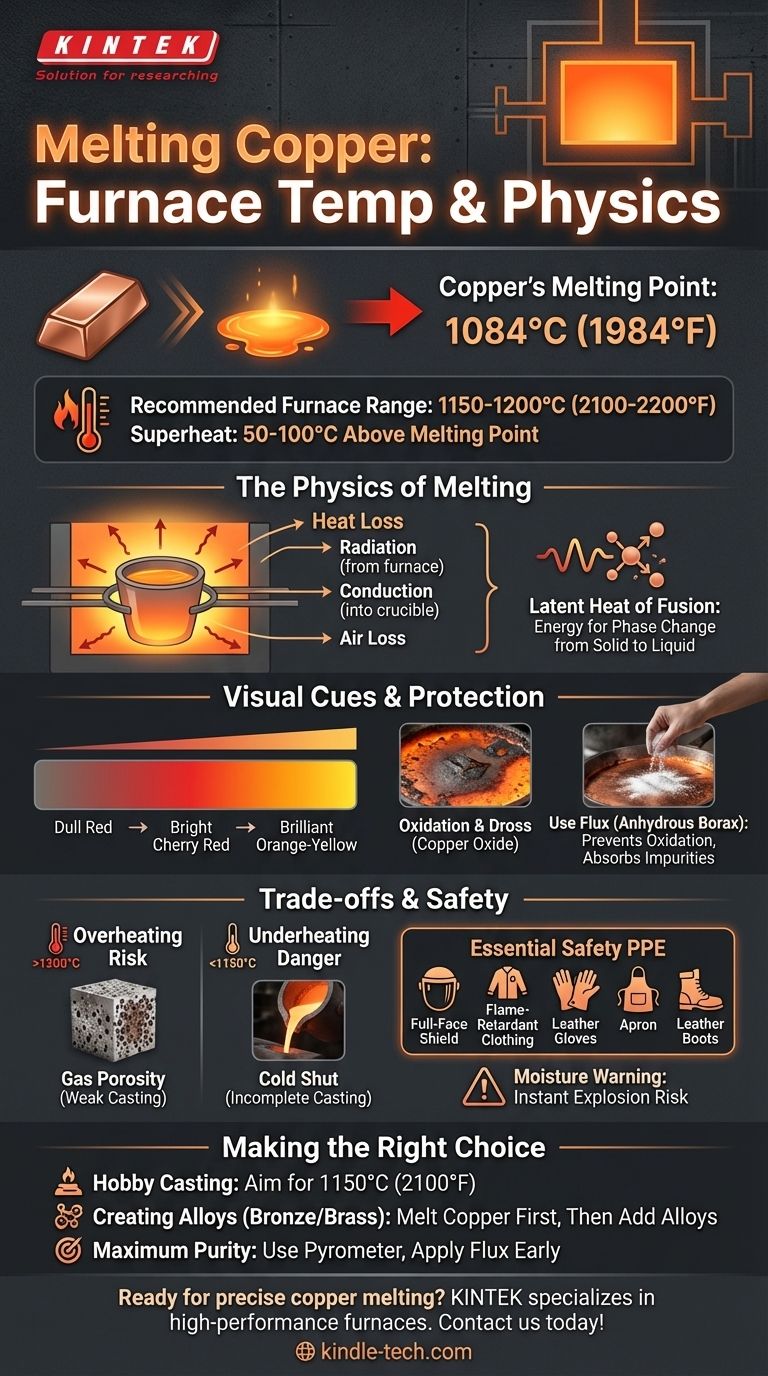
To melt copper, you must heat it to its precise melting point of 1084°C (1984°F). However, to achieve a successful melt and pour, your furnace must be capable of reaching and maintaining a temperature significantly higher than this, typically around 1150-1200°C (2100-2200°F), to account for heat loss and ensure the metal is fully liquid.

The core challenge is not just reaching a specific temperature, but managing heat effectively. While copper melts at a fixed point, successfully casting it requires a hotter furnace to overcome heat loss to the crucible and air, ensuring the metal remains fluid enough for a complete pour.
How hot does a furnace need to be to melt copper? Achieve a Perfect Pour at 1150-1200°C

The Physics of Melting Copper

To melt metal effectively, you need to understand it's not as simple as hitting a target number. You are fighting against the laws of thermodynamics, which dictate where your heat energy goes.

The Specific Melting Point

The temperature of 1084°C (1984°F) is a physical constant for pure copper. At this temperature, the crystalline structure of the solid metal breaks down, and it begins to transition into a liquid state.

The Role of Latent Heat

Simply reaching 1084°C is not enough. You must continue to apply a significant amount of energy, known as the latent heat of fusion, to complete the phase change from solid to liquid. This is why a pile of copper will appear to "stall" at its melting point until it has fully liquefied.

Why Your Furnace Must Be Hotter

Your furnace's heat is constantly escaping. It radiates out from the furnace body, conducts into the crucible holding the copper, and is lost to the surrounding air. To counteract this constant heat loss and provide the necessary latent heat, your furnace must operate at a temperature well above copper's melting point.

A good rule of thumb is to set your furnace to run at least 50-100°C (approx. 100-200°F) hotter than the metal's melting point. This "superheat" ensures the copper melts efficiently and stays hot enough for a successful pour.

From Solid to Liquid: What to Expect

Observing the process is key to understanding the state of your metal. Temperature readings are critical, but visual cues tell a vital part of the story.

Visual Cues of Melting

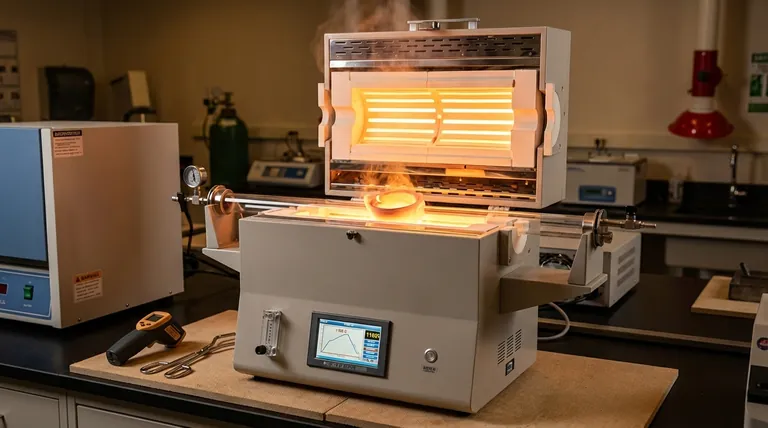
As the copper heats, it will begin to glow, moving from a dull red to a bright cherry red, and finally to a brilliant orange-yellow as it approaches and surpasses its melting point. The solid pieces will slump, lose their sharp edges, and eventually collapse into a shimmering liquid pool.

The Problem of Oxidation and Dross

Molten copper is highly reactive with oxygen in the air. This reaction forms a dark, crusty layer of copper oxide on the surface known as dross. If mixed into your pour, dross will create weak, porous spots in the final casting.

Using Flux to Protect the Melt

To prevent oxidation, you should use a flux, such as anhydrous borax. Sprinkling a small amount onto the copper as it begins to melt creates a molten glass-like barrier. This layer shields the liquid metal from the air, prevents dross from forming, and absorbs impurities.

Understanding the Trade-offs and Safety

Managing a furnace at these temperatures involves balancing risks. Both overheating and underheating create distinct problems, and safety must always be the highest priority.

The Risk of Overheating

Excessively high temperatures (well above 1200°C / 2200°F) can be detrimental. It increases the amount of gas (like hydrogen and oxygen) that dissolves into the molten copper. This gas will come out of solution as the metal cools, creating tiny bubbles and resulting in a weak, porous casting—a defect known as gas porosity.

The Danger of Underheating

Failing to superheat the copper sufficiently is a common beginner's mistake. If the metal is too close to its melting point, it may begin to solidify in transit from the crucible to the mold. This results in a "cold shut" or an incomplete casting, where the metal freezes before filling the entire mold cavity.

Essential Safety Precautions

Working with molten metal is extremely dangerous. Non-negotiable personal protective equipment (PPE) includes a full-face shield (not just glasses), flame-retardant clothing, leather gloves, an apron, and leather boots. Any moisture—even a drop of sweat—contacting molten metal will instantly flash to steam, causing a violent explosion of liquid metal.

Making the Right Choice for Your Goal

Your target temperature depends on what you intend to accomplish with the molten copper. Adjust your approach based on your specific objective.

  • If your primary focus is small-scale hobby casting: Aim for a pour temperature of around 1150°C (2100°F). This provides enough fluidity to capture detail in molds without excessive risk of gas porosity.
  • If your primary focus is creating alloys like bronze or brass: Melt the copper completely first. Only then should you add lower-melting-point metals like tin or zinc to prevent them from vaporizing and burning off before the copper is liquid.
  • If your primary focus is maximum purity and control: Use a pyrometer to precisely measure the metal's temperature, not just the furnace air. Apply a light layer of flux as soon as the metal becomes liquid to minimize oxidation.

Mastering the process is about understanding the properties of the material, not just memorizing a number.

Summary Table:

Key Temperature Purpose
1084°C (1984°F) Copper's Melting Point
1150-1200°C (2100-2200°F) Recommended Furnace Operating Range
50-100°C Above Melting Point Superheat for Efficient Pouring

Ready to achieve precise, safe, and efficient copper melting? KINTEK specializes in high-performance lab furnaces and consumables designed for metallurgy and casting applications. Our equipment ensures accurate temperature control and durability, helping you avoid defects like gas porosity and cold shuts. Contact our experts today to find the perfect furnace for your laboratory needs!

Visual Guide
How hot does a furnace need to be to melt copper? Achieve a Perfect Pour at 1150-1200°C Visual Guide

Related Products

People Also Ask

Related Products

Non Consumable Vacuum Arc Induction Melting Furnace

Non Consumable Vacuum Arc Induction Melting Furnace

Explore the benefits of Non-Consumable Vacuum Arc Furnace with high melting point electrodes. Small, easy to operate & eco-friendly. Ideal for laboratory research on refractory metals & carbides.

Lab-Scale Vacuum Induction Melting Furnace

Lab-Scale Vacuum Induction Melting Furnace

Get precise alloy composition with our Vacuum Induction Melting Furnace. Ideal for aerospace, nuclear energy, and electronic industries. Order now for effective smelting and casting of metals and alloys.

Vacuum Heat Treat Furnace and Levitation Induction Melting Furnace

Vacuum Heat Treat Furnace and Levitation Induction Melting Furnace

Experience precise melting with our Vacuum Levitation Melting Furnace. Ideal for high melting point metals or alloys, with advanced technology for effective smelting. Order now for high-quality results.

Vacuum Arc Induction Melting Furnace

Vacuum Arc Induction Melting Furnace

Discover the power of Vacuum Arc Furnace for melting active & refractory metals. High-speed, remarkable degassing effect, and free of contamination. Learn more now!

High Temperature Muffle Oven Furnace for Laboratory Debinding and Pre Sintering

High Temperature Muffle Oven Furnace for Laboratory Debinding and Pre Sintering

KT-MD High temperature debinding and pre-sintering furnace for ceramic materials with various molding processes. Ideal for electronic components such as MLCC and NFC.

2200 ℃ Tungsten Vacuum Heat Treat and Sintering Furnace

2200 ℃ Tungsten Vacuum Heat Treat and Sintering Furnace

Experience the ultimate refractory metal furnace with our Tungsten vacuum furnace. Capable of reaching 2200℃, perfect for sintering advanced ceramics and refractory metals. Order now for high-quality results.

Vacuum Heat Treat and Molybdenum Wire Sintering Furnace for Vacuum Sintering

Vacuum Heat Treat and Molybdenum Wire Sintering Furnace for Vacuum Sintering

A vacuum molybdenum wire sintering furnace is a vertical or bedroom structure, which is suitable for withdrawal, brazing, sintering and degassing of metal materials under high vacuum and high temperature conditions. It is also suitable for dehydroxylation treatment of quartz materials.

600T Vacuum Induction Hot Press Furnace for Heat Treat and Sintering

600T Vacuum Induction Hot Press Furnace for Heat Treat and Sintering

Discover the 600T Vacuum Induction Hot Press Furnace, designed for high-temperature sintering experiments in vacuum or protected atmospheres. Its precise temperature and pressure control, adjustable working pressure, and advanced safety features make it ideal for nonmetal materials, carbon composites, ceramics, and metal powders.

Vacuum Heat Treat Sintering Brazing Furnace

Vacuum Heat Treat Sintering Brazing Furnace

A vacuum brazing furnace is a type of industrial furnace used for brazing, a metalworking process that joins two pieces of metal using a filler metal that melts at a lower temperature than the base metals. Vacuum brazing furnaces are typically used for high-quality applications where a strong, clean joint is required.

Laboratory Rapid Thermal Processing (RTP) Quartz Tube Furnace

Laboratory Rapid Thermal Processing (RTP) Quartz Tube Furnace

Get lightning-fast heating with our RTP Rapid Heating Tube Furnace. Designed for precise, high-speed heating and cooling with convenient sliding rail and TFT touch screen controller. Order now for ideal thermal processing!

Graphite Vacuum Furnace Bottom Discharge Graphitization Furnace for Carbon Materials

Graphite Vacuum Furnace Bottom Discharge Graphitization Furnace for Carbon Materials

Bottom-out graphitization furnace for carbon materials, ultra-high temperature furnace up to 3100°C, suitable for graphitization and sintering of carbon rods and carbon blocks. Vertical design, bottom discharging, convenient feeding and discharging, high temperature uniformity, low energy consumption, good stability, hydraulic lifting system, convenient loading and unloading.

Mesh belt controlled atmosphere furnace

Mesh belt controlled atmosphere furnace

Discover our KT-MB mesh belt sintering furnace - perfect for high-temperature sintering of electronic components & glass insulators. Available for open air or controlled atmosphere environments.

Vacuum Heat Treat and Pressure Sintering Furnace for High Temperature Applications

Vacuum Heat Treat and Pressure Sintering Furnace for High Temperature Applications

Vacuum pressure sintering furnaces are designed for high temperature hot pressing applications in metal and ceramic sintering. Its advanced features ensure precise temperature control, reliable pressure maintenance, and a robust design for seamless operation.

Laboratory Muffle Oven Furnace Bottom Lifting Muffle Furnace

Laboratory Muffle Oven Furnace Bottom Lifting Muffle Furnace

Efficiently produce batches with excellent temperature uniformity using our Bottom Lifting Furnace. Features two electric lifting stages and advanced temperature control up to 1600℃.

1700℃ Muffle Oven Furnace for Laboratory

1700℃ Muffle Oven Furnace for Laboratory

Get superior heat control with our 1700℃ Muffle Furnace. Equipped with intelligent temperature microprocessor, TFT touch screen controller & advanced insulation materials for precise heating up to 1700C. Order now!

1200℃ Split Tube Furnace with Quartz Tube Laboratory Tubular Furnace

1200℃ Split Tube Furnace with Quartz Tube Laboratory Tubular Furnace

KT-TF12 split tube furnace: high-purity insulation, embedded heating wire coils, and max. 1200C. Widely used for new materials and chemical vapour deposition.

Electric Rotary Kiln Small Rotary Furnace for Activated Carbon Regeneration

Electric Rotary Kiln Small Rotary Furnace for Activated Carbon Regeneration

Revitalize your activated carbon with KinTek's Electric Regeneration Furnace. Achieve efficient and cost-effective regeneration with our highly automated rotary kiln and intelligent thermal controller.

Electric Rotary Kiln Pyrolysis Furnace Plant Machine Calciner Small Rotary Kiln Rotating Furnace

Electric Rotary Kiln Pyrolysis Furnace Plant Machine Calciner Small Rotary Kiln Rotating Furnace

Electric rotary kiln - precisely controlled, it's ideal for calcination and drying of materials like lithium cobalate, rare earths, and non-ferrous metals.

1200℃ Muffle Furnace Oven for Laboratory

1200℃ Muffle Furnace Oven for Laboratory

Upgrade your lab with our 1200℃ Muffle Furnace. Achieve fast, precise heating with Japan alumina fibers and Molybdenum coils. Features TFT touch screen controller for easy programming and data analysis. Order now!

Ultra-High Temperature Graphite Vacuum Graphitization Furnace

Ultra-High Temperature Graphite Vacuum Graphitization Furnace

The ultra-high temperature graphitization furnace utilizes medium frequency induction heating in a vacuum or inert gas environment. The induction coil generates an alternating magnetic field, inducing eddy currents in the graphite crucible, which heats up and radiates heat to the workpiece, bringing it to the desired temperature. This furnace is primarily used for graphitization and sintering of carbon materials, carbon fiber materials, and other composite materials.


Leave Your Message