Knowledge Vacuum Furnace How is furnace temperature controlled? Achieve Precise Thermal Processing with PID Control
Author avatar

Tech Team · Kintek Solution

Updated 2 months ago

How is furnace temperature controlled? Achieve Precise Thermal Processing with PID Control


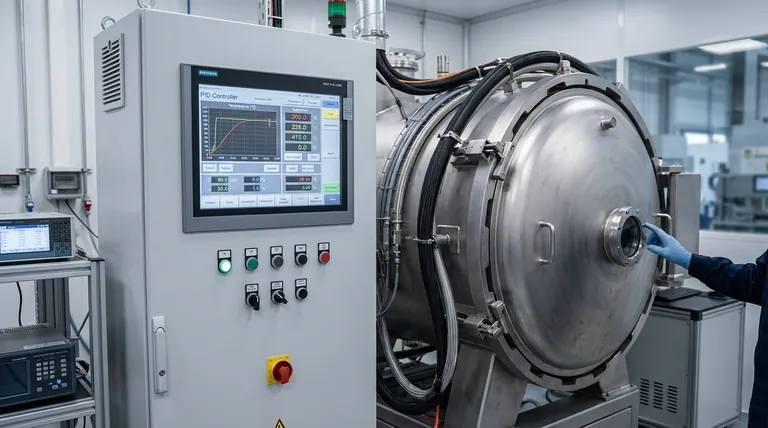
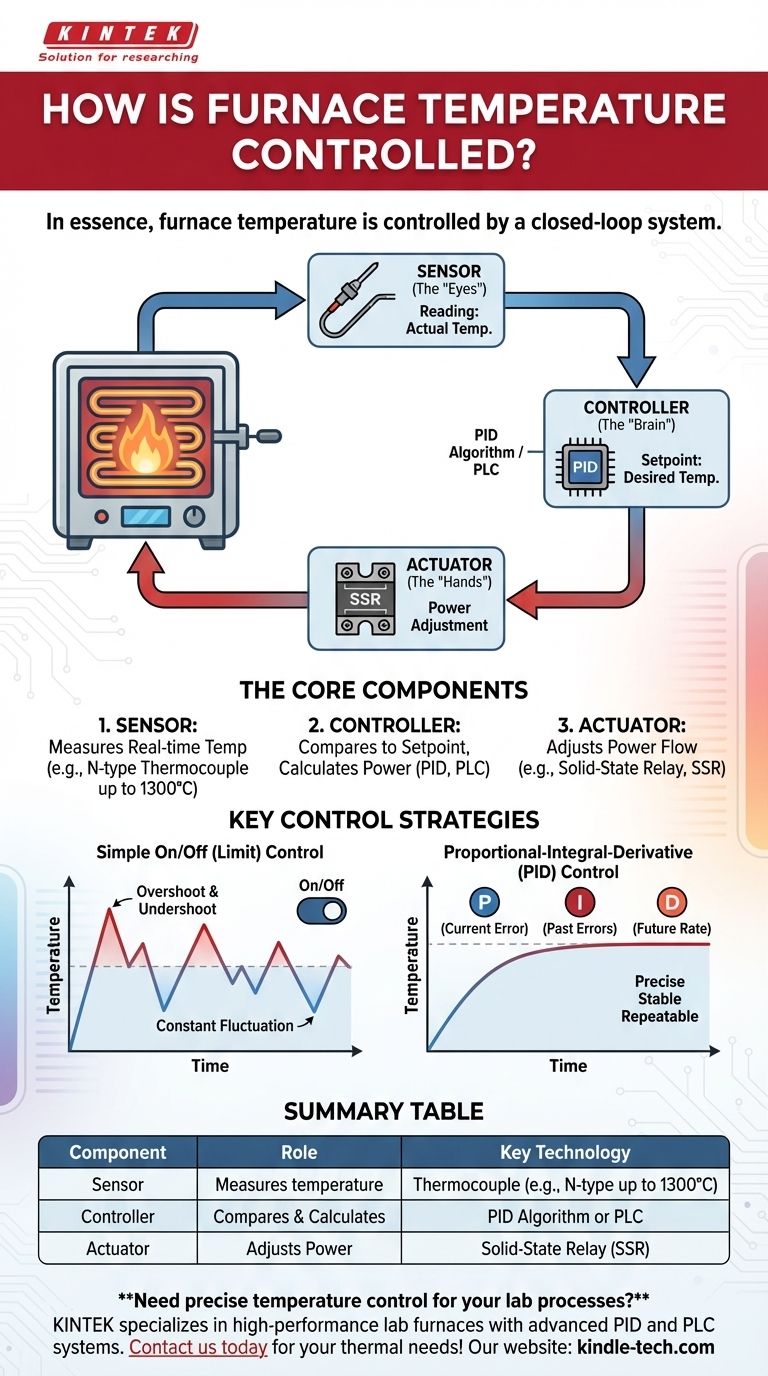
In essence, furnace temperature is controlled by a closed-loop system. This system continuously measures the internal temperature with a sensor, compares it to the desired temperature (the setpoint), and uses a controller to precisely adjust the power sent to the heating elements to minimize the difference.

The core principle is not just heating, but intelligent regulation. Modern furnaces rely on a constant cycle of measuring, comparing, and adjusting power—most often using a PID controller—to achieve stable and precise temperatures without constant manual intervention.
How is furnace temperature controlled? Achieve Precise Thermal Processing with PID Control

The Core Components of Temperature Control

A furnace's temperature control system is composed of three critical parts that work in a continuous loop: the sensor, the controller, and the actuator.

The Sensor (The "Eyes")

The sensor is responsible for accurately measuring the real-time temperature inside the furnace chamber.

The most common type is a thermocouple, such as the industry-standard N-type nickel-chromium-silicon, which is durable and reliable for high-temperature applications up to 1300°C.

The Controller (The "Brain")

The controller is the central processor. It takes the temperature reading from the thermocouple and compares it to the programmed setpoint.

Based on the difference, it calculates precisely how much power the heating elements need. This can range from a simple programmable unit to a fully automatic PLC (Programmable Logic Controller) integrated into a larger system.

The Actuator (The "Hands")

The actuator receives the command from the controller and physically adjusts the power flow to the heating elements.

In modern electric furnaces, this is typically a Solid-State Relay (SSR). An SSR can switch power on and off thousands of times per second, allowing for extremely fine-grained control over the heat output.

Key Control Strategies Explained

While the components are universal, the strategy the controller uses to make decisions can vary significantly in complexity and precision.

Simple On/Off (Limit) Control

This is the most basic method. If the temperature is below the setpoint, the controller sends 100% power. Once it's above the setpoint, it cuts power completely.

This method is simple but results in constant temperature overshooting and undershooting, making it unsuitable for processes requiring high stability.

Proportional-Integral-Derivative (PID) Control

PID control is the standard for nearly all modern precision furnaces, from laboratory models to industrial sintering units. It is a sophisticated algorithm that adjusts power based on three factors.

  • Proportional (P): Reacts to the current error. The further the temperature is from the setpoint, the more power it applies.
  • Integral (I): Reacts to the sum of past errors. This corrects for small, steady-state temperature drifts, ensuring the furnace eventually settles exactly at the setpoint.
  • Derivative (D): Reacts to the rate of future error. It anticipates where the temperature is going, reducing power as it quickly approaches the setpoint to prevent overshooting.

Advanced and Automated Control

For highly complex processes, even more advanced strategies exist. Feedforward control can compensate for predictable disturbances, while fuzzy logic allows the system to handle imprecise variables.

These systems are often managed by a PLC, which can run entire heating, soaking, and cooling programs automatically with the press of a button.

Understanding the Trade-offs

Choosing and operating a furnace requires understanding the balance between precision, simplicity, and safety.

Precision vs. Simplicity

An on/off controller is simple and cheap but imprecise. A PID controller delivers exceptional stability and repeatability for sensitive processes like sintering, but it must be properly "tuned" to the specific furnace to perform optimally.

The Importance of System Monitoring

No control system is infallible. It is critical to monitor the furnace's operation during a cycle to watch for abnormalities. A perfectly programmed controller cannot prevent a hardware failure, such as a faulty thermocouple or a failing heating element.

Automation Comes with Responsibility

The ability to program a full heat treatment cycle and press "run" is a massive advantage in efficiency and repeatability. However, this automation relies on the operator setting the program correctly according to the furnace's instructions and process requirements.

Making the Right Choice for Your Process

Your specific goal determines which level of control is necessary for your work.

  • If your primary focus is basic heating without high precision: A simple limit or on/off controller is sufficient and cost-effective.
  • If your primary focus is stable, repeatable, and precise temperatures: A PID controller is the non-negotiable industry standard for tasks like heat treatment, sintering, or lab research.
  • If your primary focus is integrating the furnace into a complex, automated workflow: A PLC-based control system provides the most power and flexibility for multi-step, unattended operation.

Understanding these control principles empowers you to operate your furnace not just as a heater, but as a precision instrument tailored to your exact needs.

Summary Table:

Component Role Key Technology
Sensor Measures temperature Thermocouple (e.g., N-type up to 1300°C)
Controller Compares & calculates PID Algorithm or PLC
Actuator Adjusts power Solid-State Relay (SSR)

Need precise temperature control for your lab processes? KINTEK specializes in high-performance lab furnaces with advanced PID controllers and PLC systems, ensuring stable and repeatable results for sintering, heat treatment, and research. Let our experts help you select the right furnace for your application. Contact us today to discuss your specific thermal processing needs!

Visual Guide
How is furnace temperature controlled? Achieve Precise Thermal Processing with PID Control Visual Guide

Related Products

People Also Ask

Related Products

Graphite Vacuum Furnace High Thermal Conductivity Film Graphitization Furnace

Graphite Vacuum Furnace High Thermal Conductivity Film Graphitization Furnace

The high thermal conductivity film graphitization furnace has uniform temperature, low energy consumption and can operate continuously.

High Temperature Muffle Oven Furnace for Laboratory Debinding and Pre Sintering

High Temperature Muffle Oven Furnace for Laboratory Debinding and Pre Sintering

KT-MD High temperature debinding and pre-sintering furnace for ceramic materials with various molding processes. Ideal for electronic components such as MLCC and NFC.

1700℃ Controlled Atmosphere Furnace Nitrogen Inert Atmosphere Furnace

1700℃ Controlled Atmosphere Furnace Nitrogen Inert Atmosphere Furnace

KT-17A Controlled atmosphere furnace: 1700℃ heating, vacuum sealing technology, PID temperature control, and versatile TFT smart touch screen controller for laboratory and industrial use.

Vertical High Temperature Graphite Vacuum Graphitization Furnace

Vertical High Temperature Graphite Vacuum Graphitization Furnace

Vertical high temperature graphitization furnace for carbonization and graphitization of carbon materials up to 3100℃.Suitable for shaped graphitization of carbon fiber filaments and other materials sintered in a carbon environment.Applications in metallurgy, electronics, and aerospace for producing high-quality graphite products like electrodes and crucibles.

1700℃ Muffle Oven Furnace for Laboratory

1700℃ Muffle Oven Furnace for Laboratory

Get superior heat control with our 1700℃ Muffle Furnace. Equipped with intelligent temperature microprocessor, TFT touch screen controller & advanced insulation materials for precise heating up to 1700C. Order now!

1200℃ Split Tube Furnace with Quartz Tube Laboratory Tubular Furnace

1200℃ Split Tube Furnace with Quartz Tube Laboratory Tubular Furnace

KT-TF12 split tube furnace: high-purity insulation, embedded heating wire coils, and max. 1200C. Widely used for new materials and chemical vapour deposition.

Ultra-High Temperature Graphite Vacuum Graphitization Furnace

Ultra-High Temperature Graphite Vacuum Graphitization Furnace

The ultra-high temperature graphitization furnace utilizes medium frequency induction heating in a vacuum or inert gas environment. The induction coil generates an alternating magnetic field, inducing eddy currents in the graphite crucible, which heats up and radiates heat to the workpiece, bringing it to the desired temperature. This furnace is primarily used for graphitization and sintering of carbon materials, carbon fiber materials, and other composite materials.

Graphite Vacuum Furnace Bottom Discharge Graphitization Furnace for Carbon Materials

Graphite Vacuum Furnace Bottom Discharge Graphitization Furnace for Carbon Materials

Bottom-out graphitization furnace for carbon materials, ultra-high temperature furnace up to 3100°C, suitable for graphitization and sintering of carbon rods and carbon blocks. Vertical design, bottom discharging, convenient feeding and discharging, high temperature uniformity, low energy consumption, good stability, hydraulic lifting system, convenient loading and unloading.

Controlled Nitrogen Inert Hydrogen Atmosphere Furnace

Controlled Nitrogen Inert Hydrogen Atmosphere Furnace

KT-AH Hydrogen atmosphere furnace - induction gas furnace for sintering/annealing with built-in safety features, dual housing design, and energy-saving efficiency. Ideal for lab and industrial use.

Large Vertical Graphite Vacuum Graphitization Furnace

Large Vertical Graphite Vacuum Graphitization Furnace

A large vertical high-temperature graphitization furnace is a type of industrial furnace used for the graphitization of carbon materials, such as carbon fiber and carbon black. It is a high-temperature furnace that can reach temperatures of up to 3100°C.

600T Vacuum Induction Hot Press Furnace for Heat Treat and Sintering

600T Vacuum Induction Hot Press Furnace for Heat Treat and Sintering

Discover the 600T Vacuum Induction Hot Press Furnace, designed for high-temperature sintering experiments in vacuum or protected atmospheres. Its precise temperature and pressure control, adjustable working pressure, and advanced safety features make it ideal for nonmetal materials, carbon composites, ceramics, and metal powders.

Laboratory Muffle Oven Furnace Bottom Lifting Muffle Furnace

Laboratory Muffle Oven Furnace Bottom Lifting Muffle Furnace

Efficiently produce batches with excellent temperature uniformity using our Bottom Lifting Furnace. Features two electric lifting stages and advanced temperature control up to 1600℃.

Vacuum Hot Press Furnace Machine Heated Vacuum Press

Vacuum Hot Press Furnace Machine Heated Vacuum Press

Discover the advantages of Vacuum Hot Press Furnace! Manufacture dense refractory metals & compounds, ceramics, and composites under high temp and pressure.

Vacuum Sealed Continuous Working Rotary Tube Furnace Rotating Tube Furnace

Vacuum Sealed Continuous Working Rotary Tube Furnace Rotating Tube Furnace

Experience efficient material processing with our vacuum-sealed rotary tube furnace. Perfect for experiments or industrial production, equipped with optional features for controlled feeding and optimized results. Order now.

2200 ℃ Graphite Vacuum Heat Treat Furnace

2200 ℃ Graphite Vacuum Heat Treat Furnace

Discover the power of the KT-VG Graphite Vacuum Furnace - with a maximum working temperature of 2200℃, it's perfect for vacuum sintering of various materials. Learn more now.

Electric Rotary Kiln Pyrolysis Furnace Plant Machine Calciner Small Rotary Kiln Rotating Furnace

Electric Rotary Kiln Pyrolysis Furnace Plant Machine Calciner Small Rotary Kiln Rotating Furnace

Electric rotary kiln - precisely controlled, it's ideal for calcination and drying of materials like lithium cobalate, rare earths, and non-ferrous metals.

Vacuum Heat Treat and Molybdenum Wire Sintering Furnace for Vacuum Sintering

Vacuum Heat Treat and Molybdenum Wire Sintering Furnace for Vacuum Sintering

A vacuum molybdenum wire sintering furnace is a vertical or bedroom structure, which is suitable for withdrawal, brazing, sintering and degassing of metal materials under high vacuum and high temperature conditions. It is also suitable for dehydroxylation treatment of quartz materials.

Dental Porcelain Zirconia Sintering Ceramic Furnace Chairside with Transformer

Dental Porcelain Zirconia Sintering Ceramic Furnace Chairside with Transformer

Experience top-notch sintering with Chairside Sintering Furnace with Transformer. Easy to operate, noise-free pallet, and automatic temperature calibration. Order now!

Horizontal High Temperature Graphite Vacuum Graphitization Furnace

Horizontal High Temperature Graphite Vacuum Graphitization Furnace

Horizontal Graphitization Furnace: This type of furnace is designed with the heating elements placed horizontally, allowing for uniform heating of the sample. It's well-suited for graphitizing large or bulky samples that require precise temperature control and uniformity.

Vacuum Heat Treat and Pressure Sintering Furnace for High Temperature Applications

Vacuum Heat Treat and Pressure Sintering Furnace for High Temperature Applications

Vacuum pressure sintering furnaces are designed for high temperature hot pressing applications in metal and ceramic sintering. Its advanced features ensure precise temperature control, reliable pressure maintenance, and a robust design for seamless operation.


Leave Your Message