Knowledge How plasma is created in magnetron sputtering? The Engine for High-Quality Thin-Film Deposition
Author avatar

Tech Team · Kintek Solution

Updated 1 week ago

How plasma is created in magnetron sputtering? The Engine for High-Quality Thin-Film Deposition


In magnetron sputtering, plasma is the energized medium that makes the entire coating process possible. It is created by applying a high voltage between two electrodes—a cathode holding the target material and an anode—within a vacuum chamber filled with a low-pressure gas, typically argon. This electric field accelerates free electrons, which then collide with and ionize the gas atoms, initiating a self-sustaining cascade that forms the plasma.

The generation of plasma in magnetron sputtering is fundamentally a controlled chain reaction. It begins with a powerful electric field that energizes a few free electrons, which then collide with neutral gas atoms, creating a dense, self-sustaining population of positive ions and more electrons that becomes the engine for the sputtering process.
How plasma is created in magnetron sputtering? The Engine for High-Quality Thin-Film Deposition

The Fundamental Requirements for Plasma Ignition

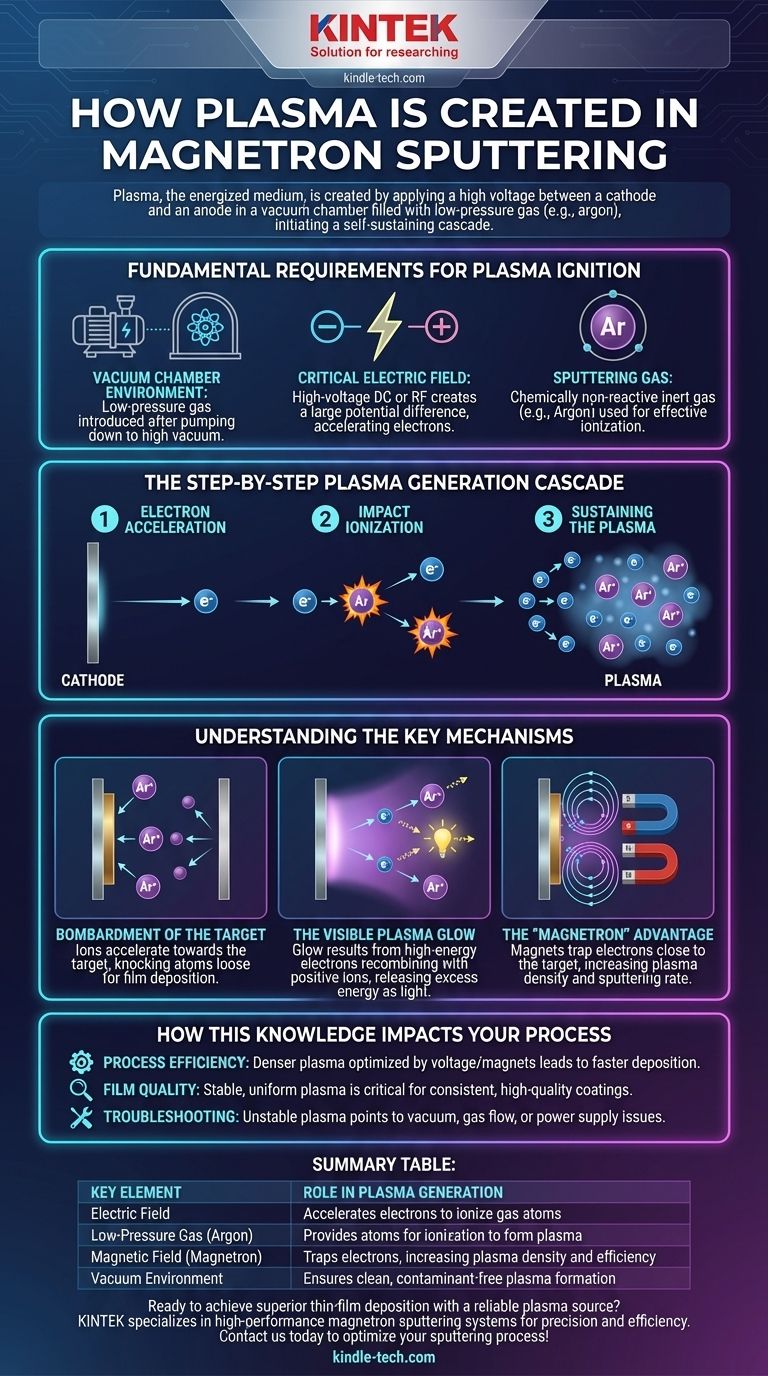
To create a stable plasma, three initial conditions must be met inside the sputtering chamber. These elements work in concert to transform a neutral gas into an ionized, reactive state.

The Vacuum Chamber Environment

First, the chamber is pumped down to a high vacuum to remove air and other contaminants. Then, a small, precisely controlled amount of a process gas is introduced, creating a low-pressure environment.

The Critical Electric Field

A high-voltage DC or RF power supply creates a large potential difference between the cathode (which holds the target material and is negatively charged) and the anode (often the chamber walls and substrate holder, which are grounded). This powerful electric field is the primary driver of the entire process.

The Sputtering Gas

An inert gas, most commonly argon (Ar), is used. Argon is chosen because it is chemically non-reactive and has a suitable atomic mass for effectively dislodging atoms from the target, yet it can be ionized with relative ease by the electric field.

The Step-by-Step Plasma Generation Cascade

Once the initial conditions are set, the creation of plasma occurs in a rapid, self-sustaining sequence of events.

Step 1: Electron Acceleration

The strong electric field immediately accelerates the few free electrons that are naturally present in the gas, propelling them away from the negative cathode at high speed.

Step 2: Impact Ionization

As these high-energy electrons travel through the chamber, they collide with neutral argon atoms. If the collision is energetic enough, it knocks an electron out of the argon atom's orbit.

This single event creates two new charged particles: a new free electron and a positively charged argon ion (Ar+).

Step 3: Sustaining the Plasma

The newly created electron is also accelerated by the electric field, leading to more collisions and more ionization. This cascade effect quickly generates a dense, stable cloud of positive ions and free electrons, which is the plasma.

Understanding the Key Mechanisms

The plasma itself does not deposit the film. Instead, it serves as the source of ions that do the work of sputtering. The visible glow is merely a side effect of this activity.

The Bombardment of the Target

While the electrons are accelerated away from the cathode, the much heavier, positively charged argon ions are accelerated towards the negatively charged cathode target. They strike the target surface with immense kinetic energy.

This high-energy bombardment physically knocks atoms loose from the target material. These ejected atoms then travel through the chamber and deposit onto the substrate, forming the thin film.

The Visible Plasma Glow

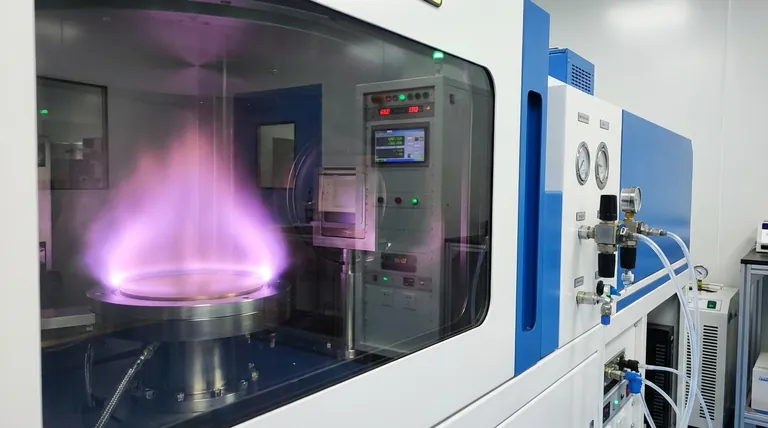
The characteristic glow seen during sputtering is not the sputtering event itself. It is produced when high-energy free electrons recombine with the positive argon ions, causing them to return to a lower energy state. The excess energy is released as photons of light, creating the visible glow.

The "Magnetron" Advantage

In magnetron sputtering specifically, powerful magnets are placed behind the cathode target. These magnets generate a magnetic field that traps the highly mobile electrons in a circular path close to the target's surface.

This trapping mechanism dramatically increases the probability that an electron will collide with an argon atom before being lost to the anode. This creates a much denser, more intense plasma right where it is needed, leading to higher sputtering rates and a more efficient process that can operate at lower gas pressures.

How This Knowledge Impacts Your Process

Understanding how plasma is formed is essential for controlling and troubleshooting your thin-film deposition process.

  • If your primary focus is process efficiency: Realize that a denser plasma, achieved by optimizing voltage and magnetic field strength, directly leads to a higher ion bombardment rate and a faster deposition.
  • If your primary focus is film quality: A stable and uniform plasma is absolutely critical for depositing a consistent, homogenous, and high-quality coating onto your substrate.
  • If you are troubleshooting your system: An unstable, weak, or non-existent plasma points directly to a problem with one of the three core requirements: the vacuum level, the gas flow, or the power supply providing the voltage.

By mastering the principles of plasma generation, you gain direct control over the quality and efficiency of your thin-film deposition.

Summary Table:

Key Element Role in Plasma Generation
Electric Field Accelerates electrons to ionize gas atoms
Low-Pressure Gas (Argon) Provides atoms for ionization to form plasma
Magnetic Field (Magnetron) Traps electrons, increasing plasma density and efficiency
Vacuum Environment Ensures clean, contaminant-free plasma formation

Ready to achieve superior thin-film deposition with a reliable plasma source? KINTEK specializes in high-performance lab equipment, including magnetron sputtering systems designed for precision and efficiency. Whether you're focused on research or production, our solutions ensure stable plasma generation for consistent, high-quality coatings. Contact us today to discuss how we can optimize your sputtering process!

Visual Guide
How plasma is created in magnetron sputtering? The Engine for High-Quality Thin-Film Deposition Visual Guide

Related Products

People Also Ask

Related Products

RF PECVD System Radio Frequency Plasma-Enhanced Chemical Vapor Deposition RF PECVD

RF PECVD System Radio Frequency Plasma-Enhanced Chemical Vapor Deposition RF PECVD

RF-PECVD is an acronym for "Radio Frequency Plasma-Enhanced Chemical Vapor Deposition." It deposits DLC (Diamond-like carbon film) on germanium and silicon substrates. It is utilized in the 3-12um infrared wavelength range.

Chemical Vapor Deposition CVD Equipment System Chamber Slide PECVD Tube Furnace with Liquid Gasifier PECVD Machine

Chemical Vapor Deposition CVD Equipment System Chamber Slide PECVD Tube Furnace with Liquid Gasifier PECVD Machine

KT-PE12 Slide PECVD System: Wide power range, programmable temp control, fast heating/cooling with sliding system, MFC mass flow control & vacuum pump.

Split Chamber CVD Tube Furnace with Vacuum Station Chemical Vapor Deposition System Equipment Machine

Split Chamber CVD Tube Furnace with Vacuum Station Chemical Vapor Deposition System Equipment Machine

Efficient split chamber CVD furnace with vacuum station for intuitive sample checking and quick cooling. Up to 1200℃ max temperature with accurate MFC mass flowmeter control.

304 316 Stainless Steel Vacuum Ball Valve Stop Valve for High Vacuum Systems

304 316 Stainless Steel Vacuum Ball Valve Stop Valve for High Vacuum Systems

Discover 304/316 stainless steel vacuum ball valves, Ideal for high vacuum systems, Ensure precise control and durability. Explore now!

Vacuum Hot Press Furnace Heated Vacuum Press Machine Tube Furnace

Vacuum Hot Press Furnace Heated Vacuum Press Machine Tube Furnace

Reduce forming pressure & shorten sintering time with Vacuum Tube Hot Press Furnace for high-density, fine-grain materials. Ideal for refractory metals.

1200℃ Controlled Atmosphere Furnace Nitrogen Inert Atmosphere Furnace

1200℃ Controlled Atmosphere Furnace Nitrogen Inert Atmosphere Furnace

Discover our KT-12A Pro Controlled atmosphere furnace - high precision, heavy duty vacuum chamber, versatile smart touch screen controller, and excellent temperature uniformity up to 1200C. Ideal for both laboratory and industrial application.

1400℃ Controlled Atmosphere Furnace with Nitrogen and Inert Atmosphere

1400℃ Controlled Atmosphere Furnace with Nitrogen and Inert Atmosphere

Achieve precise heat treatment with KT-14A controlled atmosphere furnace. Vacuum sealed with a smart controller, it's ideal for lab and industrial use up to 1400℃.

30T 40T Split Automatic Heated Hydraulic Press Machine with Heated Plates for Laboratory Hot Press

30T 40T Split Automatic Heated Hydraulic Press Machine with Heated Plates for Laboratory Hot Press

Discover our split automatic heated lab press 30T/40T for precise sample preparation in material research, pharmacy, ceramics, and electronics industries. With a small footprint and heating up to 300°C, it's perfect for processing under vacuum environment.

Vacuum Heat Treat and Sintering Furnace with 9MPa Air Pressure

Vacuum Heat Treat and Sintering Furnace with 9MPa Air Pressure

The air pressure sintering furnace is a high-tech equipment commonly used for the sintering of advanced ceramic materials. It combines vacuum sintering and pressure sintering techniques to achieve high-density and high-strength ceramics.

Electric Heated Hydraulic Vacuum Heat Press for Lab

Electric Heated Hydraulic Vacuum Heat Press for Lab

The Electric Vacuum Heat Press is a specialized heat press equipment that operates in a vacuum environment, utilizing advanced infrared heating and precise temperature control for high quality, rugged and reliable performance.

Molybdenum Tungsten Tantalum Special Shape Evaporation Boat

Molybdenum Tungsten Tantalum Special Shape Evaporation Boat

Tungsten Evaporation Boat is ideal for vacuum coating industry and sintering furnace or vacuum annealing. we offers tungsten evaporation boats that are designed to be durable and robust, with long operating lifetimes and to ensure consistent smooth and even spreading of the molten metals.

Vacuum Heat Treat Furnace with Ceramic Fiber Liner

Vacuum Heat Treat Furnace with Ceramic Fiber Liner

Vacuum furnace with polycrystalline ceramic fiber insulation liner for excellent heat insulation and uniform temperature field. Choose from 1200℃ or 1700℃ max. working temperature with high vacuum performance and precise temperature control.

Vacuum Heat Treat and Molybdenum Wire Sintering Furnace for Vacuum Sintering

Vacuum Heat Treat and Molybdenum Wire Sintering Furnace for Vacuum Sintering

A vacuum molybdenum wire sintering furnace is a vertical or bedroom structure, which is suitable for withdrawal, brazing, sintering and degassing of metal materials under high vacuum and high temperature conditions. It is also suitable for dehydroxylation treatment of quartz materials.

Small Vacuum Heat Treat and Tungsten Wire Sintering Furnace

Small Vacuum Heat Treat and Tungsten Wire Sintering Furnace

The small vacuum tungsten wire sintering furnace is a compact experimental vacuum furnace specially designed for universities and scientific research institutes. The furnace features a CNC welded shell and vacuum piping to ensure leak-free operation. Quick-connect electrical connections facilitate relocation and debugging, and the standard electrical control cabinet is safe and convenient to operate.

Graphite Vacuum Continuous Graphitization Furnace

Graphite Vacuum Continuous Graphitization Furnace

High-temperature graphitization furnace is a professional equipment for graphitization treatment of carbon materials. It is a key equipment for the production of high-quality graphite products. It has high temperature, high efficiency and uniform heating. It is suitable for various high-temperature treatments and graphitization treatments. It is widely used in metallurgy, electronics, aerospace, etc. industry.

Ultra-High Temperature Graphite Vacuum Graphitization Furnace

Ultra-High Temperature Graphite Vacuum Graphitization Furnace

The ultra-high temperature graphitization furnace utilizes medium frequency induction heating in a vacuum or inert gas environment. The induction coil generates an alternating magnetic field, inducing eddy currents in the graphite crucible, which heats up and radiates heat to the workpiece, bringing it to the desired temperature. This furnace is primarily used for graphitization and sintering of carbon materials, carbon fiber materials, and other composite materials.

2200 ℃ Tungsten Vacuum Heat Treat and Sintering Furnace

2200 ℃ Tungsten Vacuum Heat Treat and Sintering Furnace

Experience the ultimate refractory metal furnace with our Tungsten vacuum furnace. Capable of reaching 2200℃, perfect for sintering advanced ceramics and refractory metals. Order now for high-quality results.

600T Vacuum Induction Hot Press Furnace for Heat Treat and Sintering

600T Vacuum Induction Hot Press Furnace for Heat Treat and Sintering

Discover the 600T Vacuum Induction Hot Press Furnace, designed for high-temperature sintering experiments in vacuum or protected atmospheres. Its precise temperature and pressure control, adjustable working pressure, and advanced safety features make it ideal for nonmetal materials, carbon composites, ceramics, and metal powders.

Molybdenum Vacuum Heat Treat Furnace

Molybdenum Vacuum Heat Treat Furnace

Discover the benefits of a high-configuration molybdenum vacuum furnace with heat shield insulation. Ideal for high-purity, vacuum environments like sapphire crystal growth and heat treatment.

Vacuum Dental Porcelain Sintering Furnace

Vacuum Dental Porcelain Sintering Furnace

Get precise and reliable results with KinTek's Vacuum Porcelain Furnace. Suitable for all porcelain powders, it features hyperbolic ceramic furnace function, voice prompt, and automatic temperature calibration.


Leave Your Message