Knowledge What are the advantages and disadvantages of evaporative deposition? Achieve High-Purity Thin Films
Author avatar

Tech Team · Kintek Solution

Updated 6 days ago

What are the advantages and disadvantages of evaporative deposition? Achieve High-Purity Thin Films


At its core, evaporative deposition is a highly effective method for creating pure, simple thin films with excellent thickness control. Its main advantages are its precision and material versatility, while its primary disadvantages stem from its requirement for a high-vacuum environment and its difficulty in coating complex shapes.

The decision to use evaporative deposition hinges on a fundamental trade-off: it provides exceptional purity and control in a simple setup, but this comes at the cost of environmental sensitivity and limitations in coating geometry.
What are the advantages and disadvantages of evaporative deposition? Achieve High-Purity Thin Films

What is Evaporative Deposition? A Foundational Overview

Evaporative deposition is a type of Physical Vapor Deposition (PVD) used to apply a thin layer of material onto a surface, known as a substrate. The process is straightforward but requires a carefully controlled environment.

The Core Principle: From Solid to Vapor to Film

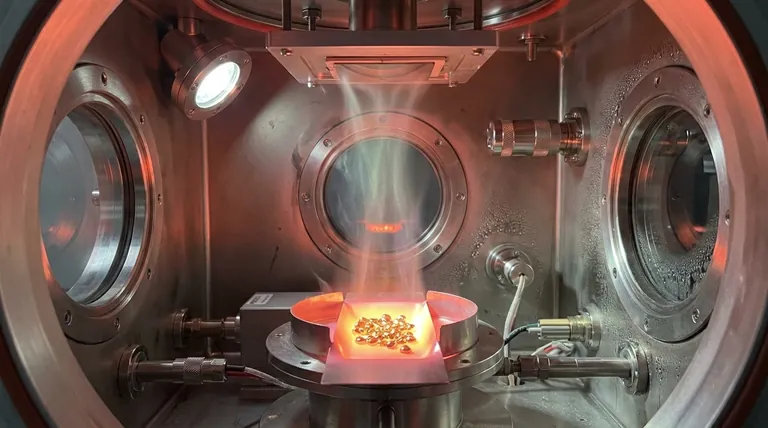
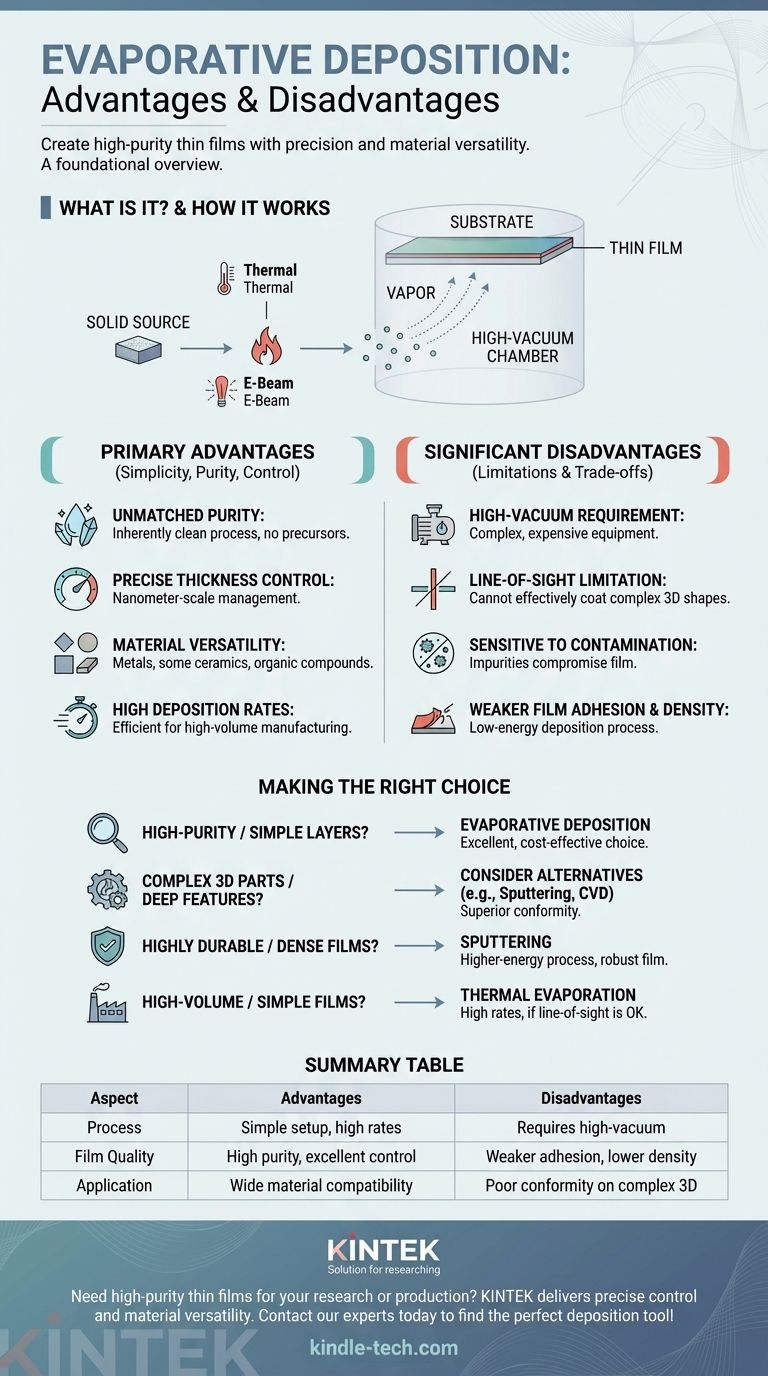
The source material is heated in a high-vacuum chamber until it evaporates, turning from a solid into a gas. These vaporized atoms travel in a straight line through the vacuum until they strike the cooler substrate, where they condense back into a solid, forming a thin, uniform film.

Key Techniques: Thermal vs. E-Beam

Two common methods are used to heat the source material.

  • Thermal Evaporation: A current is passed through a resistive "boat" or filament holding the source material, heating it until it evaporates. This is simple and cost-effective.
  • Electron Beam (E-Beam) Evaporation: A high-energy beam of electrons is fired at the source material, causing localized heating and evaporation. This allows for higher temperatures and the deposition of a wider range of materials.

The Critical Role of High Vacuum

The entire process must occur in a high-vacuum environment. This is non-negotiable for two reasons: it prevents vaporized atoms from colliding with air molecules, and it minimizes contamination from atmospheric gases, ensuring the purity of the final film.

The Primary Advantages of Evaporative Deposition

Engineers and researchers choose this method for its unique combination of simplicity, purity, and control.

Unmatched Purity and Simplicity

Because the process simply involves heating a source material in a vacuum, it is inherently clean. Unlike chemical processes, there are no precursor gases or byproducts that can become trapped in the film, resulting in exceptionally high-purity layers.

Precise Control Over Thickness

By carefully monitoring and controlling the temperature of the source, you can precisely manage its evaporation rate. This, combined with the deposition time, gives you fine-grained control over the final film thickness, often down to the nanometer scale.

Versatility Across Materials

Evaporative deposition is compatible with a vast array of materials, including most metals, some ceramics, and various organic compounds. If a material can be vaporized by heat without decomposing, it can likely be deposited.

High Deposition Rates

Compared to more complex methods like sputtering or atomic layer deposition, thermal evaporation can achieve very high deposition rates. This makes it efficient and suitable for high-volume manufacturing where speed is a factor.

Understanding the Trade-offs and Disadvantages

Despite its benefits, evaporative deposition has significant limitations that make it unsuitable for certain applications.

The High-Vacuum Requirement

Achieving and maintaining a high vacuum requires expensive and complex equipment, including vacuum chambers, pumps, and gauges. This adds to the initial cost and operational complexity of the system.

The "Line-of-Sight" Limitation

Vaporized atoms travel in straight lines from the source to the substrate. This means the process can only coat surfaces that are in the direct line of sight of the source. It cannot effectively coat complex 3D objects, undercuts, or the inside of deep trenches.

Sensitivity to Contamination

While the vacuum provides a clean environment, the process is extremely sensitive to any impurities. A small leak in the vacuum chamber or an impure source material can easily contaminate the entire film, compromising its performance.

Weaker Film Adhesion and Density

The atoms in evaporative deposition arrive at the substrate with relatively low energy. This can result in films that are less dense and have weaker adhesion compared to those produced by sputtering, where atoms are bombarded onto the surface with high kinetic energy.

Making the Right Choice for Your Application

Selecting the right deposition method requires aligning the process capabilities with your primary goal.

  • If your primary focus is high-purity optical coatings or simple metallic layers: Evaporative deposition is an excellent, cost-effective choice due to its simplicity and the clean films it produces.
  • If your primary focus is coating complex 3D parts or deep features: You must consider alternatives like sputtering or chemical vapor deposition (CVD), which offer superior conformity and step coverage.
  • If your primary focus is creating highly durable, dense, or wear-resistant films: Sputtering is often a better choice because the higher-energy deposition process creates a more robust film structure.
  • If your primary focus is high-volume production of simple films: The high deposition rates of thermal evaporation make it a very strong candidate, provided its line-of-sight limitation is not an issue.

Understanding these fundamental trade-offs empowers you to select the most effective tool for your specific engineering challenge.

Summary Table:

Aspect Advantages Disadvantages
Process Simple setup, high deposition rates Requires expensive high-vacuum equipment
Film Quality High purity, excellent thickness control Weaker adhesion and lower film density
Application Wide material compatibility Poor conformity on complex 3D shapes

Need to deposit high-purity thin films for your research or production? KINTEK specializes in lab equipment and consumables, including advanced evaporative deposition systems. Our solutions deliver the precise control and material versatility your laboratory requires. Contact our experts today to find the perfect deposition tool for your specific application!

Visual Guide
What are the advantages and disadvantages of evaporative deposition? Achieve High-Purity Thin Films Visual Guide

Related Products

People Also Ask

Related Products

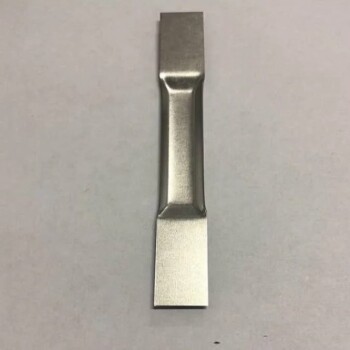
Molybdenum Tungsten Tantalum Evaporation Boat for High Temperature Applications

Molybdenum Tungsten Tantalum Evaporation Boat for High Temperature Applications

Evaporation boat sources are used in thermal evaporation systems and are suitable for depositing various metals, alloys and materials. Evaporation boat sources are available in different thicknesses of tungsten, tantalum and molybdenum to ensure compatibility with a variety of power sources. As a container, it is used for vacuum evaporation of materials. They can be used for thin film deposition of various materials, or designed to be compatible with techniques such as electron beam fabrication.

Inclined Rotary Plasma Enhanced Chemical Vapor Deposition PECVD Equipment Tube Furnace Machine

Inclined Rotary Plasma Enhanced Chemical Vapor Deposition PECVD Equipment Tube Furnace Machine

Upgrade your coating process with PECVD coating equipment. Ideal for LED, power semiconductors, MEMS and more. Deposits high-quality solid films at low temps.

HFCVD Machine System Equipment for Drawing Die Nano-Diamond Coating

HFCVD Machine System Equipment for Drawing Die Nano-Diamond Coating

The nano-diamond composite coating drawing die uses cemented carbide (WC-Co) as the substrate, and uses the chemical vapor phase method ( CVD method for short ) to coat the conventional diamond and nano-diamond composite coating on the surface of the inner hole of the mold.

Aluminized Ceramic Evaporation Boat for Thin Film Deposition

Aluminized Ceramic Evaporation Boat for Thin Film Deposition

Vessel for depositing thin films; has an aluminum-coated ceramic body for improved thermal efficiency and chemical resistance. making it suitable for various applications.

Vacuum Hot Press Furnace Machine for Lamination and Heating

Vacuum Hot Press Furnace Machine for Lamination and Heating

Experience clean and precise lamination with Vacuum Lamination Press. Perfect for wafer bonding, thin-film transformations, and LCP lamination. Order now!

915MHz MPCVD Diamond Machine Microwave Plasma Chemical Vapor Deposition System Reactor

915MHz MPCVD Diamond Machine Microwave Plasma Chemical Vapor Deposition System Reactor

915MHz MPCVD Diamond Machine and its multi-crystal effective growth, the maximum area can reach 8 inches, the maximum effective growth area of single crystal can reach 5 inches. This equipment is mainly used for the production of large-size polycrystalline diamond films, the growth of long single crystal diamonds, the low-temperature growth of high-quality graphene, and other materials that require energy provided by microwave plasma for growth.

Laboratory Sterilizer Lab Autoclave Pulse Vacuum Lifting Sterilizer

Laboratory Sterilizer Lab Autoclave Pulse Vacuum Lifting Sterilizer

The pulse vacuum lifting sterilizer is a state-of-the-art equipment for efficient and precise sterilization. It uses pulsating vacuum technology, customizable cycles, and a user-friendly design for easy operation and safety.

Laboratory Sterilizer Lab Autoclave Vertical Pressure Steam Sterilizer for Liquid Crystal Display Automatic Type

Laboratory Sterilizer Lab Autoclave Vertical Pressure Steam Sterilizer for Liquid Crystal Display Automatic Type

Liquid crystal display automatic vertical sterilizer is a safe, reliable and automatic control sterilization equipment, which is composed of heating system, microcomputer control system and overheating and overvoltage protection system.

Anti-Cracking Press Mold for Lab Use

Anti-Cracking Press Mold for Lab Use

The anti-cracking press mold is a specialized equipment designed for molding various shapes and sizes of film using high pressure and electric heating.

Benchtop Laboratory Vacuum Freeze Dryer

Benchtop Laboratory Vacuum Freeze Dryer

Benchtop laboratory freeze dryer for efficient lyophilization of biological, pharmaceutical, and food samples. Features intuitive touchscreen, high-performance refrigeration, and durable design. Preserve sample integrity—consult now!

Laboratory CVD Boron Doped Diamond Materials

Laboratory CVD Boron Doped Diamond Materials

CVD boron-doped diamond: A versatile material enabling tailored electrical conductivity, optical transparency, and exceptional thermal properties for applications in electronics, optics, sensing, and quantum technologies.

Laboratory Test Sieves and Sieving Machines

Laboratory Test Sieves and Sieving Machines

Precision lab test sieves & sieving machines for accurate particle analysis. Stainless steel, ISO-compliant, 20μm-125mm range. Request specs now!

Graphite Vacuum Furnace High Thermal Conductivity Film Graphitization Furnace

Graphite Vacuum Furnace High Thermal Conductivity Film Graphitization Furnace

The high thermal conductivity film graphitization furnace has uniform temperature, low energy consumption and can operate continuously.

Laboratory Vacuum Tilt Rotary Tube Furnace Rotating Tube Furnace

Laboratory Vacuum Tilt Rotary Tube Furnace Rotating Tube Furnace

Discover the versatility of Laboratory Rotary Furnace: Ideal for calcination, drying, sintering, and high-temperature reactions. Adjustable rotating and tilting functions for optimal heating. Suitable for vacuum and controlled atmosphere environments. Learn more now!

Benchtop Laboratory Freeze Dryer for Lab Use

Benchtop Laboratory Freeze Dryer for Lab Use

Premium benchtop laboratory freeze dryer for lyophilization, preserving samples with ≤ -60°C cooling. Ideal for pharmaceuticals & research.

Vacuum Dental Porcelain Sintering Furnace

Vacuum Dental Porcelain Sintering Furnace

Get precise and reliable results with KinTek's Vacuum Porcelain Furnace. Suitable for all porcelain powders, it features hyperbolic ceramic furnace function, voice prompt, and automatic temperature calibration.

Vacuum Heat Treat and Molybdenum Wire Sintering Furnace for Vacuum Sintering

Vacuum Heat Treat and Molybdenum Wire Sintering Furnace for Vacuum Sintering

A vacuum molybdenum wire sintering furnace is a vertical or bedroom structure, which is suitable for withdrawal, brazing, sintering and degassing of metal materials under high vacuum and high temperature conditions. It is also suitable for dehydroxylation treatment of quartz materials.

Small Vacuum Heat Treat and Tungsten Wire Sintering Furnace

Small Vacuum Heat Treat and Tungsten Wire Sintering Furnace

The small vacuum tungsten wire sintering furnace is a compact experimental vacuum furnace specially designed for universities and scientific research institutes. The furnace features a CNC welded shell and vacuum piping to ensure leak-free operation. Quick-connect electrical connections facilitate relocation and debugging, and the standard electrical control cabinet is safe and convenient to operate.

Molybdenum Vacuum Heat Treat Furnace

Molybdenum Vacuum Heat Treat Furnace

Discover the benefits of a high-configuration molybdenum vacuum furnace with heat shield insulation. Ideal for high-purity, vacuum environments like sapphire crystal growth and heat treatment.

Graphite Vacuum Continuous Graphitization Furnace

Graphite Vacuum Continuous Graphitization Furnace

High-temperature graphitization furnace is a professional equipment for graphitization treatment of carbon materials. It is a key equipment for the production of high-quality graphite products. It has high temperature, high efficiency and uniform heating. It is suitable for various high-temperature treatments and graphitization treatments. It is widely used in metallurgy, electronics, aerospace, etc. industry.


Leave Your Message