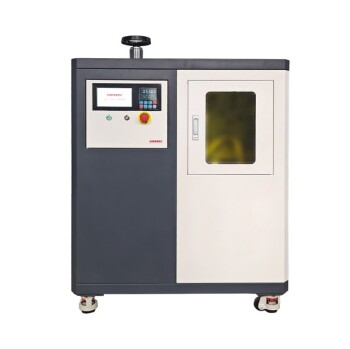
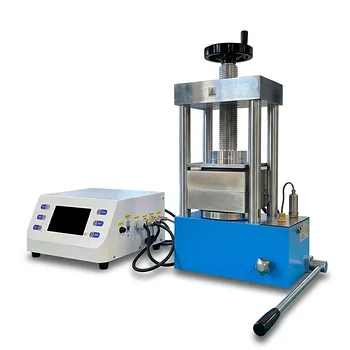
The primary advantage of a Cold Isostatic Press (CIP) over a traditional pneumatic flat-plate hot press is its ability to decouple high pressure from mechanical stress. While flat-plate systems are typically restricted to low pressures (under 1 MPa) to prevent cracking, a CIP utilizes hydrostatic force to safely apply several hundred MPa. This allows for superior densification and interface contact in large-area (e.g., 5.5 cm²) and flexible perovskite devices without the risk of structural damage.
Core Takeaway Traditional flat-plate pressing creates stress concentrations that limit the pressure you can safely apply, often resulting in poor interface contact. Cold Isostatic Pressing leverages Pascal's principle to deliver uniform, omnidirectional pressure, enabling the high-force processing required for maximum performance in scalable and flexible solar cells.
The Physics of Uniformity
overcoming Stress Concentrations
Traditional pneumatic flat-plate presses apply uniaxial pressure. If there are even microscopic irregularities in the plate or the solar cell stack, force concentrates on those high points.
This creates "hot spots" of stress. In fragile materials like perovskites, this mechanical limitation forces operators to keep pressure extremely low (often < 1 MPa) to avoid cracking the device.
Leveraging Pascal’s Principle
A Cold Isostatic Press eliminates rigid contact points by using a fluid medium to transmit force. According to Pascal’s principle, pressure applied to a confined fluid is transmitted undiminished in all directions.
This ensures that every distinct point on the solar cell surface experiences the exact same pressure vector. The force is isostatic (equal from all sides), meaning the material is compressed without being distorted or sheared.
Scaling to Large and Flexible Form Factors
Achieving Critical Interface Contact
To maximize the efficiency of a perovskite solar cell, the internal layers must have intimate physical contact. Poor interface contact leads to significant performance loss.
Because CIP distributes force evenly, it allows you to apply several hundred MPa of pressure. This massive increase in pressure forces the layers into tight contact, optimizing electron transport paths that are otherwise impossible to achieve with low-pressure flat plates.
Processing Large-Area Devices
As you scale up from small lab cells to larger areas (such as 5.5 cm²), the risk of non-uniformity in a flat-plate press increases exponentially.
CIP decouples size from risk. Because the pressure is hydrostatic, a larger surface area does not increase the likelihood of cracking. This allows for the production of high-integrity billets or devices with virtually no distortion.
Enabling Roll-to-Roll (R2R) Manufacturing
Flexible devices present a unique challenge for rigid flat plates, which can pinch or deform the substrate.
CIP is inherently suited for flexible and Roll-to-Roll (R2R) devices. The fluid pressure creates a supportive mold around the flexible substrate, allowing for high-pressure densification without damaging the delicate mechanical structure of the flex device.
Pitfalls of the Traditional Approach
The Limit of Low Pressure
When using a pneumatic flat-plate press, you are forced to operate within a very narrow window. You need pressure to ensure contact, but the rigid tooling limits you to effectively less than 1 MPa.
Inevitable Performance Compromises
Operating at such low pressures invariably leads to suboptimal interface contact. While the device may survive the pressing process intact, the electrical performance is compromised because the layers are not sufficiently densified.
Risk of "Invisible" Damage
Even if a flat-plate pressed device does not shatter, it often suffers from microscopic stress fractures or uneven thickness. These imperfections can lead to inconsistent performance data and reduced long-term stability.
Making the Right Choice for Your Goal
To select the correct processing method, you must evaluate your specific manufacturing targets:
- If your primary focus is Large-Area Scaling: You should use CIP to safely apply high pressure across surfaces larger than 1 cm² without inducing stress fractures.
- If your primary focus is Flexible/R2R Electronics: You must use CIP to ensure uniform densification on non-rigid substrates where flat plates would cause deformation.
- If your primary focus is Maximum Efficiency: You need the high-pressure capability (hundreds of MPa) of CIP to eliminate poor interface contact and minimize internal resistance.
Switching to Cold Isostatic Pressing removes the mechanical ceiling on your process, allowing you to prioritize device performance over structural survival.
Summary Table:
| Feature | Traditional Flat-Plate Press | Cold Isostatic Press (CIP) |
|---|---|---|
| Pressure Limit | Low (< 1 MPa) to prevent cracking | High (Several hundred MPa) |
| Force Distribution | Uniaxial / Uneven (Stress points) | Isostatic / Uniform (Omnidirectional) |
| Scalability | High risk of fracture on large areas | Safe scaling for 5.5 cm² and above |
| Flexibility | Risk of substrate deformation | Ideal for flexible/R2R substrates |
| Interface Contact | Suboptimal due to low pressure | Superior densification and contact |
Elevate your solar research with KINTEK’s advanced processing solutions. Whether you are scaling large-area devices or pioneering flexible perovskite electronics, our specialized Cold Isostatic Presses (CIP) and isostatic systems provide the uniform high pressure needed to maximize interface contact without risk of damage. Beyond CIP, KINTEK offers a full suite of laboratory equipment, including high-temperature furnaces, hydraulic presses, and battery research tools tailored for precision manufacturing. Optimize your device efficiency—contact KINTEK today for a consultation!
Related Products
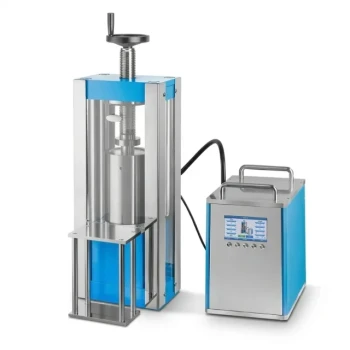
- Electric Split Lab Cold Isostatic Press CIP Machine for Cold Isostatic Pressing
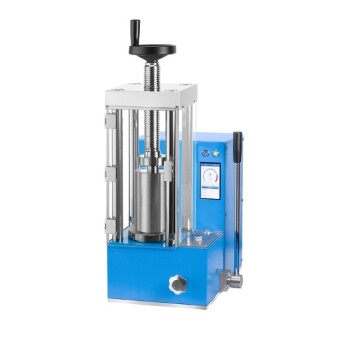
- Electric Lab Cold Isostatic Press CIP Machine for Cold Isostatic Pressing
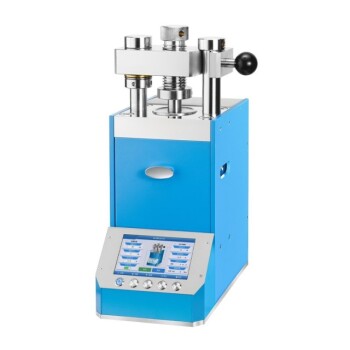
- Automatic Lab Cold Isostatic Press CIP Machine Cold Isostatic Pressing
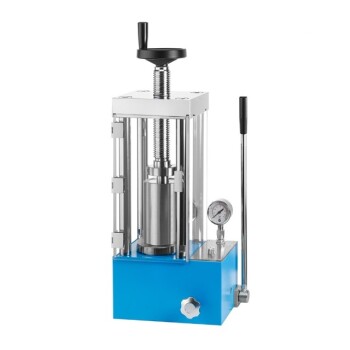
- Manual Cold Isostatic Pressing Machine CIP Pellet Press
- Warm Isostatic Press for Solid State Battery Research
People Also Ask
- How is isostatic pressing equipment utilized to integrate lithium metal anodes during solid-state battery assembly?
- How does isostatic pressing equipment enhance lithium metal anode contact? Optimize Your Solid-State Battery Assembly
- What is the meaning of isostatic pressing? Achieve Uniform Density in Complex Parts
- What is isostatic pressing method for ceramics? Achieve Uniform Density for Complex Parts
- What role does cold isostatic pressing play in the formation of feed rods for single crystal growth? Ensure Stability.