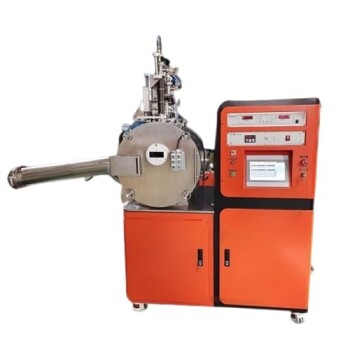
The independent internal charging tank functions as a specialized, protective cartridge system. It fundamentally streamlines the magnesium processing workflow by simplifying material handling, while simultaneously acting as a critical shield to protect the furnace’s sensitive heating elements from damage.
The core advantage of this design is the decoupling of the raw material from the furnace infrastructure; this isolation extends equipment lifespan by preventing electrical shorts and corrosion while drastically reducing turnaround time between cycles.
Streamlining Material Handling
Simplified Loading and Unloading
The independent tank transforms the loading process into a modular operation.
Rather than loading raw material directly into a fixed furnace pot, operators utilize this removable vessel.
This facilitates the easy loading of magnesium waste and the rapid removal of distillation residues once the process is complete.
Reducing Furnace Downtime
Because the tank is independent, the furnace structure itself remains cleaner.
This minimizes the need for extensive cleaning of the furnace interior between batches.
It allows for a faster reset of the system, increasing overall throughput.
Maximizing Equipment Longevity
Creating a Protective Barrier
The internal tank provides a physical wall between the raw magnesium materials and the furnace's internal components.
This isolation is vital for preserving the integrity of the heating elements.
Without this barrier, the heating system would be exposed to direct contact with the charge, leading to rapid degradation.
Preventing Electrical Failures
One of the most critical safety features of the independent tank is the prevention of short circuits.
By containing the conductive magnesium waste, the tank ensures that material does not accidentally bridge or touch the electrical heating elements.
This eliminates a common cause of catastrophic equipment failure and heating system burnout.
Mitigating Corrosion
Magnesium processing can create a harsh environment for furnace internals.
The tank acts as a sacrificial liner or shield.
It prevents corrosive interactions between the raw materials and the heating elements, significantly extending the service life of the expensive heater components.
Controlling the Distillation Process
Regulating Vapor Flow
The design of the tank is not merely for containment; it plays an active role in the distillation physics.
The tank features specifically designed small holes.
These perforations control the escape path of the magnesium vapor as it sublimates.
Ensuring Directional Movement
By restricting the exit points, the tank directs the vapor flow.
This ensures the magnesium travels efficiently toward the condensation zone rather than scattering unpredictably within the hot zone.
Operational Considerations
Managing Vapor Pathways
While the independent tank offers significant protection, the vapor holes must be managed correctly.
Blocking these perforations can stifle the process.
Operators must ensure that the loading configuration does not obstruct these small holes, as this would impede the escape path of the magnesium vapor and reduce distillation efficiency.
Making the Right Choice for Your Goal
To maximize the benefits of a vertical vacuum distillation furnace, align your operational procedures with the tank's design intent.
- If your primary focus is Operational Efficiency: Leverage the modular nature of the tank to pre-load materials outside the furnace, minimizing the time the unit is idle.
- If your primary focus is Asset Protection: Prioritize the regular inspection of the tank's physical integrity to ensure it continues to provide a complete barrier against corrosion and electrical shorts.
By utilizing the independent charging tank effectively, you convert a complex maintenance challenge into a reliable, repeatable production cycle.
Summary Table:
| Feature | Key Benefit | Impact on Magnesium Processing |
|---|---|---|
| Modular Design | Simplified loading/unloading | Drastically reduces turnaround time between batches |
| Physical Isolation | Protective barrier for heaters | Prevents electrical shorts and corrosive degradation |
| Vapor Control | Perforated tank design | Ensures efficient, directional vapor flow to the condensation zone |
| Residue Management | Removable containment | Simplifies cleaning and prevents furnace infrastructure damage |
Optimize Your Metal Processing with KINTEK Expertise
Maximize your laboratory's efficiency and protect your capital investment with KINTEK’s advanced high-temperature furnaces. Whether you are refining magnesium via vacuum distillation or performing complex CVD/PECVD processes, our equipment is engineered for durability and precision.
From high-temperature vacuum furnaces and crushing and milling systems to specialized PTFE and ceramic consumables, KINTEK provides the comprehensive tools needed for demanding research and production environments.
Ready to upgrade your furnace performance? Contact our technical experts today to find the perfect solution for your high-temperature and high-pressure processing needs.
Related Products
- Vertical High Temperature Graphite Vacuum Graphitization Furnace
- Large Vertical Graphite Vacuum Graphitization Furnace
- Graphite Vacuum Furnace Bottom Discharge Graphitization Furnace for Carbon Materials
- Vacuum Heat Treat and Molybdenum Wire Sintering Furnace for Vacuum Sintering
- Horizontal High Temperature Graphite Vacuum Graphitization Furnace
People Also Ask
- How does a vertical furnace work? Achieve Superior Uniformity in Semiconductor Manufacturing
- What is a vertical furnace? Achieve Superior Temperature Uniformity for Sensitive Processes
- What are the advantages of a vertical furnace versus a horizontal furnace? Maximize Lab Efficiency & Space
- How does a vertical furnace achieve energy-saving sintering? Harness Internal Energy for Efficient Pellet Treatment
- What is the use of graphite furnace? Achieve Extreme-Temperature Processing for Advanced Materials