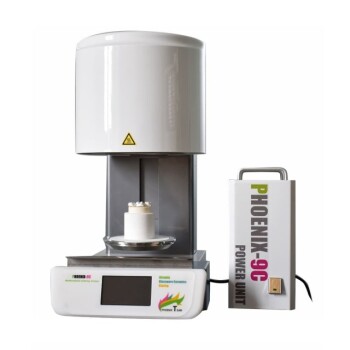
The sintering process primarily offers the benefit of producing highly repeatable, accurate parts with complex geometries that are difficult or impossible to machine. It is a manufacturing method that enables cost-effective mass production by minimizing the need for finishing processes while maintaining exceptional material integrity.
Sintering fundamentally changes manufacturing economics by allowing for the creation of near-net-shape components from high-melting-point materials without the structural weaknesses or waste associated with traditional melting and machining.
Achieving Precision and Geometry
Unmatched Repeatability
Sintering excels in creating parts that are highly repeatable and accurate. By controlling the grain size of the input material, manufacturers can ensure that every unit produced meets strict specifications with minimal variation.
Complex Geometries
One of the most significant advantages is the ability to form non-machinable geometries. Shapes that are too intricate for standard machining tools can be easily achieved through sintering, offering greater design freedom.
Near-Net-Shape Production
The process produces "near-net-shaped" objects. This means the part emerges from the furnace very close to its final dimensions, significantly reducing the need for subsequent machining or material removal.
Material Properties and Integrity
Purity and Cleanliness
Sintering maintains high levels of purity in the starting materials. Unlike melting processes, it avoids binding contact or inclusions (stringering) between particles, ensuring a uniform internal structure.
Handling High-Melting-Point Metals
This method is essential for working with materials that have very high melting points, such as tungsten or molybdenum. These metals are often impossible to process using standard casting technologies.
Controlled Porosity
Manufacturers can engineer specific material characteristics by controlling the porosity. This allows for the creation of components that are permeable or have specific density requirements, which is difficult to achieve with casting.
Economic and Cosmetic Advantages
Cost Amortization
While setting up a sintering line requires investment, the cost is easily amortized over large production runs. This makes it an economically superior choice for high-volume manufacturing.
Superior Cosmetic Finishes
Parts produced via sintering often achieve great cosmetic results directly out of the furnace. This eliminates the labor and expense associated with polishing or secondary finishing processes.
Advanced Sintering Techniques
Vacuum Sintering for Purity
Vacuum sintering prevents contamination from atmospheric gases like oxygen and nitrogen. This technique removes oxide films, enhances wettability, and leads to higher material density and wear resistance.
Efficiency of Hot Pressing
Hot pressing provides uniform temperature distribution and significantly reduces energy consumption. It allows for the preparation of large-diameter materials with lower pressure requirements than isostatic pressing.
Understanding the Trade-offs
Volume Dependence
The primary reference highlights that cost is amortized over large production runs. This implies that for small-batch or prototype manufacturing, the initial setup costs of sintering may be prohibitive compared to simple machining.
Equipment Investment
While techniques like hot pressing reduce investment compared to other methods, sintering still requires specialized furnaces and atmosphere control systems. It is generally a capital-intensive process suited for established production lines rather than ad-hoc fabrication.
Making the Right Choice for Your Goal
- If your primary focus is Mass Production: Sintering is ideal because the setup costs are amortized over high volumes, ensuring repeatable, accurate parts with minimal waste.
- If your primary focus is Material Purity: Utilize vacuum sintering to eliminate atmospheric contamination and prevent oxidation, ensuring the highest possible material density and strength.
- If your primary focus is Complex Design: Choose sintering to achieve non-machinable geometries and near-net shapes that would be impossible or too costly to create via traditional machining.
Sintering transforms the limitations of difficult materials into manufacturing advantages, offering a pathway to produce complex, high-performance components at scale.
Summary Table:
| Benefit Category | Key Advantage | Impact on Manufacturing |
|---|---|---|
| Geometry | Near-Net-Shape | Minimizes secondary machining and material waste. |
| Material Integrity | High Purity & Density | Prevents inclusions; ideal for high-melting-point metals. |
| Design Freedom | Complex Geometries | Enables production of non-machinable, intricate shapes. |
| Performance | Controlled Porosity | Allows for engineered permeability and specific densities. |
| Economic | High Repeatability | Reduces unit costs over large-scale production runs. |
| Specialized | Vacuum/Hot Pressing | Removes oxide films and reduces energy consumption. |
Elevate Your Material Production with KINTEK
Ready to harness the power of precision sintering for your laboratory or production line? KINTEK specializes in advanced thermal processing solutions designed to deliver unmatched repeatability and material purity.
Whether you require high-temperature muffle, vacuum, or tube furnaces for near-net-shape production, or hydraulic presses for high-density components, we provide the cutting-edge tools needed to transform complex designs into reality. From specialized crushing and milling systems to essential crucibles and ceramics, our comprehensive portfolio supports every stage of your material research and manufacturing workflow.
Optimize your process efficiency and achieve superior cosmetic finishes today.
Related Products
- Vacuum Heat Treat and Sintering Furnace with 9MPa Air Pressure
- Spark Plasma Sintering Furnace SPS Furnace
- Vacuum Heat Treat and Molybdenum Wire Sintering Furnace for Vacuum Sintering
- Small Vacuum Heat Treat and Tungsten Wire Sintering Furnace
- Vacuum Heat Treat and Pressure Sintering Furnace for High Temperature Applications
People Also Ask
- What is the process of pressure sintering? Achieve Superior Density and Strength for High-Performance Parts
- What is the effect of pressure during sintering? Achieve Higher Density and Finer Microstructures Faster
- Why must green bodies produced via binder jetting undergo treatment in a vacuum sintering furnace?
- What is a vacuum sintering furnace? Unlock Purity and Performance in Advanced Materials
- How does the vacuum environment impact sintering of diamond-copper composites? Protect Against Thermal Damage