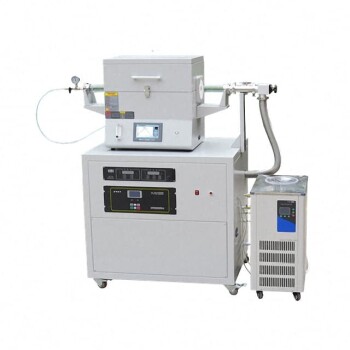
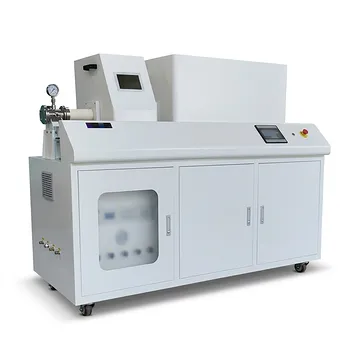
Hot-wall Chemical Vapor Deposition (CVD) systems are characterized by a furnace design where the entire growth zone is heated directly. Unlike systems that heat only the substrate, this architecture maintains the reactor walls and the deposition environment at the same elevated temperature. It is a commercially dominant method favored for its maturity and operational efficiency.
Hot-wall CVD utilizes a global heating approach where the furnace heats the entire reaction chamber. This results in a stable, uniform thermal environment that lowers preparation costs and ensures high reliability in material growth.
The Core Thermal Architecture
Global Zone Heating
The defining characteristic of a hot-wall system is that the entire growth zone is heated. The furnace surrounds the reaction chamber, applying thermal energy to the walls as well as the substrate.
Uniform Thermal Environment
Because the heat source is external and envelops the chamber, the system creates a highly uniform temperature profile. This eliminates cold spots on the reactor walls that can occur in other deposition methods.
Simplified Heating Mechanics
In this configuration, the heating system acts as a global energy source. This contrasts with complex localized heating methods, making the thermal management system robust and straightforward.
Commercial and Operational Advantages
Process Maturity
Hot-wall CVD is considered a relatively mature process. The technology has been refined over time, meaning the engineering principles governing the gas flow and reaction kinetics are well-understood.
Cost Efficiency
One of the primary drivers for adoption is economic. These systems typically offer lower preparation costs. The simplified design reduces the complexity of the setup compared to more experimental or highly localized deposition techniques.
High Reliability
The stability of the thermal environment translates directly to product quality. These systems are noted for good reliability in material growth, ensuring consistent results across production batches.
System Components and Integration
Essential Subsystems
While the heating method is unique, a hot-wall system integrates standard CVD components. This includes a reaction chamber for the deposition and a gas delivery system to introduce precursors.
Vacuum and Exhaust
To control the reaction environment, the system employs a vacuum system to maintain specific pressure levels. An exhaust system is utilized to safely remove byproducts and unreacted gases from the heated zone.
Critical Control Systems
A central controller manages the interaction between the energy source and gas flow. In a hot-wall setup, the thermal management system is particularly vital to ensure the furnace maintains precise temperatures across the large heated zone.
Understanding the Design Implications
Thermal Management Requirements
While the system is reliable, heating the entire growth zone places a heavy emphasis on the thermal management system. The controller must ensure that the large thermal mass of the furnace responds correctly to process changes.
Precursor Delivery Context
It is important to note that while the walls are hot, the method of delivering chemicals can vary. The system may still utilize standard gas delivery, or specialized methods like liquid injection, provided the core "hot-wall" thermal characteristic remains.
Making the Right Choice for Your Goal
When evaluating CVD architectures, the choice often comes down to a balance between cost, maturity, and specific process needs.
- If your primary focus is Cost Efficiency: Choose hot-wall CVD to leverage lower preparation costs and reduced system complexity.
- If your primary focus is Process Stability: Select this system for its mature status and proven reliability in consistent material growth.
Hot-wall CVD remains a cornerstone of industrial material synthesis, offering a pragmatic balance of economic value and engineering reliability.
Summary Table:
| Characteristic | Description |
|---|---|
| Heating Method | Global heating; the furnace heats the entire reaction chamber and walls. |
| Thermal Profile | Highly uniform temperature distribution; eliminates cold spots. |
| Process Status | Mature technology with well-understood gas flow and reaction kinetics. |
| Cost Profile | Lower preparation and operational costs due to simplified mechanics. |
| Reliability | High consistency in material growth across production batches. |
| Key Components | Reaction chamber, gas delivery, vacuum, and robust thermal management. |
Elevate Your Material Research with KINTEK's Advanced CVD Solutions
Are you looking to optimize your thin-film deposition process? KINTEK specializes in high-performance laboratory equipment, offering a comprehensive range of CVD, PECVD, and MPCVD systems alongside precision high-temperature furnaces and vacuum systems tailored for research and industrial applications.
Our expertise extends across specialized high-temperature high-pressure reactors, crushing and milling systems, and essential laboratory consumables like ceramics and crucibles. By choosing KINTEK, you gain a partner dedicated to providing the reliability, uniform thermal control, and cost-efficiency your projects demand.
Ready to scale your production? Contact us today to find the perfect CVD system for your lab!
Related Products
- HFCVD Machine System Equipment for Drawing Die Nano-Diamond Coating
- Chemical Vapor Deposition CVD Equipment System Chamber Slide PECVD Tube Furnace with Liquid Gasifier PECVD Machine
- Multi Heating Zones CVD Tube Furnace Machine Chemical Vapor Deposition Chamber System Equipment
- Customer Made Versatile CVD Tube Furnace Chemical Vapor Deposition Chamber System Equipment
- Split Chamber CVD Tube Furnace with Vacuum Station Chemical Vapor Deposition System Equipment Machine
People Also Ask
- What is the full form of HFCVD? A Guide to Hot Filament Chemical Vapor Deposition
- What are the disadvantages and challenges of the HFCVD method? Overcome Growth Limits and Filament Issues
- What is the function of tungsten filaments in HFCVD? Powering Diamond Film Synthesis with Thermal Excitation
- Why is Chemical Vapor Deposition (CVD) equipment uniquely suited for constructing hierarchical superhydrophobic structures?
- What is the chemical vapor deposition growth process? Build Superior Thin Films from the Atom Up