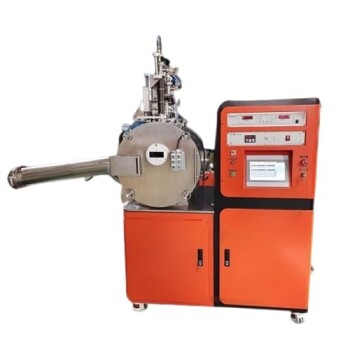
The decisive advantage of a Spark Plasma Sintering (SPS) system lies in its internal heating mechanism. Unlike traditional hot pressing, which relies on external elements to radiate heat slowly, SPS utilizes low-voltage, high-current density pulsed direct current to generate heat directly within the mold or sample. This fundamental difference enables rapid heating rates that dramatically alter the microstructure and performance of nickel-based alloys.
Core Takeaway SPS technology solves the conflict between densification and grain growth. By achieving full density through rapid internal heating and short holding times, you retain fine-grained microstructures and achieve superior mechanical properties that are often lost during the prolonged heating cycles of traditional hot pressing.
The Fundamental Shift in Heating Mechanics
Internal vs. External Heating
Traditional hot pressing relies on radiant heating from external elements. This process is inherently slow, as heat must penetrate from the outside of the furnace to the core of the sample.
In contrast, SPS employs an internal heating mechanism. The system passes pulsed direct current through the conductive die or the sample itself, generating heat instantaneously where it is needed most.
Drastically Reduced Cycle Times
Because the heat is generated internally, SPS achieves extremely high heating rates.
This efficiency leads to significantly shorter sintering cycles. You can reach the required sintering temperatures—often between 1300 and 1500°C for biomedical alloys—much faster than with conventional methods.
Microstructural Control and Material Performance
Inhibiting Grain Growth
The most critical outcome of rapid heating is the preservation of the material's microstructure. Prolonged exposure to high temperatures in traditional pressing allows grains to merge and grow, weakening the material.
The short holding times of SPS effectively inhibit grain growth in nickel-based alloys. This allows you to produce fine-grained or even nanocrystalline materials that maintain their original powder characteristics.
Superior Mechanical Properties
The preservation of a fine microstructure directly translates to enhanced performance. SPS-processed nickel alloys exhibit high hardness and high toughness, properties that are difficult to balance in conventional processing.
For specific biomedical applications, this process can result in strength exceeding 900 MPa while maintaining a low elastic modulus.
Chemical Uniformity
Rapid densification prevents the segregation of alloying elements.
SPS ensures the chemical uniformity of refractory elements, such as Niobium (Nb). This prevents the abnormal grain growth of specific phases (such as the beta phase), ensuring a consistent and reliable material structure.
Understanding the Operational Trade-offs
Geometric Limitations of Axial Pressure
While efficient, the SPS process described relies on axial pressure to achieve densification.
This creates a limitation regarding part geometry. Unlike Isostatic pressing, which applies pressure from all sides, axial pressure is best suited for simple shapes. Complex, net-shape components may require additional machining after sintering.
The Necessity of Precision
The very advantage of SPS—its speed—requires precise control.
Because the system operates with high heating rates and high current densities, the window for error is small. Parameters must be strictly monitored to prevent overheating or localized melting, given the intensity of the pulsed current.
Making the Right Choice for Your Goal
To maximize the value of an SPS system, align its capabilities with your specific material objectives.
- If your primary focus is Maximum Strength: Leverage the rapid heating rates to produce nanocrystalline structures, which provide superior hardness and toughness compared to coarse-grained counterparts.
- If your primary focus is Alloy Homogeneity: Use the short holding times to prevent segregation in complex mixes containing refractory elements like Niobium, ensuring chemical uniformity throughout the part.
By shifting from external radiant heating to direct pulsed current, you move from simply sintering a part to actively engineering its microstructure.
Summary Table:
| Feature | Traditional Hot Pressing | Spark Plasma Sintering (SPS) |
|---|---|---|
| Heating Mechanism | External (Radiant) | Internal (Pulsed DC Current) |
| Heating Rate | Slow and gradual | Extremely rapid |
| Sintering Cycle | Long holding times | Short, efficient cycles |
| Microstructure | Coarse grain growth | Fine-grained / Nanocrystalline |
| Performance | Standard hardness/toughness | High hardness and high toughness |
| Chemical Uniformity | Potential segregation | High (prevents alloy segregation) |
Elevate Your Material Research with KINTEK Precision
Unlock the full potential of your powder metallurgy projects with KINTEK’s advanced Spark Plasma Sintering (SPS) systems. Our technology empowers researchers and manufacturers to engineer superior nickel-based alloys by mastering microstructural control.
Beyond SPS, KINTEK offers a comprehensive portfolio of laboratory solutions designed for high-performance environments:
- High-Temperature Furnaces: Muffle, tube, vacuum, and CVD systems.
- Material Processing: Crushing, milling, and sieving equipment.
- Pressing Solutions: Hydraulic, pellet, and isostatic presses.
- Specialized Reactors: High-temperature high-pressure reactors and autoclaves.
- Lab Essentials: ULT freezers, ceramics, and PTFE consumables.
Ready to achieve high hardness, chemical uniformity, and nanocrystalline structures? Contact our technical experts today to find the perfect solution for your lab!
Related Products
- Spark Plasma Sintering Furnace SPS Furnace
- Vacuum Heat Treat and Pressure Sintering Furnace for High Temperature Applications
- Vacuum Heat Treat and Sintering Furnace with 9MPa Air Pressure
- Small Vacuum Heat Treat and Tungsten Wire Sintering Furnace
- Vacuum Induction Melting Spinning System Arc Melting Furnace
People Also Ask
- What is SPS sintering method? A Guide to High-Speed, High-Performance Material Fabrication
- Why are Spark Plasma Sintering (SPS) furnaces or hot presses utilized in the preparation of Li3PS4 solid electrolytes?
- What is the difference between spark plasma sintering and flash sintering? A Guide to Advanced Sintering Methods
- What technical advantages does a Spark Plasma Sintering (SPS) furnace offer for LZP ceramics? Enhance Ionic Conductivity
- What is the theory of spark plasma sintering? A Guide to Rapid, Low-Temperature Densification