Knowledge What are the disadvantages of powder metallurgy? Key Limitations in Strength and Size
Author avatar

Tech Team · Kintek Solution

Updated 1 week ago

What are the disadvantages of powder metallurgy? Key Limitations in Strength and Size


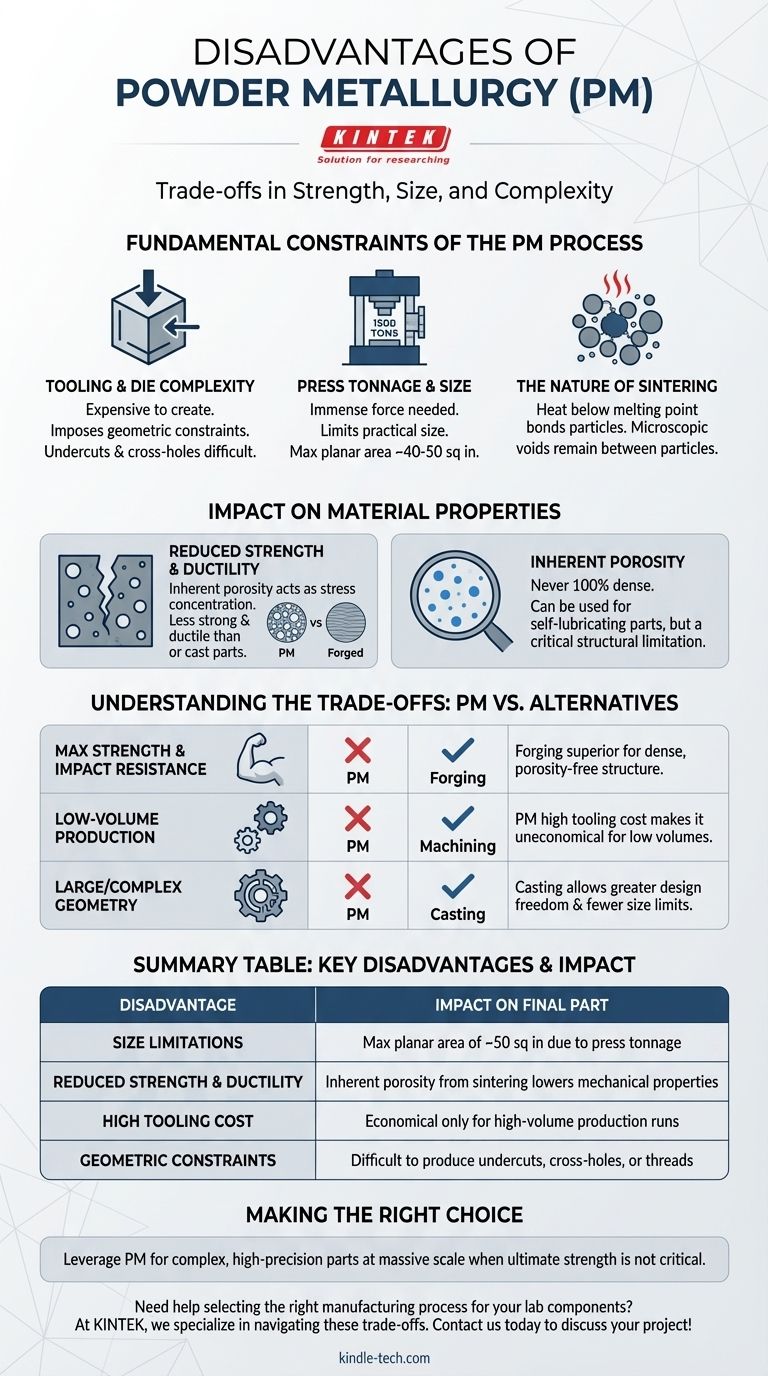
The primary disadvantages of powder metallurgy (PM) are its inherent limitations on part size, the challenge of producing certain complex geometries, and the resulting components having lower strength and ductility compared to fully dense methods like forging. These constraints stem directly from the core mechanics of pressing powder in a rigid die and sintering it below its melting point.

While powder metallurgy is a highly effective process for producing precise, net-shape parts in high volumes, its fundamental trade-off is sacrificing ultimate material strength and size for complexity and production efficiency.
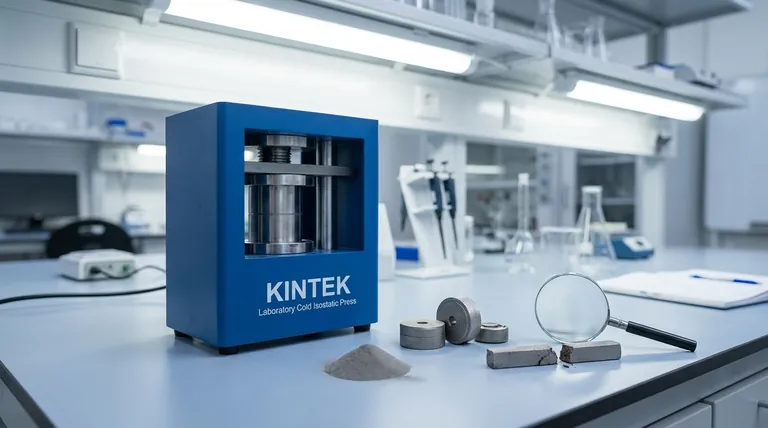
What are the disadvantages of powder metallurgy? Key Limitations in Strength and Size

The Fundamental Constraints of the PM Process

To understand the disadvantages of powder metallurgy, you must first understand the core steps of the process itself. The limitations are not accidental; they are direct consequences of how a PM part is formed.

Tooling and Die Complexity

Powder metallurgy relies on pressing metal powder into a rigid die. This tooling is expensive to create and imposes geometric constraints on the final part.

Features like undercuts, cross-holes, or threads that are perpendicular to the direction of pressing are extremely difficult or impossible to produce directly.

Press Tonnage and Size Limitations

The force required to compact the powder uniformly is immense. The industry's largest presses are around 1,500 tons, which limits the practical size of a component.

This typically translates to a maximum planar surface area of 40 to 50 square inches. Anything larger becomes unfeasible with standard PM equipment.

The Nature of Sintering

After pressing, the fragile "green" compact is heated in a process called sintering. This heat treatment occurs below the metal's melting point.

Sintering bonds the metal particles together, giving the part its strength. However, because the metal is not fully melted, microscopic voids remain between the original particles.

The Impact on Material Properties

The physical constraints of the PM process directly influence the final mechanical properties of the component, which is the most critical consideration for any engineering application.

Reduced Strength and Ductility

The voids left after sintering result in inherent porosity. A PM part is never 100% dense like a forged or cast part.

This porosity acts as a stress concentration point, making PM parts generally less strong and less ductile (more brittle) than their wrought or cast iron counterparts.

Inherent Porosity

While porosity is a disadvantage for strength, it can be a planned feature for applications like self-lubricating bearings, where oil is held within the pores.

However, for structural components, this porosity is a critical limiting factor that must be accounted for in the design phase.

Understanding the Trade-offs: PM vs. Other Methods

No manufacturing process is perfect for every application. The disadvantages of PM become clear when compared directly against traditional alternatives like forging or casting.

When to Avoid PM for Strength

If your application demands the absolute highest tensile strength, fatigue resistance, and impact toughness, forging is the superior choice. The forging process creates a dense, wrought grain structure that is free of the porosity found in PM parts.

The Cost Factor: Tooling vs. Part Volume

The high upfront cost of creating the compaction die makes powder metallurgy uneconomical for low-volume production runs or prototypes.

PM only becomes cost-effective at high volumes where the tooling cost can be amortized over tens of thousands of parts. Machining or casting is often better for smaller quantities.

The Geometry and Size Barrier

If you need to produce a very large component or one with complex internal channels, undercuts, or other features not aligned with the pressing axis, casting is a far more suitable process. Casting allows for much greater design freedom and has significantly fewer size limitations.

Making the Right Choice for Your Application

Choosing the correct manufacturing process requires aligning your primary goal with the inherent strengths and weaknesses of each method.

  • If your primary focus is maximum strength and impact resistance: Forging is almost always the superior choice due to its dense, porosity-free grain structure.
  • If your primary focus is producing a small number of parts: The high initial tooling cost of PM makes machining from bar stock a more economical option.
  • If your primary focus is a very large or geometrically intricate component: The size and shape limitations of PM make casting or fabrication a more practical solution.

Ultimately, understanding these disadvantages allows you to leverage powder metallurgy for what it does best: producing complex, high-precision parts at a massive scale when ultimate strength is not the single most critical factor.

Summary Table:

Disadvantage Impact on Final Part
Size Limitations Max planar area of ~50 sq in due to press tonnage
Reduced Strength & Ductility Inherent porosity from sintering lowers mechanical properties
High Tooling Cost Economical only for high-volume production runs
Geometric Constraints Difficult to produce undercuts, cross-holes, or threads

Need help selecting the right manufacturing process for your lab components? At KINTEK, we specialize in providing high-quality lab equipment and consumables, helping you navigate material and process trade-offs to achieve optimal performance. Whether you're working with powder metallurgy parts or exploring alternatives, our expertise ensures you get durable, precise solutions tailored to your laboratory needs. Contact us today to discuss your project!

Visual Guide
What are the disadvantages of powder metallurgy? Key Limitations in Strength and Size Visual Guide

Related Products

People Also Ask

Related Products

Electric Lab Cold Isostatic Press CIP Machine for Cold Isostatic Pressing

Electric Lab Cold Isostatic Press CIP Machine for Cold Isostatic Pressing

Produce dense, uniform parts with improved mechanical properties with our Electric Lab Cold Isostatic Press. Widely used in material research, pharmacy, and electronic industries. Efficient, compact, and vacuum-compatible.

Manual Cold Isostatic Pressing Machine CIP Pellet Press

Manual Cold Isostatic Pressing Machine CIP Pellet Press

Lab Manual Isostatic Press is a high-efficient equipment for sample preparation widely used in material research, pharmacy, ceramics, and electronic industries. It allows for precision control of the pressing process and can work in a vacuum environment.

Manual High Temperature Heated Hydraulic Press Machine with Heated Plates for Lab

Manual High Temperature Heated Hydraulic Press Machine with Heated Plates for Lab

The High Temperature Hot Press is a machine specifically designed for pressing, sintering and processing materials in a high temperature environment. It is capable of operating in the range of hundreds of degrees Celsius to thousands of degrees Celsius for a variety of high temperature process requirements.

Automatic High Temperature Heated Hydraulic Press Machine with Heated Plates for Lab

Automatic High Temperature Heated Hydraulic Press Machine with Heated Plates for Lab

The High Temperature Hot Press is a machine specifically designed for pressing, sintering and processing materials in a high temperature environment. It is capable of operating in the range of hundreds of degrees Celsius to thousands of degrees Celsius for a variety of high temperature process requirements.

24T 30T 60T Heated Hydraulic Press Machine with Heated Plates for Laboratory Hot Press

24T 30T 60T Heated Hydraulic Press Machine with Heated Plates for Laboratory Hot Press

Looking for a reliable Hydraulic Heated Lab Press? Our 24T / 40T model is perfect for material research labs, pharmacy, ceramics, and more. With a small footprint and the ability to work inside a vacuum glove box, it's the efficient and versatile solution for your sample preparation needs.

Heated Hydraulic Press Machine with Heated Plates for Vacuum Box Laboratory Hot Press

Heated Hydraulic Press Machine with Heated Plates for Vacuum Box Laboratory Hot Press

The lab press for vacuum box is a specialized piece of equipment designed for laboratory use. Its main purpose is to press pills and powders according to specific requirements.

Heated Hydraulic Press Machine with Heated Plates for Vacuum Box Laboratory Hot Press

Heated Hydraulic Press Machine with Heated Plates for Vacuum Box Laboratory Hot Press

Enhance your lab's precision with our lab press for vacuum box. Press pills and powders with ease and precision in a vacuum environment, reducing oxidation and improving consistency. Compact and easy to use with a digital pressure gauge.

Double Plate Heating Press Mold for Lab

Double Plate Heating Press Mold for Lab

Discover precision in heating with our Double Plate Heating Mold, featuring high-quality steel and uniform temperature control for efficient lab processes. Ideal for various thermal applications.

Automatic Heated Hydraulic Press Machine with Heated Plates for Laboratory Hot Press

Automatic Heated Hydraulic Press Machine with Heated Plates for Laboratory Hot Press

The Automatic High Temperature Heat Press is a sophisticated hydraulic hot press designed for efficient temperature control and product quality processing.

Manual Heated Hydraulic Press Machine with Heated Plates for Laboratory Hot Press

Manual Heated Hydraulic Press Machine with Heated Plates for Laboratory Hot Press

The Manual Heat Press is a versatile piece of equipment suitable for a variety of applications, operated by a manual hydraulic system that applies controlled pressure and heat to the material placed on the piston.

Warm Isostatic Press WIP Workstation 300Mpa for High Pressure Applications

Warm Isostatic Press WIP Workstation 300Mpa for High Pressure Applications

Discover Warm Isostatic Pressing (WIP) - A cutting-edge technology that enables uniform pressure to shape and press powdered products at a precise temperature. Ideal for complex parts and components in manufacturing.

Heated Hydraulic Press Machine with Heated Plates Split Manual Laboratory Hot Press

Heated Hydraulic Press Machine with Heated Plates Split Manual Laboratory Hot Press

Efficiently prepare your samples with our Split Manual Heated Lab Press. With a pressure range up to 40T and heating plates up to 300°C, it's perfect for various industries.

Warm Isostatic Press for Solid State Battery Research

Warm Isostatic Press for Solid State Battery Research

Discover the advanced Warm Isostatic Press (WIP) for semiconductor lamination. Ideal for MLCC, hybrid chips, and medical electronics. Enhance strength and stability with precision.

Laboratory Hydraulic Press Lab Pellet Press Machine for Glove Box

Laboratory Hydraulic Press Lab Pellet Press Machine for Glove Box

Controlled environment lab press machine for glove box. Specialized equipment for material pressing and shaping with high precision digital pressure gauge.

Laboratory Hydraulic Press Split Electric Lab Pellet Press

Laboratory Hydraulic Press Split Electric Lab Pellet Press

Efficiently prepare samples with a split electric lab press - available in various sizes and ideal for material research, pharmacy, and ceramics. Enjoy greater versatility and higher pressure with this portable and programmable option.

Laboratory Hydraulic Press Lab Pellet Press for Button Battery

Laboratory Hydraulic Press Lab Pellet Press for Button Battery

Efficiently prepare samples with our 2T Button Battery Press. Ideal for material research labs and small-scale production. Small footprint, lightweight, and vacuum-compatible.

Rubber Vulcanizer Vulcanizing Machine Plate Vulcanizing Press for Lab

Rubber Vulcanizer Vulcanizing Machine Plate Vulcanizing Press for Lab

The Plate vulcanizing press is a kind of equipment used in the production of rubber products, mainly used for the vulcanization of rubber products. Vulcanization is a key step in rubber processing.

Heated Hydraulic Press Machine with Integrated Manual Heated Plates for Lab Use

Heated Hydraulic Press Machine with Integrated Manual Heated Plates for Lab Use

Efficiently process heat-pressing samples with our Integrated Manual Heated Lab Press. With a heating range up to 500°C, it's perfect for various industries.

Laboratory Manual Hydraulic Pellet Press for Lab Use

Laboratory Manual Hydraulic Pellet Press for Lab Use

Efficient Manure Lab Hydraulic Press with Safety Cover for sample preparation in material research, pharmacy, and electronic industries. Available in 15T to 60T.

Vacuum Cold Mounting Machine for Sample Preparation

Vacuum Cold Mounting Machine for Sample Preparation

Vacuum Cold Mounting Machine for precise sample prep. Handles porous, fragile materials with -0.08MPa vacuum. Ideal for electronics, metallurgy, and failure analysis.


Leave Your Message