Chemical Vapor Deposition (CVD) is the backbone of modern CMOS fabrication, offering a unique combination of precision and volume capability that other deposition methods cannot match. Its primary advantages are excellent uniformity across the wafer, superior conformality for coating complex 3D structures, high scalability for mass production, and the versatility to deposit a vast array of materials including metals, dielectrics, and semiconductors.
The Core Insight While PVD (Physical Vapor Deposition) is effective for line-of-sight coating, CVD dominates in CMOS because it is a chemical process that occurs at the surface. This allows it to coat vertical walls and deep trenches with the same thickness as flat surfaces—a capability that is non-negotiable for modern, high-aspect-ratio device architectures.
The Strategic Value of CVD in Fabrication
Mastering Complex 3D Geometries
The defining strength of CVD is conformality. As CMOS devices scale down, they utilize complex 3D structures with high aspect ratios, such as deep trenches and fins.
CVD gases flow into these intricate features, reacting chemically to coat surfaces evenly. This ensures that vertical sidewalls receive the same film thickness as horizontal surfaces, preventing voids that could lead to device failure.
Ensuring Consistency Across the Wafer
To maximize yield, every chip on a wafer must perform identically. CVD processes, particularly Low-Pressure CVD (LPCVD), offer excellent uniformity.
This creates consistent film properties from the center of the wafer to the edge. Whether depositing an insulating dielectric or a conductive metal, the electrical characteristics remain stable across the entire device.
Leveraging Material Flexibility
CVD is not limited to a single class of materials. It offers immense material versatility, allowing engineers to deposit metals, dielectrics, and semiconductors within the same fundamental process flow.
Advanced variations, such as Photochemical CVD, extend this versatility further. By using light energy, engineers can deposit materials with specific optical characteristics or high crystallinity, often at lower temperatures than thermal processes allow.
Scaling for Mass Production
For a technology to be viable commercially, it must be scalable. CVD supports cost-effective, large-scale production.
While precise control is required, methods like Atmospheric Pressure CVD (APCVD) offer simpler, high-throughput options. This allows manufacturers to transition from research-grade precision to high-volume manufacturing without reinventing the deposition strategy.
Understanding the Operational Trade-offs
To use CVD effectively, you must navigate its inherent challenges. It is generally more complex and hazardous than physical deposition methods.
Safety and Handling Risks
CVD relies on chemical precursors that are often toxic, flammable, or highly reactive. This necessitates stringent safety protocols and specialized gas handling systems, increasing facility complexity.
Contamination Control
Because CVD involves chemical reactions, there is a risk of residual byproducts remaining in the film or chamber. If not managed, these impurities can introduce defects that degrade device performance.
Process Complexity and Cost
Achieving the high-quality films described above requires precise control of temperature, pressure, and precursor concentration. Maintaining this balance at scale drives up both equipment and operational costs compared to simpler techniques.
Making the Right Choice for Your Goal
When integrating CVD into your process flow, the specific variant you choose depends on your priority metrics.
- If your primary focus is covering complex 3D structures: Prioritize LPCVD. Its lower pressure regime enhances gas diffusion, delivering the superior conformality required for high-aspect-ratio features.
- If your primary focus is cost and throughput: Consider APCVD. It operates at atmospheric pressure, offering a simpler and more cost-effective approach, though you may sacrifice some degree of film uniformity.
- If your primary focus is temperature-sensitive substrates: Utilize Photochemical CVD. It uses light rather than heat to drive reactions, protecting delicate underlying layers while controlling film properties.
Select the CVD method that balances your need for film quality with your budget for process complexity.
Summary Table:
| Advantage | Key Benefit | Ideal Application |
|---|---|---|
| High Conformality | Even coating on vertical walls & deep trenches | High-aspect-ratio 3D structures (FinFETs) |
| Uniformity | Consistent film thickness across the whole wafer | Maximizing yield in mass production |
| Material Versatility | Deposits metals, dielectrics, and semiconductors | Multilayer device integration |
| Scalability | High-throughput manufacturing options | Cost-effective industrial fabrication |
Elevate Your Semiconductor Fabrication with KINTEK
Precision is the foundation of modern CMOS technology. KINTEK specializes in advanced laboratory and production equipment, providing the cutting-edge tools needed for sophisticated material deposition. Whether you require high-performance CVD and PECVD systems for 3D geometries, or reliable high-temperature furnaces and vacuum solutions for thermal processing, our portfolio is designed to meet the rigorous demands of semiconductor research and mass production.
Why choose KINTEK?
- Comprehensive Range: From CVD reactors to high-pressure autoclaves and essential ceramics.
- Tailored Solutions: Specialized tools for battery research, material crushing, and cooling.
- Expert Support: We help you balance process complexity with cost-efficiency.
Contact our specialists today to find the perfect equipment for your next innovation!
Related Products
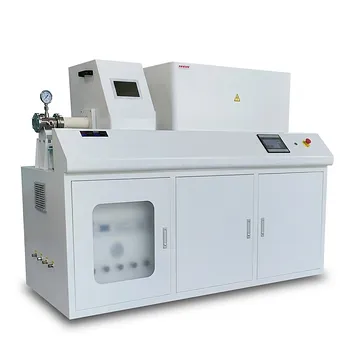
- Chemical Vapor Deposition CVD Equipment System Chamber Slide PECVD Tube Furnace with Liquid Gasifier PECVD Machine
- Customer Made Versatile CVD Tube Furnace Chemical Vapor Deposition Chamber System Equipment
- HFCVD Machine System Equipment for Drawing Die Nano-Diamond Coating
- Multi Heating Zones CVD Tube Furnace Machine Chemical Vapor Deposition Chamber System Equipment
- CVD Diamond Dressing Tools for Precision Applications
People Also Ask
- What are the advantages of chemical vapor deposition? Achieve Superior Thin Films for Your Lab
- What types of substrates are used in CVD to facilitate graphene films? Optimize Graphene Growth with the Right Catalyst
- What is the chemical vapor deposition growth process? Build Superior Thin Films from the Atom Up
- How expensive is chemical vapor deposition? Understanding the True Cost of High-Performance Coating
- Why is Chemical Vapor Deposition (CVD) equipment uniquely suited for constructing hierarchical superhydrophobic structures?