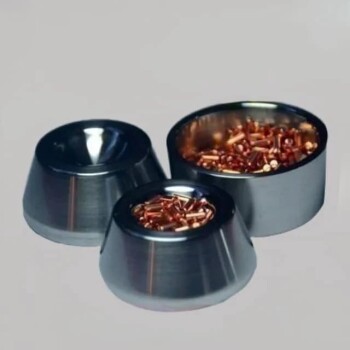
Reaction crucibles for the currentless transfer (CT) method depend primarily on exceptional chemical and thermal resilience. To function correctly, these vessels must withstand temperatures around 1173 K while maintaining high chemical stability against the corrosive nature of chloride or fluoride melts.
The crucible serves as more than a container; it provides the necessary physical integrity to support the chemical potential gradients that drive the disproportionation of metal cations.
The Chemical and Thermal Demands
Resisting Corrosive Environments
The most critical requirement for the reaction crucible is high chemical stability.
The CT method utilizes highly aggressive chloride or fluoride melts.
The crucible material must not react with or degrade in the presence of these corrosive salts during the coating process.
Thermal Stability at High Heat
The process requires the crucible to operate effectively at elevated temperatures, specifically around 1173 K.
At this thermal range, the crucible must maintain its structure without softening or deformation.
Failures in thermal resistance can lead to breaches in containment, halting the entire process.
Supporting the Reaction Mechanism
Physical Integrity in Redox Conditions
The coating process involves active metal redox reactions.
The crucible must act as a stable vessel that does not interfere chemically with these reduction-oxidation processes.
It must maintain physical integrity throughout the duration of the reaction to ensure consistent results.
Facilitating Potential Gradients
The driving force of the CT method is the chemical potential gradient.
The crucible holds the environment where the disproportionation of metal cations occurs.
By remaining inert and stable, the crucible allows these delicate chemical gradients to function without external disruption.
Understanding the Trade-offs
Stability vs. Process Compatibility
A common challenge in selecting a crucible is balancing inertness with thermal performance.
If a crucible is chemically stable but brittle at 1173 K, it risks catastrophic physical failure.
Conversely, a mechanically strong crucible that lacks chemical resistance will corrode, likely contaminating the melt and ruining the refractory metal carbide coating.
Making the Right Choice for Your Goal
Selecting the correct crucible parameters is essential for the success of the currentless transfer method.
- If your primary focus is process safety: Prioritize materials with proven resistance to fluoride and chloride corrosion to prevent dangerous melt breaches.
- If your primary focus is coating purity: Ensure the crucible exhibits absolute chemical stability to prevent foreign elements from interfering with the metal cation disproportionation.
The ideal crucible acts as a silent partner, providing a robust stage for the chemistry to occur without becoming part of the reaction itself.
Summary Table:
| Requirement | Specification | Importance in CT Method |
|---|---|---|
| Thermal Stability | Resists temperatures up to 1173 K | Prevents structural deformation or containment failure during heating. |
| Chemical Inertness | High resistance to chloride/fluoride melts | Prevents salt corrosion and contamination of the refractory coating. |
| Physical Integrity | Durable under redox conditions | Maintains the environment for metal cation disproportionation. |
| Compatibility | Non-reactive with metal cations | Ensures chemical potential gradients remain undisturbed. |
Elevate Your Coating Precision with KINTEK Materials
Success in the currentless transfer (CT) method starts with the right containment. KINTEK specializes in high-performance laboratory equipment, offering premium ceramics and crucibles designed to withstand the most aggressive chemical and thermal environments. Whether you are managing complex metal redox reactions or utilizing our advanced high-temperature furnaces, our solutions ensure the purity and integrity of your refractory metal carbide coatings.
Don't let crucible degradation compromise your research. Our team provides the high-quality consumables and thermal processing systems needed for reliable results in material science.
Ready to optimize your lab's performance? Contact KINTEK today for expert guidance and solutions!
References
- Yu. V. Stulov, С. А. Кузнецов. Electrochemical Synthesis of Functional Coatings and Nanomaterials in Molten Salts and Their Application. DOI: 10.3390/coatings13020352
This article is also based on technical information from Kintek Solution Knowledge Base .
Related Products
- Electron Beam Evaporation Coating Oxygen-Free Copper Crucible and Evaporation Boat
- Electron Beam Evaporation Coating Gold Plating Tungsten Molybdenum Crucible for Evaporation
- High Purity Pure Graphite Crucible for Evaporation
People Also Ask
- What is the container that holds the metal source material called in e-beam evaporation? Ensure Purity and Quality in Your Thin-Film Deposition
- What is e-beam evaporation? Achieve High-Purity Thin Film Deposition for Your Lab
- What is the voltage of e-beam evaporation? Achieve Precise Thin-Film Deposition
- What is the current of e-beam evaporation? A Guide to High-Purity Thin Film Deposition
- What are the applications of e-beam evaporation? Achieve High-Purity Coatings for Optics & Electronics