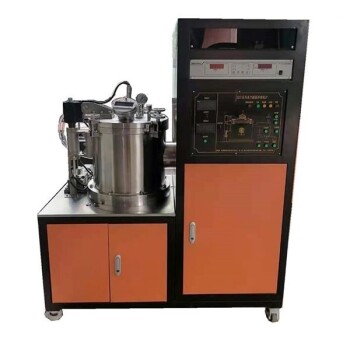
Medium-frequency induction sintering offers a high-performance pathway for the fabrication of CrFeCuMnNi high-entropy alloy (HEA) composites. By leveraging electromagnetic induction to heat graphite dies or the sample itself, these furnaces achieve rapid heating rates of up to 120°C/min. This speed facilitates high densification while simultaneously inhibiting undesirable grain coarsening, ensuring the resulting material maintains its intended microstructural integrity.
The core technical advantage lies in the furnace's ability to decouple heating speed from thermal mass. This allows for precise control over the sintering window, enabling full solid solution diffusion without the deleterious effects of prolonged high-temperature exposure.
Precision Thermal Dynamics
The fundamental benefit of medium-frequency induction is the transition from external heat radiation to internal heat generation.
Rapid Heating and Residence Time
Induction furnaces can reach sintering temperatures, such as 1200°C, at speeds exceeding 120°C/min. This rapid ramp-up significantly reduces the material's total residence time at peak temperatures. Minimizing this window is critical for HEAs to prevent the breakdown of complex solid solutions.
Uniform Volumetric Heating
The electromagnetic field ensures that heating occurs uniformly throughout the graphite die or the conductive specimen. Unlike traditional resistance furnaces, which rely on surface-to-core conduction, induction provides consistent thermal gradients. This uniformity results in more predictable shrinkage and structural homogeneity across the composite.
Microstructural Management
The primary challenge in sintering CrFeCuMnNi composites is balancing density with grain size.
Inhibition of Grain Coarsening
High-entropy alloys are sensitive to "oversintering," where excessive time at high heat causes grains to grow, reducing mechanical strength. The rapid cycle of an induction furnace "freezes" the microstructure. It allows for high densification while keeping the matrix grains small and dispersed.
Enhanced Particle Distribution
The process facilitates the full diffusion of the CrFeCuMnNi solid solution while maintaining a dispersed distribution of oxide particles. This is vital for composite materials where the interaction between the matrix and the reinforcement determines the final performance. By controlling the heating rate, you can optimize the interface between these phases.
Atmospheric and Chemical Control
Maintaining the purity of the CrFeCuMnNi system is essential to avoid brittle phases or oxidation.
Oxidation Prevention
Medium-frequency induction furnaces are designed to operate under protective argon gas environments. This effectively eliminates the risk of oxidation for sensitive alloy elements like Chromium (Cr) and Manganese (Mn). It ensures the final product reflects the intended chemical stoichiometry.
Minimal Element Loss
Because the heating process is fast and the environment is controlled, there is minimal burning loss of volatile alloying elements. This leads to a more uniform metallic composition. It also reduces the need for "over-alloying" to compensate for losses during the sintering cycle.
Understanding the Trade-offs
While highly efficient, medium-frequency induction sintering requires careful management of specific technical variables.
Skin Effect and Frequency Matching
The "skin effect" means that current density is highest at the surface of the conductor. If the frequency is not correctly matched to the die size, you may encounter non-uniform heating in very large samples. Precision in frequency selection is mandatory for large-scale composite production.
Initial Equipment Complexity
The setup for induction sintering is more complex than standard muffle furnaces. It requires specialized graphite tooling and precise coupling between the induction coil and the workpiece. This results in higher initial capital expenditure and a need for skilled operators to manage the electromagnetic parameters.
Making the Right Choice for Your Goal
To maximize the benefits of induction sintering, align your operational parameters with your specific material objectives.
- If your primary focus is mechanical strength: Prioritize the highest possible heating rate to minimize grain growth and preserve fine-grained structures.
- If your primary focus is chemical purity: Ensure the furnace is equipped with high-vacuum or ultra-pure argon purging to protect sensitive HEA elements.
- If your primary focus is production throughput: Utilize the fast cooling and heating cycles of medium-frequency systems to increase the number of sintering runs per shift.
By mastering the rapid thermal cycles of induction heating, engineers can produce HEA composites that achieve a superior balance of density, grain refinement, and chemical stability.
Summary Table:
| Feature | Technical Advantage | Impact on HEA Composites |
|---|---|---|
| Rapid Heating | Up to 120°C/min ramp rates | Inhibits grain coarsening; preserves fine microstructure. |
| Volumetric Heating | Internal heat generation in graphite/sample | Ensures uniform thermal gradients and predictable shrinkage. |
| Atmospheric Control | Argon gas/protective environment | Prevents oxidation of sensitive elements like Cr and Mn. |
| Fast Sintering Cycle | Decoupled heating speed from thermal mass | Minimizes residence time; prevents solid solution breakdown. |
| Chemical Stability | Minimal burning loss of volatile elements | Maintains precise stoichiometry and metallic composition. |
Elevate your advanced materials research with KINTEK’s precision induction technology. As a leading specialist in laboratory equipment, we provide high-performance induction melting and atmosphere furnaces tailored for the complex demands of high-entropy alloys.
Our comprehensive portfolio supports your entire workflow—from crushing and milling systems for powder preparation and hydraulic presses for pelletizing, to vacuum furnaces, CVD/PECVD systems, and essential ceramic crucibles. Whether you are focused on achieving superior mechanical strength or chemical purity, KINTEK offers the reliability and expertise you need to succeed.
Ready to optimize your HEA fabrication? Contact our experts today to find the perfect thermal solution for your laboratory!
References
- S. Sivasankaran, Abdel-baset H. Mekky. Effect of Al2O3 (x = 0, 1, 2, and 3 vol.%) in CrFeCuMnNi-x High-Entropy Alloy Matrix Composites on Their Microstructure and Mechanical and Wear Performance. DOI: 10.3390/ma16103672
This article is also based on technical information from Kintek Solution Knowledge Base .
Related Products
- 600T Vacuum Induction Hot Press Furnace for Heat Treat and Sintering
- Lab-Scale Vacuum Induction Melting Furnace
- Vacuum Arc Induction Melting Furnace
- Vacuum Heat Treat Furnace and Levitation Induction Melting Furnace
- Non Consumable Vacuum Arc Induction Melting Furnace
People Also Ask
- What role does an induction vacuum hot pressing furnace play in sintering? Achieve 98% Density in Carbide Blocks
- What advantages does a vacuum hot press furnace provide for LSLBO ceramic electrolytes? Achieve 94% Relative Density
- What role does a Vacuum Hot Press (VHP) furnace play in the densification of austenitic stainless steel 316 composites?
- What are the advantages of a vacuum hot press furnace for W-50%Cu? Achieve 99.6% Density at Lower Temperatures
- What role does mechanical pressure play during the vacuum diffusion bonding of tungsten and copper? Keys to Solid Bonding