Knowledge What are the techniques of dip coating? Master the 5-Step Process for Uniform Films
Author avatar

Tech Team · Kintek Solution

Updated 6 days ago

What are the techniques of dip coating? Master the 5-Step Process for Uniform Films


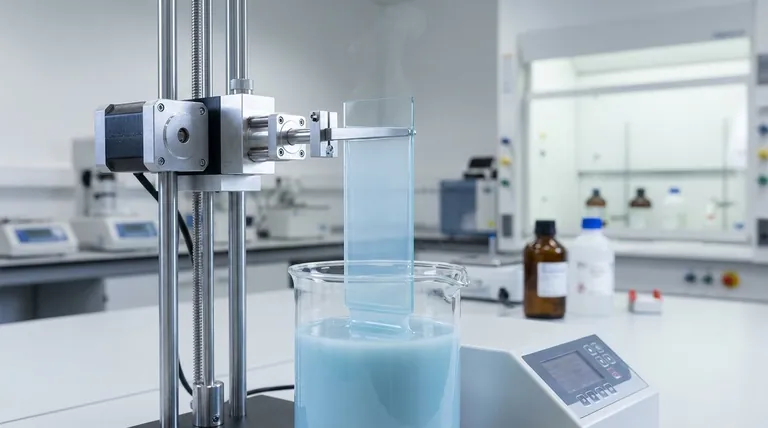
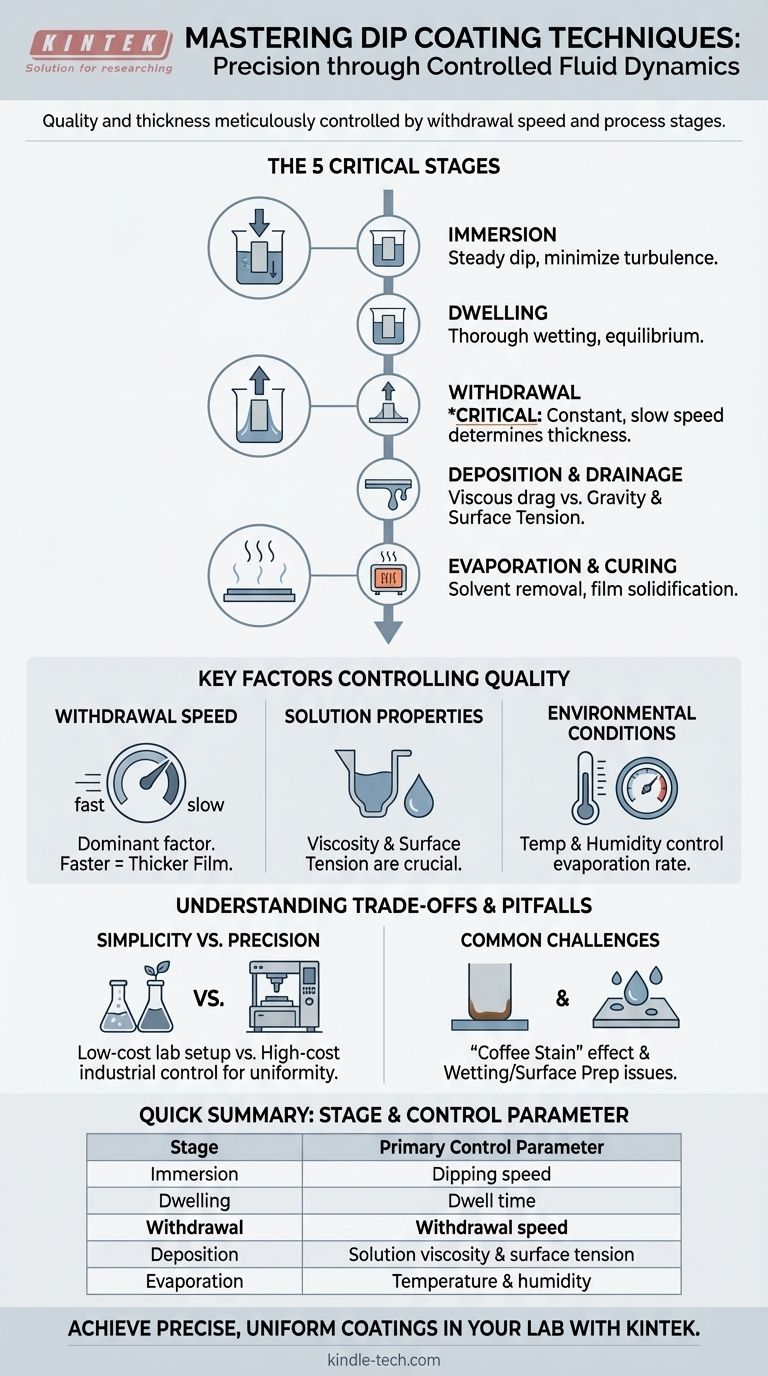
At its core, the dip coating technique consists of five distinct stages: immersion, dwelling, controlled withdrawal, deposition and drainage, and finally, evaporation. While the concept is simple—dipping an object (substrate) into a liquid—the quality and thickness of the final film are meticulously controlled by the parameters of these stages, particularly the speed of withdrawal.

Dip coating is not merely a dip; it is a precisely controlled fluid dynamics process. The final film's characteristics are less about the immersion and more about the controlled, steady withdrawal and subsequent drying conditions.
What are the techniques of dip coating? Master the 5-Step Process for Uniform Films

The Five Critical Stages of the Dip Coating Process

To achieve a uniform, high-quality coating, each stage of the process must be carefully managed. These stages flow sequentially to form the final film.

Stage 1: Immersion

The process begins by fully immersing the substrate into the coating solution. This is typically done at a steady, controlled speed to minimize any turbulence or wave generation in the liquid.

Stage 2: Dwelling (Incubation)

Once immersed, the substrate remains stationary in the solution for a set period. This dwell time ensures the entire surface of the substrate is thoroughly wetted, allowing the solution to reach equilibrium.

Stage 3: Withdrawal

This is the most critical stage. The substrate is pulled out of the solution at a constant, slow speed. A thin layer of the liquid clings to the surface and is drawn up with the substrate.

Stage 4: Deposition and Drainage

As the substrate is withdrawn, a liquid film is deposited. The thickness of this film is determined by a balance of forces: the viscous drag of the liquid pulling it up versus the force of gravity and surface tension pulling it down. Excess liquid drains from the surface.

Stage 5: Evaporation and Curing

The solvent begins to evaporate from the liquid layer, leaving behind the desired coating material. In some processes, like those involving sol-gel solutions, this stage may also involve a chemical reaction or a thermal treatment (curing) to solidify and densify the film.

Key Factors Controlling Film Quality

The simplicity of dip coating is deceptive. Achieving a repeatable, high-quality film requires precise control over several interconnected variables.

Withdrawal Speed

This is the single most dominant factor influencing film thickness. A faster withdrawal speed results in a thicker film because it gives the liquid less time to drain back into the reservoir.

Solution Properties

The viscosity and surface tension of the coating solution are critical. Higher viscosity generally leads to thicker films. The solution's density also plays a role in the gravitational draining force.

Environmental Conditions

The atmosphere into which the substrate is withdrawn has a significant impact. Temperature and humidity control the rate of solvent evaporation, which can affect the final film structure and introduce defects if not properly managed.

Understanding the Trade-offs and Pitfalls

While powerful, the dip coating technique has limitations and common challenges that must be anticipated.

Simplicity vs. Precision

The method is famously low-cost and simple to set up, making it excellent for lab-scale research and prototyping. However, achieving industrial-scale precision and uniformity requires highly sophisticated and expensive equipment to control withdrawal speed and the environment.

The "Coffee Stain" Effect

A common issue is the tendency for the coating to be thicker at the very bottom edge of the substrate where the last droplet drains and evaporates. This non-uniformity can be a critical defect in applications like optics.

Material and Solvent Compatibility

The technique is entirely dependent on the solution properly wetting the substrate. If the surface energy of the substrate is too low, the liquid will bead up rather than form a continuous film. Substrate cleaning and preparation are therefore paramount.

Applying This to Your Process

Your specific goal will determine which variables you need to control most rigorously.

  • If your primary focus is repeatable film thickness: Concentrate on achieving an absolutely constant withdrawal speed and maintaining a consistent solution viscosity.
  • If your primary focus is a defect-free optical surface: Prioritize a vibration-free environment, a cleanroom setting to eliminate dust, and carefully controlled atmospheric conditions to manage evaporation.
  • If your primary focus is rapid prototyping or low-cost coating: The inherent simplicity of the method is your greatest asset, allowing for quick tests of different materials and solutions.

Mastering these fundamental stages and variables allows you to leverage the simple elegance of dip coating for a wide range of advanced applications.

Summary Table:

Stage Key Action Primary Control Parameter
1. Immersion Substrate is dipped into the solution Dipping speed
2. Dwelling Substrate rests in solution Dwell time
3. Withdrawal Substrate is pulled out Withdrawal speed
4. Deposition Liquid film drains and deposits Solution viscosity & surface tension
5. Evaporation Solvent evaporates, film solidifies Temperature & humidity

Ready to achieve precise, uniform coatings in your lab?

KINTEK specializes in the lab equipment and consumables you need to perfect your dip coating process. Whether you require precise withdrawal speed controllers, stable coating solutions, or expert advice on optimizing your parameters for materials research, we are here to support your laboratory's success.

Contact our experts today to discuss how we can help you enhance your coating quality and efficiency.

Visual Guide
What are the techniques of dip coating? Master the 5-Step Process for Uniform Films Visual Guide

Related Products

People Also Ask

Related Products

Vacuum Hot Press Furnace Machine for Lamination and Heating

Vacuum Hot Press Furnace Machine for Lamination and Heating

Experience clean and precise lamination with Vacuum Lamination Press. Perfect for wafer bonding, thin-film transformations, and LCP lamination. Order now!

Automatic Laboratory Heat Press Machine

Automatic Laboratory Heat Press Machine

Precision automatic heat press machines for labs—ideal for material testing, composites, and R&D. Customizable, safe, and efficient. Contact KINTEK today!

Metallographic Specimen Mounting Machine for Laboratory Materials and Analysis

Metallographic Specimen Mounting Machine for Laboratory Materials and Analysis

Precision metallographic mounting machines for labs—automated, versatile, and efficient. Ideal for sample prep in research and quality control. Contact KINTEK today!

Custom PTFE Teflon Parts Manufacturer for Culture Dish and Evaporation Dish

Custom PTFE Teflon Parts Manufacturer for Culture Dish and Evaporation Dish

The PTFE culture dish evaporating dish is a versatile laboratory tool known for its chemical resistance and high-temperature stability. PTFE, a fluoropolymer, offers exceptional non-stick properties and durability, making it ideal for various applications in research and industry, including filtration, pyrolysis, and membrane technology.

Single Punch Electric Tablet Press Machine Laboratory Powder Tablet Punching TDP Tablet Press

Single Punch Electric Tablet Press Machine Laboratory Powder Tablet Punching TDP Tablet Press

The single-punch electric tablet press is a laboratory-scale tablet press suitable for corporate laboratories in pharmaceutical, chemical, food, metallurgical and other industries.

Single Punch Tablet Press Machine and Mass Production Rotary Tablet Punching Machine for TDP

Single Punch Tablet Press Machine and Mass Production Rotary Tablet Punching Machine for TDP

Rotary tablet punching machine is an automatic rotating and continuous tableting machine. It is mainly used for tablet manufacturing in the pharmaceutical industry, and is also suitable for industrial sectors such as food, chemicals, batteries, electronics, ceramics, etc. to compress granular raw materials into tablets.

Custom PTFE Teflon Parts Manufacturer for PTFE Containers

Custom PTFE Teflon Parts Manufacturer for PTFE Containers

PTFE container is a container with excellent corrosion resistance and chemical inertness.

Lab Electrochemical Workstation Potentiostat for Laboratory Use

Lab Electrochemical Workstation Potentiostat for Laboratory Use

Electrochemical workstations, also known as laboratory electrochemical analyzers, are sophisticated instruments designed for precise monitoring and control in various scientific and industrial processes.

Infrared High Resistance Single Crystal Silicon Lens

Infrared High Resistance Single Crystal Silicon Lens

Silicon (Si) is widely regarded as one of the most durable mineral and optical materials for applications in the near-infrared (NIR) range, approximately 1 μm to 6 μm.

Vacuum Sealed Continuous Working Rotary Tube Furnace Rotating Tube Furnace

Vacuum Sealed Continuous Working Rotary Tube Furnace Rotating Tube Furnace

Experience efficient material processing with our vacuum-sealed rotary tube furnace. Perfect for experiments or industrial production, equipped with optional features for controlled feeding and optimized results. Order now.

Graphite Vacuum Continuous Graphitization Furnace

Graphite Vacuum Continuous Graphitization Furnace

High-temperature graphitization furnace is a professional equipment for graphitization treatment of carbon materials. It is a key equipment for the production of high-quality graphite products. It has high temperature, high efficiency and uniform heating. It is suitable for various high-temperature treatments and graphitization treatments. It is widely used in metallurgy, electronics, aerospace, etc. industry.

Spark Plasma Sintering Furnace SPS Furnace

Spark Plasma Sintering Furnace SPS Furnace

Discover the benefits of Spark Plasma Sintering Furnaces for rapid, low-temperature material preparation. Uniform heating, low cost & eco-friendly.

Aluminum Foil Current Collector for Lithium Battery

Aluminum Foil Current Collector for Lithium Battery

The surface of aluminum foil is extremely clean and hygienic, and no bacteria or microorganisms can grow on it. It is a non-toxic, tasteless and plastic packaging material.

Electrolytic Electrochemical Cell for Coating Evaluation

Electrolytic Electrochemical Cell for Coating Evaluation

Looking for corrosion-resistant coating evaluation electrolytic cells for electrochemical experiments? Our cells boast complete specifications, good sealing, high-quality materials, safety, and durability. Plus, they're easily customizable to meet your needs.

600T Vacuum Induction Hot Press Furnace for Heat Treat and Sintering

600T Vacuum Induction Hot Press Furnace for Heat Treat and Sintering

Discover the 600T Vacuum Induction Hot Press Furnace, designed for high-temperature sintering experiments in vacuum or protected atmospheres. Its precise temperature and pressure control, adjustable working pressure, and advanced safety features make it ideal for nonmetal materials, carbon composites, ceramics, and metal powders.

Custom PTFE Teflon Parts Manufacturer for Hollow Etching Flower Basket ITO FTO Developing Glue Removal

Custom PTFE Teflon Parts Manufacturer for Hollow Etching Flower Basket ITO FTO Developing Glue Removal

PTFE adjustable height flower basket (Teflon flower baskets) are made of high-purity experimental grade PTFE, with excellent chemical stability, corrosion resistance, sealing and high and low temperature resistance.

Customer Made Versatile CVD Tube Furnace Chemical Vapor Deposition Chamber System Equipment

Customer Made Versatile CVD Tube Furnace Chemical Vapor Deposition Chamber System Equipment

Get your exclusive CVD furnace with KT-CTF16 Customer Made Versatile Furnace. Customizable sliding, rotating, and tilting functions for precise reactions. Order now!

Precision Machined Zirconia Ceramic Ball for Engineering Advanced Fine Ceramics

Precision Machined Zirconia Ceramic Ball for Engineering Advanced Fine Ceramics

zirconia ceramic ball have the characteristics of high strength, high hardness, PPM wear level, high fracture toughness, good wear resistance, and high specific gravity.

Laboratory Disc Rotary Mixer for Efficient Sample Mixing and Homogenization

Laboratory Disc Rotary Mixer for Efficient Sample Mixing and Homogenization

Efficient Laboratory Disc Rotary Mixer for Precise Sample Mixing, Versatile for Various Applications, DC Motor and Microcomputer Control, Adjustable Speed and Angle.

Laboratory Hybrid Tissue Grinding Mill

Laboratory Hybrid Tissue Grinding Mill

KT-MT20 is a versatile laboratory device used for rapid grinding or mixing of small samples, whether dry, wet, or frozen. It comes with two 50ml ball mill jars and various cell wall breaking adapters for biological applications such as DNA/RNA and protein extraction.


Leave Your Message