Knowledge atmosphere furnace What does it mean to have an atmosphere that is oxidizing vs a reducing atmosphere? Mastering Chemical Control for Your Materials
Author avatar

Tech Team · Kintek Solution

Updated 3 months ago

What does it mean to have an atmosphere that is oxidizing vs a reducing atmosphere? Mastering Chemical Control for Your Materials


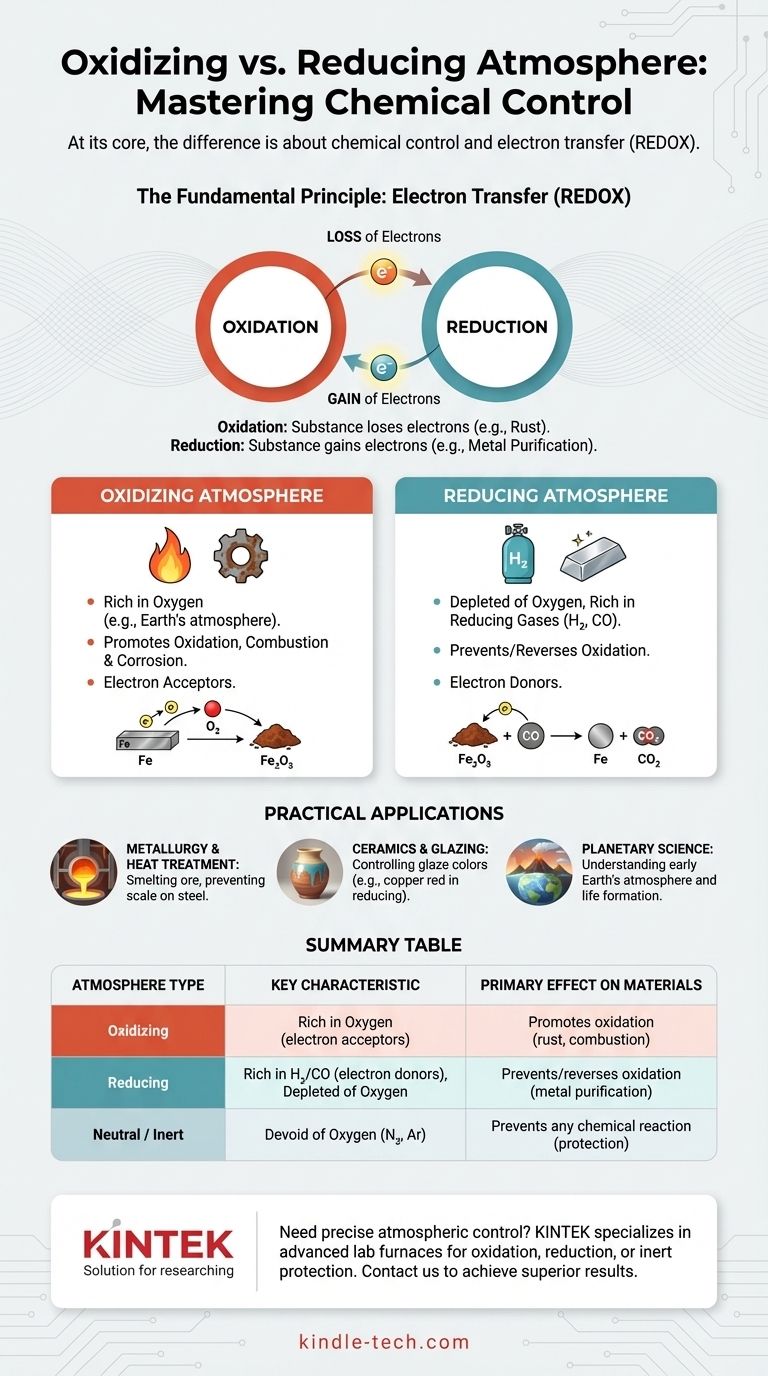
At its core, the difference is about chemical control. An oxidizing atmosphere is rich in oxygen or other substances that accept electrons, promoting reactions like combustion and corrosion. In direct contrast, a reducing atmosphere is intentionally depleted of oxygen and often contains gases like hydrogen or carbon monoxide that donate electrons, which prevents or even reverses oxidation.

The key distinction isn't just the presence of oxygen, but whether the atmosphere's chemistry causes a material to lose electrons (oxidation) or gain electrons (reduction). Choosing the right atmosphere is fundamental to controlling the outcome of high-temperature processes, from manufacturing steel to firing artistic pottery.
What does it mean to have an atmosphere that is oxidizing vs a reducing atmosphere? Mastering Chemical Control for Your Materials

The Fundamental Principle: Electron Transfer

To truly understand the difference, you must look past the gases and focus on the underlying chemistry of electron exchange. This is known as REDOX (Reduction-Oxidation).

Understanding Oxidation: The Loss of Electrons

Oxidation is a chemical process where a substance loses electrons. While oxygen is the most famous oxidizing agent, it's not the only one.

The classic example is rust. When iron is exposed to an oxygen-rich atmosphere, the iron atoms lose electrons to the oxygen atoms, forming iron oxide. The material has been oxidized.

Understanding Reduction: The Gain of Electrons

Reduction is the exact opposite process: a substance gains electrons. This "reduces" its oxidation state.

In a reducing atmosphere, gases like hydrogen (H₂) or carbon monoxide (CO) are present. These gases are electron donors; they readily give their electrons to other substances, reversing the process of oxidation.

Characteristics of Each Environment

The composition of the atmosphere directly dictates its chemical behavior and its effect on materials within it.

The Oxidizing Atmosphere

An oxidizing environment is characterized by an abundance of free oxygen or other oxidizing agents. Earth’s atmosphere is the most common example.

This environment supports and accelerates combustion. It is also the primary driver of corrosion and degradation for many materials, especially metals at high temperatures.

The Reducing Atmosphere

A reducing atmosphere is defined by the near-total absence of oxygen. To be actively "reducing," it must also contain reducing gases.

These gases, such as hydrogen or carbon monoxide, will chemically strip oxygen atoms from materials they come into contact with. This is essential for processes like smelting ore into pure metal.

The Neutral (or Inert) Atmosphere

It is important to recognize a third state: a neutral or inert atmosphere. This environment, typically composed of nitrogen or argon, is also devoid of oxygen.

However, unlike a reducing atmosphere, these gases do not actively donate electrons. Their purpose is simply to displace oxygen and prevent any chemical reactions from occurring, protecting the material without altering it.

Practical Implications and Why It Matters

The choice between these atmospheres is not academic; it is a critical decision in countless industrial and scientific processes.

In Metallurgy and Heat Treatment

When smelting iron ore, a blast furnace is filled with coke (a form of carbon), which burns to create a carbon monoxide-rich, oxygen-poor reducing atmosphere. The CO strips oxygen from the iron oxide ore, reducing it to pure liquid iron.

Similarly, when heat-treating steel, a reducing atmosphere is used to prevent the formation of "scale" (a layer of iron oxide) on the hot surface of the metal.

In Ceramics and Glazing

The atmosphere inside a kiln has a profound effect on the final color of pottery glazes.

A copper carbonate glaze, for example, will turn green in an oxidizing atmosphere. In a reducing atmosphere, the same glaze will produce a brilliant red as the copper oxide is chemically "reduced" back to pure copper.

In Planetary Science

The distinction is also crucial to understanding planetary formation. The early Earth had a reducing atmosphere, which was a necessary condition for the formation of the complex organic molecules that led to life.

Only after the evolution of photosynthetic organisms did our planet develop the oxygen-rich, oxidizing atmosphere we depend on today.

Making the Right Choice for Your Goal

Your choice is dictated entirely by the chemical transformation you need to achieve.

  • If your primary focus is preventing corrosion or removing oxygen from a compound (like smelting ore): You require a reducing atmosphere rich in agents like carbon monoxide or hydrogen.
  • If your primary focus is complete combustion or creating a specific chemical oxide: You need an oxidizing atmosphere with a controlled supply of oxygen.
  • If your primary focus is simply protecting a material from any chemical change at high temperatures: You should use a neutral or inert atmosphere, such as pure argon or nitrogen.

Ultimately, mastering the atmospheric conditions means you are mastering the final state and integrity of your material.

Summary Table:

Atmosphere Type Key Characteristic Primary Effect on Materials Common Applications
Oxidizing Rich in oxygen (electron acceptors) Promotes oxidation (e.g., rust, combustion) Complete combustion, creating specific oxides
Reducing Depleted of oxygen, rich in H₂/CO (electron donors) Prevents/reverses oxidation (e.g., metal purification) Smelting ore, preventing scale on steel, ceramic color effects
Neutral/Inert Devoid of oxygen (e.g., N₂, Ar) Prevents any chemical reaction Protecting materials from change at high temperatures

Need precise atmospheric control for your lab processes? The right furnace atmosphere is critical for achieving your desired material properties, whether you're heat-treating metals, developing new ceramics, or protecting sensitive samples. KINTEK specializes in advanced lab furnaces and equipment designed for exact atmospheric control. Our experts can help you select the perfect solution to ensure oxidation, reduction, or inert protection for your specific application. Contact KINTEK today to discuss your laboratory needs and achieve superior results.

Visual Guide
What does it mean to have an atmosphere that is oxidizing vs a reducing atmosphere? Mastering Chemical Control for Your Materials Visual Guide

Related Products

People Also Ask

Related Products

1700℃ Controlled Atmosphere Furnace Nitrogen Inert Atmosphere Furnace

1700℃ Controlled Atmosphere Furnace Nitrogen Inert Atmosphere Furnace

KT-17A Controlled atmosphere furnace: 1700℃ heating, vacuum sealing technology, PID temperature control, and versatile TFT smart touch screen controller for laboratory and industrial use.

1200℃ Controlled Atmosphere Furnace Nitrogen Inert Atmosphere Furnace

1200℃ Controlled Atmosphere Furnace Nitrogen Inert Atmosphere Furnace

Discover our KT-12A Pro Controlled atmosphere furnace - high precision, heavy duty vacuum chamber, versatile smart touch screen controller, and excellent temperature uniformity up to 1200C. Ideal for both laboratory and industrial application.

1400℃ Controlled Atmosphere Furnace with Nitrogen and Inert Atmosphere

1400℃ Controlled Atmosphere Furnace with Nitrogen and Inert Atmosphere

Achieve precise heat treatment with KT-14A controlled atmosphere furnace. Vacuum sealed with a smart controller, it's ideal for lab and industrial use up to 1400℃.

Controlled Nitrogen Inert Hydrogen Atmosphere Furnace

Controlled Nitrogen Inert Hydrogen Atmosphere Furnace

KT-AH Hydrogen atmosphere furnace - induction gas furnace for sintering/annealing with built-in safety features, dual housing design, and energy-saving efficiency. Ideal for lab and industrial use.

Mesh belt controlled atmosphere furnace

Mesh belt controlled atmosphere furnace

Discover our KT-MB mesh belt sintering furnace - perfect for high-temperature sintering of electronic components & glass insulators. Available for open air or controlled atmosphere environments.

1200℃ Muffle Furnace Oven for Laboratory

1200℃ Muffle Furnace Oven for Laboratory

Upgrade your lab with our 1200℃ Muffle Furnace. Achieve fast, precise heating with Japan alumina fibers and Molybdenum coils. Features TFT touch screen controller for easy programming and data analysis. Order now!

1200℃ Split Tube Furnace with Quartz Tube Laboratory Tubular Furnace

1200℃ Split Tube Furnace with Quartz Tube Laboratory Tubular Furnace

KT-TF12 split tube furnace: high-purity insulation, embedded heating wire coils, and max. 1200C. Widely used for new materials and chemical vapour deposition.

Graphite Vacuum Furnace Bottom Discharge Graphitization Furnace for Carbon Materials

Graphite Vacuum Furnace Bottom Discharge Graphitization Furnace for Carbon Materials

Bottom-out graphitization furnace for carbon materials, ultra-high temperature furnace up to 3100°C, suitable for graphitization and sintering of carbon rods and carbon blocks. Vertical design, bottom discharging, convenient feeding and discharging, high temperature uniformity, low energy consumption, good stability, hydraulic lifting system, convenient loading and unloading.

1700℃ Muffle Oven Furnace for Laboratory

1700℃ Muffle Oven Furnace for Laboratory

Get superior heat control with our 1700℃ Muffle Furnace. Equipped with intelligent temperature microprocessor, TFT touch screen controller & advanced insulation materials for precise heating up to 1700C. Order now!

Vertical High Temperature Graphite Vacuum Graphitization Furnace

Vertical High Temperature Graphite Vacuum Graphitization Furnace

Vertical high temperature graphitization furnace for carbonization and graphitization of carbon materials up to 3100℃.Suitable for shaped graphitization of carbon fiber filaments and other materials sintered in a carbon environment.Applications in metallurgy, electronics, and aerospace for producing high-quality graphite products like electrodes and crucibles.

Ultra-High Temperature Graphite Vacuum Graphitization Furnace

Ultra-High Temperature Graphite Vacuum Graphitization Furnace

The ultra-high temperature graphitization furnace utilizes medium frequency induction heating in a vacuum or inert gas environment. The induction coil generates an alternating magnetic field, inducing eddy currents in the graphite crucible, which heats up and radiates heat to the workpiece, bringing it to the desired temperature. This furnace is primarily used for graphitization and sintering of carbon materials, carbon fiber materials, and other composite materials.

Horizontal High Temperature Graphite Vacuum Graphitization Furnace

Horizontal High Temperature Graphite Vacuum Graphitization Furnace

Horizontal Graphitization Furnace: This type of furnace is designed with the heating elements placed horizontally, allowing for uniform heating of the sample. It's well-suited for graphitizing large or bulky samples that require precise temperature control and uniformity.

Graphite Vacuum Furnace High Thermal Conductivity Film Graphitization Furnace

Graphite Vacuum Furnace High Thermal Conductivity Film Graphitization Furnace

The high thermal conductivity film graphitization furnace has uniform temperature, low energy consumption and can operate continuously.

Vacuum Heat Treat and Pressure Sintering Furnace for High Temperature Applications

Vacuum Heat Treat and Pressure Sintering Furnace for High Temperature Applications

Vacuum pressure sintering furnaces are designed for high temperature hot pressing applications in metal and ceramic sintering. Its advanced features ensure precise temperature control, reliable pressure maintenance, and a robust design for seamless operation.

Electric Rotary Kiln Small Rotary Furnace for Activated Carbon Regeneration

Electric Rotary Kiln Small Rotary Furnace for Activated Carbon Regeneration

Revitalize your activated carbon with KinTek's Electric Regeneration Furnace. Achieve efficient and cost-effective regeneration with our highly automated rotary kiln and intelligent thermal controller.

High Temperature Muffle Oven Furnace for Laboratory Debinding and Pre Sintering

High Temperature Muffle Oven Furnace for Laboratory Debinding and Pre Sintering

KT-MD High temperature debinding and pre-sintering furnace for ceramic materials with various molding processes. Ideal for electronic components such as MLCC and NFC.

Laboratory Muffle Oven Furnace Bottom Lifting Muffle Furnace

Laboratory Muffle Oven Furnace Bottom Lifting Muffle Furnace

Efficiently produce batches with excellent temperature uniformity using our Bottom Lifting Furnace. Features two electric lifting stages and advanced temperature control up to 1600℃.

600T Vacuum Induction Hot Press Furnace for Heat Treat and Sintering

600T Vacuum Induction Hot Press Furnace for Heat Treat and Sintering

Discover the 600T Vacuum Induction Hot Press Furnace, designed for high-temperature sintering experiments in vacuum or protected atmospheres. Its precise temperature and pressure control, adjustable working pressure, and advanced safety features make it ideal for nonmetal materials, carbon composites, ceramics, and metal powders.

Molybdenum Vacuum Heat Treat Furnace

Molybdenum Vacuum Heat Treat Furnace

Discover the benefits of a high-configuration molybdenum vacuum furnace with heat shield insulation. Ideal for high-purity, vacuum environments like sapphire crystal growth and heat treatment.

Multi Heating Zones CVD Tube Furnace Machine Chemical Vapor Deposition Chamber System Equipment

Multi Heating Zones CVD Tube Furnace Machine Chemical Vapor Deposition Chamber System Equipment

KT-CTF14 Multi Heating Zones CVD Furnace - Precise Temperature Control and Gas Flow for Advanced Applications. Max temp up to 1200℃, 4 channels MFC mass flow meter, and 7" TFT touch screen controller.


Leave Your Message