Knowledge Electric Rotary Kiln What is calcination with example? A Guide to Thermal Decomposition Processes
Author avatar

Tech Team · Kintek Solution

Updated 2 months ago

What is calcination with example? A Guide to Thermal Decomposition Processes


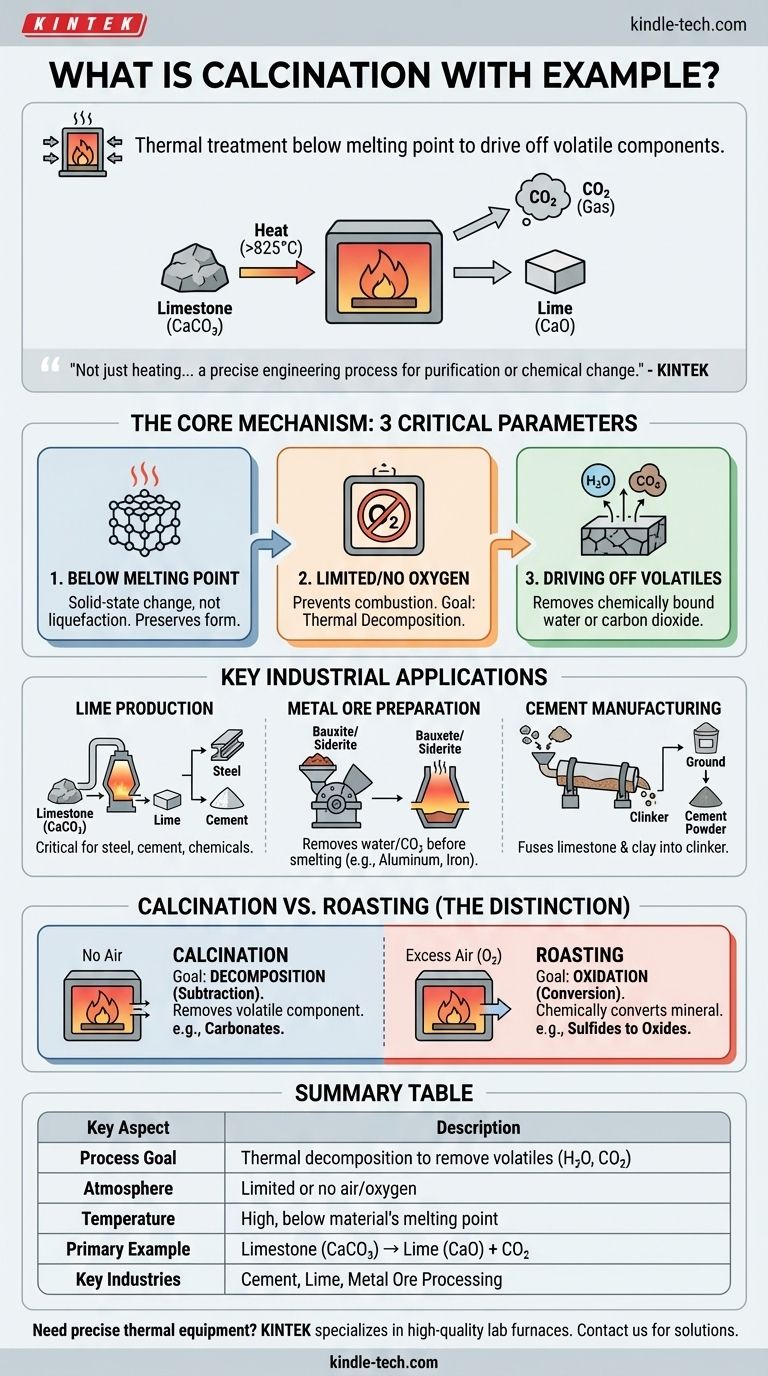
At its core, calcination is a thermal treatment process where a solid material is heated to a high temperature, below its melting point, in the absence or a limited supply of air. This controlled heating is not meant to melt the substance but to cause thermal decomposition, driving off volatile components. The most common example is heating limestone (calcium carbonate) to produce lime (calcium oxide) and release carbon dioxide gas.

Calcination is not simply about heating something up. It is a precise engineering process designed to purify a material or change its chemical composition by using heat to break bonds and drive off specific volatile substances like water or carbon dioxide.
What is calcination with example? A Guide to Thermal Decomposition Processes

The Core Mechanism: What Happens During Calcination?

Calcination is defined by three critical parameters: temperature, atmosphere, and the resulting chemical change. Understanding each is key to grasping the process.

Heating Below the Melting Point

The temperature is raised high enough to break chemical bonds but is intentionally kept below the material's melting point. The goal is to induce a change within the solid-state, not to liquefy it.

This preserves the material's solid form while altering its chemical makeup, often making it more porous or reactive for subsequent steps.

Limited or No Oxygen

The process occurs in an environment with very little or no oxygen. This is a crucial distinction from other heat treatment processes.

The lack of oxygen prevents combustion or oxidation. The objective is thermal decomposition (breaking down with heat), not a reaction with the surrounding air.

Driving Off Volatile Substances

The primary purpose of calcination is to remove a volatile fraction from the solid. This typically involves driving off chemically bound water (hydrates) or carbon dioxide (from carbonates).

For example, when limestone (CaCO₃) is calcined, the heat breaks it down into solid lime (CaO) and carbon dioxide gas (CO₂), which escapes.

Key Industrial Applications

Calcination is a foundational process in several major industries, used to prepare materials for further processing or to create a finished product.

Producing Lime from Limestone

This is the quintessential example. Limestone is heated to over 825°C (1517°F), causing the reaction: CaCO₃(s) → CaO(s) + CO₂(g).

The resulting product, lime (CaO), is a critical component in the manufacturing of steel, cement, and numerous chemical processes.

Preparing Metal Ores

In metallurgy, calcination is a common preparatory step before smelting. It removes water from hydrated ores like bauxite (aluminum ore) or siderite (iron ore).

It also removes carbon dioxide from carbonate ores like smithsonite (ZnCO₃) or calamine (a mix of zinc ores), making the subsequent metal extraction more efficient.

Manufacturing Cement

The production of Portland cement involves heating a mixture of limestone and clay in a kiln to about 1450°C (2640°F).

This calcination process drives off CO₂ and chemically fuses the materials into a new substance called "clinker." The clinker is then ground into the fine powder we know as cement.

Understanding the Key Distinction: Calcination vs. Roasting

Many people confuse calcination with roasting, another high-temperature process used in metallurgy. The difference lies in the atmospheric conditions and the intended chemical reaction.

The Goal of Calcination: Decomposition

As established, calcination uses heat in the absence of air to break down a compound. It is a process of subtraction, where a volatile component is removed from the ore.

The Goal of Roasting: Oxidation

Roasting, by contrast, is performed in an excess of air. Its purpose is to chemically convert a mineral into a new state through oxidation. A common use is converting sulfide ores into more easily processed oxides (e.g., 2ZnS + 3O₂ → 2ZnO + 2SO₂).

Making the Right Choice for Your Analysis

To correctly identify the process you are observing, focus on the inputs and the intended output.

  • If the primary goal is to remove water or CO₂ from a carbonate or hydrate: You are observing calcination, which uses heat to thermally decompose a compound.
  • If the primary goal is to react a sulfide ore with oxygen to form an oxide: You are observing roasting, which leverages both heat and excess air to trigger oxidation.
  • If the primary goal is to produce cement clinker or industrial lime: You are observing one of the most widespread and critical applications of calcination.

Understanding this fundamental difference between thermal decomposition (calcination) and oxidation (roasting) is the key to mastering these core industrial processes.

Summary Table:

Key Aspect Description
Process Goal Thermal decomposition to remove volatile substances (e.g., H₂O, CO₂)
Atmosphere Limited or no air/oxygen
Temperature High, but below the material's melting point
Primary Example Limestone (CaCO₃) → Lime (CaO) + Carbon Dioxide (CO₂)
Key Industries Cement production, lime manufacturing, metal ore processing
Contrasting Process Roasting (uses excess air for oxidation)

Need precise thermal processing equipment for your lab or production line?

Calcination is a critical step in many industrial and research applications, requiring reliable and accurate heating equipment. KINTEK specializes in high-quality lab furnaces and thermal processing solutions designed for processes like calcination, roasting, and more.

Our equipment offers the precise temperature control and atmospheric conditions necessary to achieve consistent, high-purity results, whether you are processing minerals, synthesizing materials, or developing new products.

Contact KINTEK today to discuss how our specialized thermal equipment can enhance the efficiency and accuracy of your material processing workflows.

Visual Guide
What is calcination with example? A Guide to Thermal Decomposition Processes Visual Guide

Related Products

People Also Ask

Related Products

Electric Rotary Kiln Pyrolysis Furnace Plant Machine Calciner Small Rotary Kiln Rotating Furnace

Electric Rotary Kiln Pyrolysis Furnace Plant Machine Calciner Small Rotary Kiln Rotating Furnace

Electric rotary kiln - precisely controlled, it's ideal for calcination and drying of materials like lithium cobalate, rare earths, and non-ferrous metals.

Electric Rotary Kiln Continuous Working Small Rotary Furnace Heating Pyrolysis Plant

Electric Rotary Kiln Continuous Working Small Rotary Furnace Heating Pyrolysis Plant

Efficiently calcine and dry bulk powder and lump fluid materials with an electric heating rotary furnace. Ideal for processing lithium ion battery materials and more.

Non Consumable Vacuum Arc Induction Melting Furnace

Non Consumable Vacuum Arc Induction Melting Furnace

Explore the benefits of Non-Consumable Vacuum Arc Furnace with high melting point electrodes. Small, easy to operate & eco-friendly. Ideal for laboratory research on refractory metals & carbides.

Vertical High Temperature Graphite Vacuum Graphitization Furnace

Vertical High Temperature Graphite Vacuum Graphitization Furnace

Vertical high temperature graphitization furnace for carbonization and graphitization of carbon materials up to 3100℃.Suitable for shaped graphitization of carbon fiber filaments and other materials sintered in a carbon environment.Applications in metallurgy, electronics, and aerospace for producing high-quality graphite products like electrodes and crucibles.

Ultra-High Temperature Graphite Vacuum Graphitization Furnace

Ultra-High Temperature Graphite Vacuum Graphitization Furnace

The ultra-high temperature graphitization furnace utilizes medium frequency induction heating in a vacuum or inert gas environment. The induction coil generates an alternating magnetic field, inducing eddy currents in the graphite crucible, which heats up and radiates heat to the workpiece, bringing it to the desired temperature. This furnace is primarily used for graphitization and sintering of carbon materials, carbon fiber materials, and other composite materials.

High Temperature Muffle Oven Furnace for Laboratory Debinding and Pre Sintering

High Temperature Muffle Oven Furnace for Laboratory Debinding and Pre Sintering

KT-MD High temperature debinding and pre-sintering furnace for ceramic materials with various molding processes. Ideal for electronic components such as MLCC and NFC.

Large Vertical Graphite Vacuum Graphitization Furnace

Large Vertical Graphite Vacuum Graphitization Furnace

A large vertical high-temperature graphitization furnace is a type of industrial furnace used for the graphitization of carbon materials, such as carbon fiber and carbon black. It is a high-temperature furnace that can reach temperatures of up to 3100°C.

Graphite Vacuum Continuous Graphitization Furnace

Graphite Vacuum Continuous Graphitization Furnace

High-temperature graphitization furnace is a professional equipment for graphitization treatment of carbon materials. It is a key equipment for the production of high-quality graphite products. It has high temperature, high efficiency and uniform heating. It is suitable for various high-temperature treatments and graphitization treatments. It is widely used in metallurgy, electronics, aerospace, etc. industry.

Graphite Vacuum Furnace Bottom Discharge Graphitization Furnace for Carbon Materials

Graphite Vacuum Furnace Bottom Discharge Graphitization Furnace for Carbon Materials

Bottom-out graphitization furnace for carbon materials, ultra-high temperature furnace up to 3100°C, suitable for graphitization and sintering of carbon rods and carbon blocks. Vertical design, bottom discharging, convenient feeding and discharging, high temperature uniformity, low energy consumption, good stability, hydraulic lifting system, convenient loading and unloading.

Graphite Vacuum Furnace High Thermal Conductivity Film Graphitization Furnace

Graphite Vacuum Furnace High Thermal Conductivity Film Graphitization Furnace

The high thermal conductivity film graphitization furnace has uniform temperature, low energy consumption and can operate continuously.

Electric Rotary Kiln Small Rotary Furnace for Activated Carbon Regeneration

Electric Rotary Kiln Small Rotary Furnace for Activated Carbon Regeneration

Revitalize your activated carbon with KinTek's Electric Regeneration Furnace. Achieve efficient and cost-effective regeneration with our highly automated rotary kiln and intelligent thermal controller.

2200 ℃ Tungsten Vacuum Heat Treat and Sintering Furnace

2200 ℃ Tungsten Vacuum Heat Treat and Sintering Furnace

Experience the ultimate refractory metal furnace with our Tungsten vacuum furnace. Capable of reaching 2200℃, perfect for sintering advanced ceramics and refractory metals. Order now for high-quality results.

Dental Porcelain Zirconia Sintering Ceramic Furnace Chairside with Transformer

Dental Porcelain Zirconia Sintering Ceramic Furnace Chairside with Transformer

Experience top-notch sintering with Chairside Sintering Furnace with Transformer. Easy to operate, noise-free pallet, and automatic temperature calibration. Order now!

1200℃ Split Tube Furnace with Quartz Tube Laboratory Tubular Furnace

1200℃ Split Tube Furnace with Quartz Tube Laboratory Tubular Furnace

KT-TF12 split tube furnace: high-purity insulation, embedded heating wire coils, and max. 1200C. Widely used for new materials and chemical vapour deposition.

Horizontal High Temperature Graphite Vacuum Graphitization Furnace

Horizontal High Temperature Graphite Vacuum Graphitization Furnace

Horizontal Graphitization Furnace: This type of furnace is designed with the heating elements placed horizontally, allowing for uniform heating of the sample. It's well-suited for graphitizing large or bulky samples that require precise temperature control and uniformity.

High Temperature Alumina (Al2O3) Furnace Tube for Engineering Advanced Fine Ceramics

High Temperature Alumina (Al2O3) Furnace Tube for Engineering Advanced Fine Ceramics

High temperature alumina furnace tube combines the advantages of high hardness of alumina, good chemical inertness and steel, and has excellent wear resistance, thermal shock resistance and mechanical shock resistance.

1200℃ Controlled Atmosphere Furnace Nitrogen Inert Atmosphere Furnace

1200℃ Controlled Atmosphere Furnace Nitrogen Inert Atmosphere Furnace

Discover our KT-12A Pro Controlled atmosphere furnace - high precision, heavy duty vacuum chamber, versatile smart touch screen controller, and excellent temperature uniformity up to 1200C. Ideal for both laboratory and industrial application.

600T Vacuum Induction Hot Press Furnace for Heat Treat and Sintering

600T Vacuum Induction Hot Press Furnace for Heat Treat and Sintering

Discover the 600T Vacuum Induction Hot Press Furnace, designed for high-temperature sintering experiments in vacuum or protected atmospheres. Its precise temperature and pressure control, adjustable working pressure, and advanced safety features make it ideal for nonmetal materials, carbon composites, ceramics, and metal powders.

Vacuum Heat Treat and Pressure Sintering Furnace for High Temperature Applications

Vacuum Heat Treat and Pressure Sintering Furnace for High Temperature Applications

Vacuum pressure sintering furnaces are designed for high temperature hot pressing applications in metal and ceramic sintering. Its advanced features ensure precise temperature control, reliable pressure maintenance, and a robust design for seamless operation.

2200 ℃ Graphite Vacuum Heat Treat Furnace

2200 ℃ Graphite Vacuum Heat Treat Furnace

Discover the power of the KT-VG Graphite Vacuum Furnace - with a maximum working temperature of 2200℃, it's perfect for vacuum sintering of various materials. Learn more now.


Leave Your Message