Fast sintering techniques are a category of advanced manufacturing processes designed to significantly reduce the time and temperature required to compact powdered materials into a solid, dense object. Unlike traditional methods that can take many hours, fast sintering applies energy—typically a combination of heat and pressure—very rapidly to promote densification while minimizing unwanted grain growth, resulting in materials with superior properties.
The core principle behind fast sintering is a strategic race against time. The goal is to apply energy so quickly that the material's particles fuse together and eliminate pores (densification) before the material's microscopic crystal grains have a chance to grow large (coarsening), which often degrades mechanical strength.
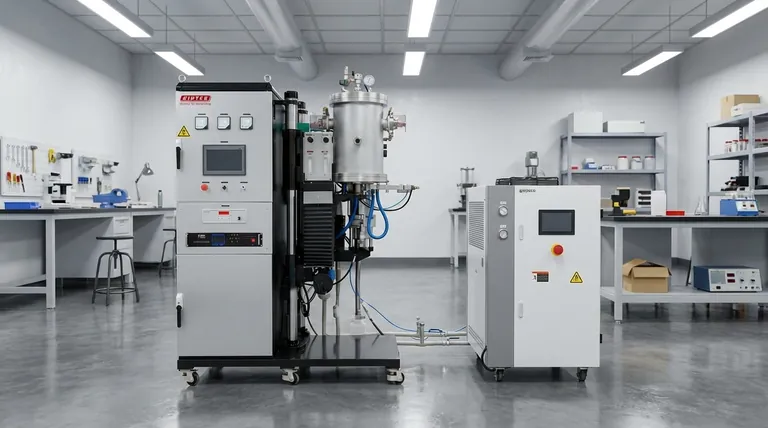
The Fundamental Challenge: Densification vs. Grain Growth
To understand the value of fast sintering, you must first understand the central trade-off in any sintering process.
The Goal: Achieving Full Density
Sintering starts with a loose collection of particles. The primary objective is to heat this powder until the particles bond and the empty spaces, or pores, between them disappear. A fully dense part is stronger and performs more reliably.
The Unwanted Side Effect: Grain Coarsening
The same heat that drives densification also allows the microscopic crystal grains within the material to grow larger. While some grain growth is inevitable, excessive growth often weakens the final product, making it more brittle and prone to failure. Traditional sintering, with its long heating cycles, provides ample time for this undesirable coarsening to occur.
How Fast Sintering Breaks the Mold
Fast sintering techniques disrupt the traditional relationship between time, temperature, and grain growth. They achieve high density by fundamentally changing how energy is delivered to the material.
The Principle of Simultaneous Heat and Pressure
Many fast sintering methods, such as hot pressing or Spark Plasma Sintering (SPS), apply intense pressure at the same time as heat. This dual action provides a powerful advantage. The pressure physically forces the particles together, which dramatically accelerates the rate of densification.
Lower Sintering Temperatures and Times
Because pressure aids the densification process so effectively, the material doesn't need to be heated to as high a temperature or for as long. The references note that the pressure required can be just 1/10th of that needed for cold pressing, making the process more efficient. This reduction in both temperature and time is the key to producing superior materials.
Inhibiting Unwanted Grain Growth
The most critical outcome of a shorter, lower-temperature cycle is the inhibition of grain growth. By completing the sintering process in minutes instead of hours, there is simply not enough time for the grains to grow large. This results in a final product with a very fine grain structure, which is directly linked to higher strength, hardness, and toughness.
Understanding the Trade-offs
While powerful, fast sintering is not a universal solution. It involves specific considerations that differ from conventional furnace sintering.
Equipment Complexity and Cost
These techniques often require highly specialized and expensive equipment capable of delivering high pressures and rapid heating rates simultaneously. This represents a significant capital investment compared to a standard industrial furnace.
Material and Geometry Limitations
The need to apply uniform pressure can limit the size and complexity of the parts that can be produced. Very large or intricately shaped components can be challenging to process effectively with some fast sintering methods.
The Need for Precise Process Control
Rapid heating and cooling cycles demand extremely precise control. Without it, the material can experience thermal shock, leading to cracks, or the sintering may be incomplete, resulting in a part with poor density and performance.
Making the Right Choice for Your Goal
The decision to use a fast sintering technique depends entirely on the desired outcome for your final product.
- If your primary focus is maximum mechanical performance: Fast sintering is the superior choice for creating high-strength components where a fine grain structure is critical.
- If your primary focus is manufacturing efficiency for advanced materials: The dramatically shorter cycle times can significantly increase throughput for high-value parts like cutting tools or medical implants.
- If your primary focus is processing difficult, high-melting-point metals: Fast sintering makes it possible to create dense parts from materials like tungsten or advanced alloys without needing to reach their extreme melting points.
- If your primary focus is cost-effective production of simple, non-critical parts: Traditional furnace sintering often remains the more economical and straightforward solution.
Ultimately, fast sintering empowers engineers and material scientists to create a new class of materials that are stronger and tougher by winning the race against grain growth.
Summary Table:
| Aspect | Traditional Sintering | Fast Sintering |
|---|---|---|
| Time | Hours | Minutes |
| Temperature | High | Lower |
| Pressure Applied | Usually none | Simultaneous heat & pressure |
| Grain Growth | Significant | Minimized |
| Final Material Properties | Standard | Superior strength & toughness |
Ready to enhance your materials' performance?
Fast sintering techniques from KINTEK can help you achieve denser, stronger components with fine microstructures—ideal for cutting tools, medical implants, and advanced alloys.
Let our expertise in lab equipment and consumables support your R&D or production goals. Contact our specialists today to discuss how fast sintering can benefit your application!
Visual Guide

Related Products
- Vacuum Heat Treat and Molybdenum Wire Sintering Furnace for Vacuum Sintering
- Small Vacuum Heat Treat and Tungsten Wire Sintering Furnace
- Laboratory Sterilizer Lab Autoclave Pulse Vacuum Lifting Sterilizer
- Laboratory Sterilizer Lab Autoclave Vertical Pressure Steam Sterilizer for Liquid Crystal Display Automatic Type
- Vacuum Dental Porcelain Sintering Furnace
People Also Ask
- What is vacuum sintering? Achieve Unmatched Purity and Performance for Advanced Materials
- What are the advantages of vacuum sintering? Achieve Superior Purity, Strength, and Performance
- Where is vacuum furnace used? Essential for Aerospace, Medical, and High-Tech Manufacturing
- What is the sintering process of powder metallurgy? Transform Powder into Durable Metal Parts
- What are the factors influencing shrinkage during sintering? Control Dimensional Changes for Precision Parts