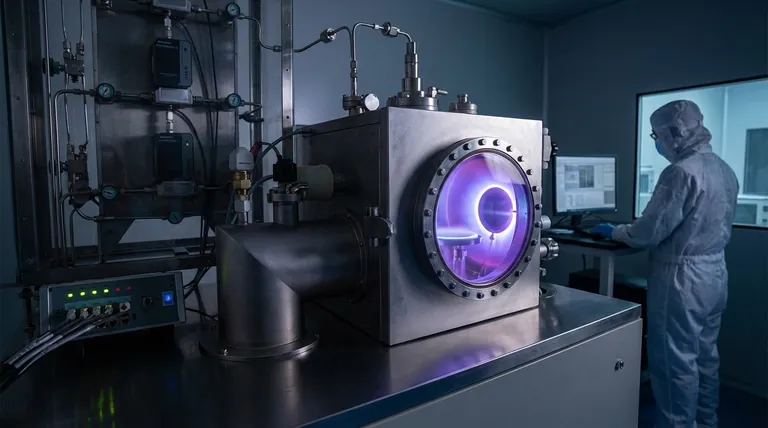
In short, plasma sputtering PVD is a vacuum-based coating technique that uses a high-energy, ionized gas (a plasma) to physically dislodge atoms from a source material, known as a "target." These dislodged atoms then travel through the vacuum and deposit onto a component's surface, forming an exceptionally thin and uniform film.
The core principle to understand is that sputtering is not a chemical or thermal process; it is a purely physical momentum transfer. This makes it a highly controllable and versatile method for creating precise, high-quality coatings on a vast range of materials.
How Sputtering Works: A Step-by-Step Breakdown
To grasp why sputtering is so widely used in advanced manufacturing, from semiconductors to architectural glass, it's essential to understand the mechanics of the process. It's a carefully controlled sequence inside a vacuum chamber.
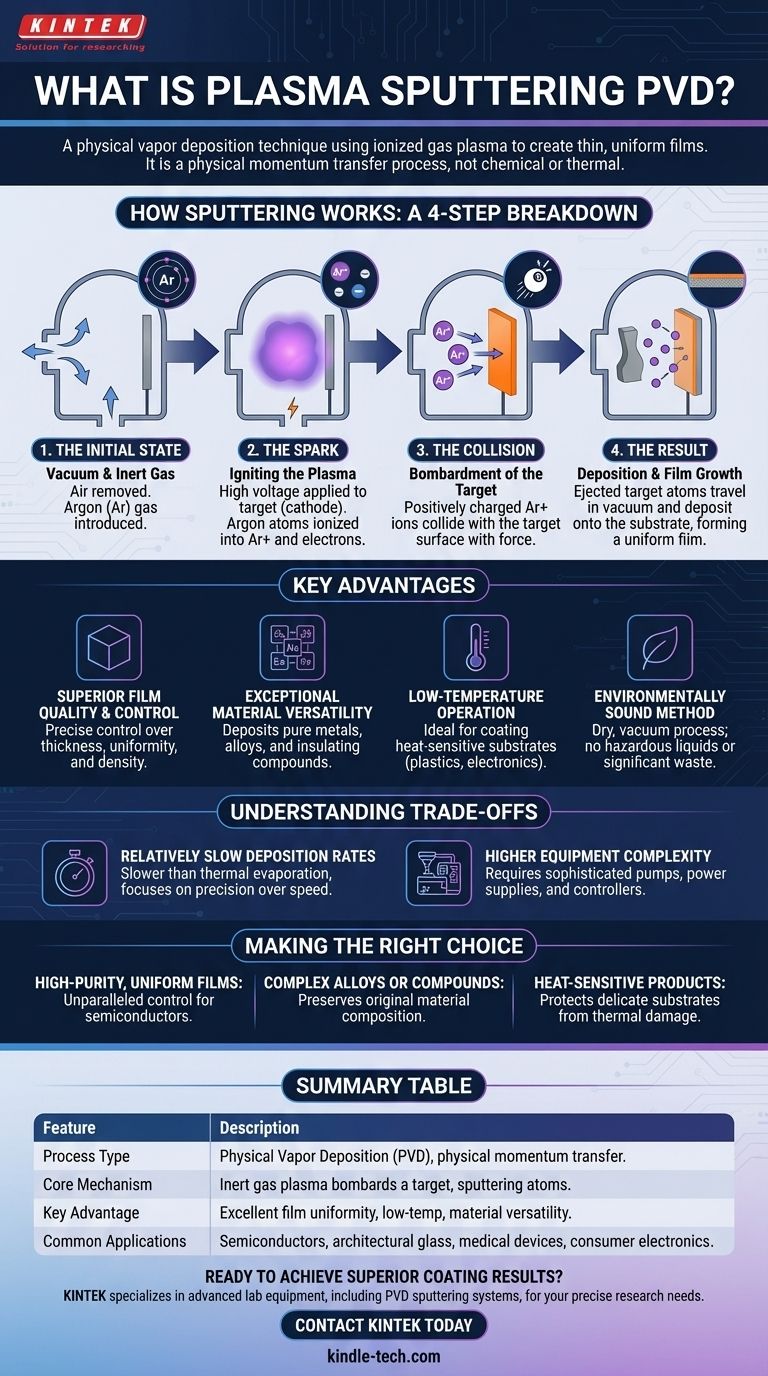
The Initial State: Vacuum and Inert Gas
First, all the air and contaminants are pumped out of a sealed chamber to create a vacuum.
A small, precisely controlled amount of an inert gas, most commonly argon (Ar), is then introduced into the chamber. This gas provides the atoms that will eventually do the work.
The Spark: Igniting the Plasma
A high voltage is applied across the chamber, with the source material (the target) acting as the negative electrode (cathode).
This powerful electric field strips electrons from the argon atoms, creating a glowing, ionized gas known as a plasma. This plasma consists of positively charged argon ions (Ar+) and free electrons.
The Collision: Bombardment of the Target
The positively charged argon ions are powerfully accelerated by the electric field and drawn towards the negatively charged target.
These ions collide with the surface of the target with significant force. Think of it as a microscopic game of billiards, where the argon ions are the cue balls.
The Result: Deposition and Film Growth
The energy from these collisions is enough to physically knock atoms loose from the target material. This ejection of atoms is the "sputtering" effect.
These sputtered atoms travel in a straight line through the vacuum until they strike the object being coated (the substrate), gradually building a thin, uniform, and highly adherent film.
Key Advantages of the Sputtering Process
Sputtering isn't chosen by accident. Its physical mechanism provides distinct advantages over other coating methods.
Superior Film Quality and Control
Because the process physically transfers atoms from the target to the substrate, it allows for extremely precise control over film thickness, uniformity, and density. This is critical for applications like semiconductor manufacturing.
Exceptional Material Versatility
Sputtering can be used to deposit films from a vast array of materials, including pure metals, alloys, and even insulating compounds. This flexibility makes it suitable for many different industries.
Low-Temperature Operation
Compared to processes like Chemical Vapor Deposition (CVD), which often require very high heat, sputtering is a relatively low-temperature process. This makes it ideal for coating temperature-sensitive substrates like plastics or electronics.
An Environmentally Sound Method
PVD sputtering is a dry process that occurs entirely within a vacuum. It does not involve hazardous liquids or produce significant chemical waste, making it a much cleaner and safer alternative to traditional plating methods.
Understanding the Trade-offs
No single process is perfect for every application. To make an informed decision, you must understand the limitations.
Relatively Slow Deposition Rates
The atom-by-atom nature of sputtering, while precise, can be slower than other PVD methods like thermal evaporation. For applications where sheer speed is more important than film quality, other methods might be preferred.
Higher Equipment Complexity
A sputtering system requires sophisticated vacuum pumps, high-voltage power supplies, and precise gas flow controllers. This can make the initial equipment investment more significant than for simpler coating techniques.
Making the Right Choice for Your Goal
Selecting a coating process depends entirely on the required outcome. Sputtering excels where precision and quality are paramount.
- If your primary focus is high-purity, uniform films: Sputtering offers unparalleled control over film thickness, density, and composition.
- If you are working with complex alloys or compounds: Sputtering is excellent at preserving the original material's composition in the deposited film.
- If you need to coat heat-sensitive products: The low-temperature nature of the process protects delicate substrates from thermal damage.
Ultimately, plasma sputtering is a cornerstone technology for creating the high-performance surfaces that define modern electronics and advanced materials.
Summary Table:
| Feature | Description |
|---|---|
| Process Type | Physical Vapor Deposition (PVD), a physical momentum transfer. |
| Core Mechanism | Inert gas plasma bombards a target, sputtering atoms onto a substrate. |
| Key Advantage | Excellent film uniformity, low-temperature operation, and material versatility. |
| Common Applications | Semiconductor manufacturing, architectural glass, medical devices, and consumer electronics. |
Ready to achieve superior coating results?
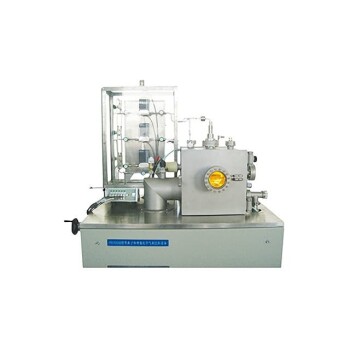
KINTEK specializes in advanced lab equipment, including PVD sputtering systems, to meet the precise needs of your laboratory. Whether you are developing new semiconductor components or coating temperature-sensitive materials, our expertise ensures you get the high-quality, uniform films your research demands.
Contact KINTEK today to discuss how our sputtering solutions can enhance your projects and drive innovation in your lab.
Visual Guide
Related Products
- Inclined Rotary Plasma Enhanced Chemical Vapor Deposition PECVD Equipment Tube Furnace Machine
- RF PECVD System Radio Frequency Plasma-Enhanced Chemical Vapor Deposition RF PECVD
- 915MHz MPCVD Diamond Machine Microwave Plasma Chemical Vapor Deposition System Reactor
- HFCVD Machine System Equipment for Drawing Die Nano-Diamond Coating
- Vacuum Hot Press Furnace Machine for Lamination and Heating
People Also Ask
- What is the difference between CVD and PECVD? Choose the Right Thin-Film Deposition Method
- What is PECVD silicon deposition? Achieve Low-Temperature, High-Quality Thin Films
- What is PECVD used for? Achieve Low-Temperature, High-Performance Thin Films
- What materials are deposited in PECVD? Discover the Versatile Thin-Film Materials for Your Application
- What is plasma in CVD process? Lowering Deposition Temperatures for Heat-Sensitive Materials