Knowledge What is the application of vacuum technology in industries? Enabling Precision Manufacturing and Purity
Author avatar

Tech Team · Kintek Solution

Updated 6 days ago

What is the application of vacuum technology in industries? Enabling Precision Manufacturing and Purity


In nearly every advanced industry, vacuum technology is an invisible yet essential tool that enables the creation of modern products. It is the foundational process for manufacturing the semiconductors in your phone, preserving the food you eat, and developing new pharmaceuticals. Its applications are not about creating "emptiness" for its own sake, but about precisely removing atmospheric gases to control an environment and enable processes that are otherwise impossible.

The fundamental value of industrial vacuum is not suction, but environmental control. By removing air and other particles, vacuum systems create a highly controlled space that prevents contamination, eliminates physical obstructions, and alters the fundamental physical properties of materials.
What is the application of vacuum technology in industries? Enabling Precision Manufacturing and Purity

The Core Principles Driving Vacuum Applications

To understand where vacuum is used, you must first understand why it is used. Industrial applications are almost always based on one of four fundamental principles.

Principle 1: Removing Particle Interference

Many high-tech processes involve directing tiny particles—ions, electrons, or molecules—from a source to a target.

Atmospheric gas molecules act as a dense field of obstacles, causing these directed particles to scatter and lose energy, ruining the process.

A vacuum clears this path. This ensures processes like semiconductor manufacturing (thin-film deposition), optical lens coating, and scientific research (particle accelerators) can function with absolute precision.

Principle 2: Preventing Unwanted Reactions and Contamination

The air around us is chemically reactive, containing oxygen, water vapor, and various contaminants.

These substances can cause unwanted oxidation (like rust), introduce impurities, or otherwise degrade materials during sensitive processes.

By removing the atmosphere, a vacuum creates an inert environment. This is critical for high-purity welding of reactive metals like titanium, sterilizing medical devices without high heat, and producing pristine materials for aerospace components.

Principle 3: Leveraging Pressure Differentials

This is the most intuitive application of vacuum—using atmospheric pressure to perform work.

When you remove air from one side of an object, the normal atmospheric pressure on the other side (about 14.7 psi at sea level) pushes on it with immense force.

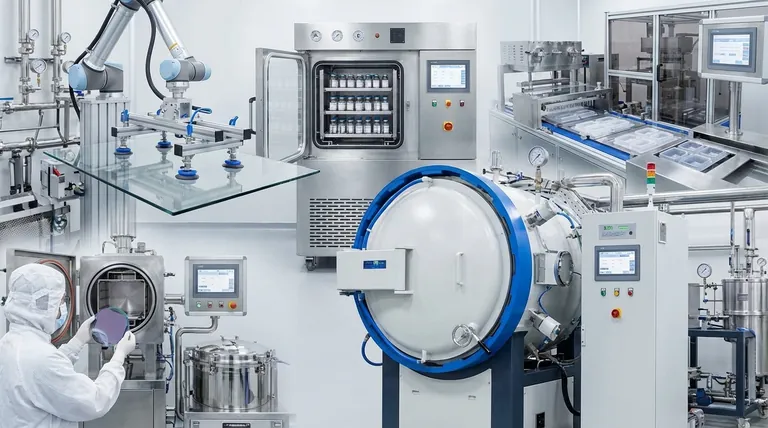
This principle is the basis for vacuum lifting systems that move heavy glass or metal plates, thermoforming plastics into packaging, and vacuum chucks that hold delicate parts for machining. It is simple, powerful, and clean.

Principle 4: Lowering Boiling Points

The boiling point of a liquid is not fixed; it depends on the pressure above it. Lowering the pressure dramatically lowers the temperature at which a liquid boils.

This allows for the removal of water or other solvents from a product without using high heat, which could destroy it.

This is the key to freeze-drying (lyophilization) in the pharmaceutical and food industries, preserving sensitive biological samples and creating instant coffee. It is also used for vacuum distillation to purify temperature-sensitive vitamins and oils.

Understanding the Trade-offs and Challenges

Implementing vacuum technology is not a simple decision. It involves significant investment and operational complexity that must be weighed against its benefits.

The Cost of a Controlled Environment

Vacuum systems are expensive. The initial capital outlay for high-quality pumps, chambers, valves, and gauges can be substantial, especially for systems requiring high or ultra-high vacuum levels.

Energy Consumption

Generating and maintaining a vacuum is an energy-intensive process. Pumps often need to run continuously to overcome tiny leaks and the outgassing of materials within the chamber, leading to significant ongoing operational costs.

Complexity and Maintenance

Vacuum systems are not "set it and forget it" equipment. They require specialized knowledge to design, operate, and maintain.

Leak detection is a constant concern, as even a microscopic leak can render a high-vacuum process useless. Regular maintenance of pump oil, seals, and sensors is mandatory.

Material Limitations (Outgassing)

Not all materials behave well in a vacuum. Plastics, composites, and certain adhesives can slowly release trapped gases—a phenomenon called outgassing.

This can contaminate the vacuum environment, making it impossible to reach the required pressure and potentially ruining sensitive products like optical lenses or semiconductors.

Making the Right Choice for Your Goal

The right vacuum application depends entirely on the industrial outcome you need to achieve.

  • If your primary focus is high-purity manufacturing and precision: Leverage deep vacuum systems to eliminate particle interference and prevent reactions, essential for semiconductors, optics, and aerospace.
  • If your primary focus is material preservation and stability: Use vacuum's ability to lower boiling points and remove reactive gases for food processing, pharmaceutical production, and chemical purification.
  • If your primary focus is physical automation and handling: Employ low-vacuum systems to create powerful pressure differentials for lifting, forming, holding, and packaging applications.

Ultimately, mastering vacuum technology is about understanding which atmospheric element you need to remove to achieve your specific industrial outcome.

Summary Table:

Application Area Primary Function Key Industries
Precision Manufacturing Removes particle interference for accuracy Semiconductors, Optics, Aerospace
Material Preservation Prevents unwanted reactions and contamination Food Processing, Pharmaceuticals
Physical Automation Leverages pressure differentials for work Packaging, Material Handling
Process Enhancement Lowers boiling points for gentle processing Chemical, Pharmaceutical

Ready to enhance your industrial processes with precision vacuum solutions? KINTEK specializes in high-performance lab equipment and consumables, providing reliable vacuum systems tailored to your laboratory's unique needs. Whether you're in semiconductor manufacturing, pharmaceuticals, or materials research, our expertise ensures optimal environmental control for contamination-free results. Contact us today to discuss how our vacuum technology can drive efficiency and innovation in your operations!

Visual Guide
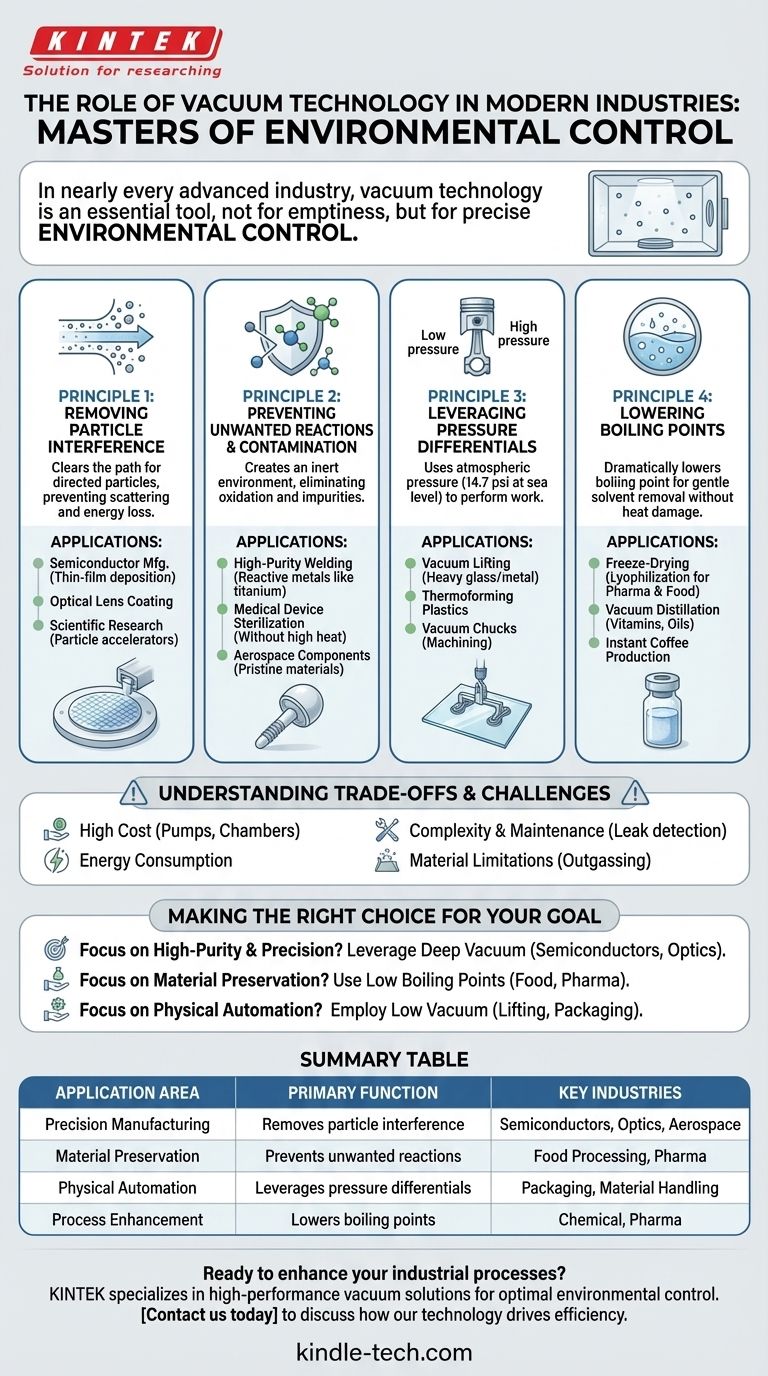
What is the application of vacuum technology in industries? Enabling Precision Manufacturing and Purity Visual Guide

Related Products

People Also Ask

Related Products

Vacuum Heat Treat Furnace with Ceramic Fiber Liner

Vacuum Heat Treat Furnace with Ceramic Fiber Liner

Vacuum furnace with polycrystalline ceramic fiber insulation liner for excellent heat insulation and uniform temperature field. Choose from 1200℃ or 1700℃ max. working temperature with high vacuum performance and precise temperature control.

Vacuum Heat Treat Sintering Brazing Furnace

Vacuum Heat Treat Sintering Brazing Furnace

A vacuum brazing furnace is a type of industrial furnace used for brazing, a metalworking process that joins two pieces of metal using a filler metal that melts at a lower temperature than the base metals. Vacuum brazing furnaces are typically used for high-quality applications where a strong, clean joint is required.

2200 ℃ Tungsten Vacuum Heat Treat and Sintering Furnace

2200 ℃ Tungsten Vacuum Heat Treat and Sintering Furnace

Experience the ultimate refractory metal furnace with our Tungsten vacuum furnace. Capable of reaching 2200℃, perfect for sintering advanced ceramics and refractory metals. Order now for high-quality results.

Vacuum Heat Treat Furnace and Levitation Induction Melting Furnace

Vacuum Heat Treat Furnace and Levitation Induction Melting Furnace

Experience precise melting with our Vacuum Levitation Melting Furnace. Ideal for high melting point metals or alloys, with advanced technology for effective smelting. Order now for high-quality results.

Molybdenum Vacuum Heat Treat Furnace

Molybdenum Vacuum Heat Treat Furnace

Discover the benefits of a high-configuration molybdenum vacuum furnace with heat shield insulation. Ideal for high-purity, vacuum environments like sapphire crystal growth and heat treatment.

Vacuum Heat Treat and Sintering Furnace with 9MPa Air Pressure

Vacuum Heat Treat and Sintering Furnace with 9MPa Air Pressure

The air pressure sintering furnace is a high-tech equipment commonly used for the sintering of advanced ceramic materials. It combines vacuum sintering and pressure sintering techniques to achieve high-density and high-strength ceramics.

Vacuum Heat Treat and Molybdenum Wire Sintering Furnace for Vacuum Sintering

Vacuum Heat Treat and Molybdenum Wire Sintering Furnace for Vacuum Sintering

A vacuum molybdenum wire sintering furnace is a vertical or bedroom structure, which is suitable for withdrawal, brazing, sintering and degassing of metal materials under high vacuum and high temperature conditions. It is also suitable for dehydroxylation treatment of quartz materials.

Vertical Laboratory Quartz Tube Furnace Tubular Furnace

Vertical Laboratory Quartz Tube Furnace Tubular Furnace

Elevate your experiments with our Vertical Tube Furnace. Versatile design allows for operation under various environments and heat treatment applications. Order now for precise results!

1200℃ Controlled Atmosphere Furnace Nitrogen Inert Atmosphere Furnace

1200℃ Controlled Atmosphere Furnace Nitrogen Inert Atmosphere Furnace

Discover our KT-12A Pro Controlled atmosphere furnace - high precision, heavy duty vacuum chamber, versatile smart touch screen controller, and excellent temperature uniformity up to 1200C. Ideal for both laboratory and industrial application.

1400℃ Controlled Atmosphere Furnace with Nitrogen and Inert Atmosphere

1400℃ Controlled Atmosphere Furnace with Nitrogen and Inert Atmosphere

Achieve precise heat treatment with KT-14A controlled atmosphere furnace. Vacuum sealed with a smart controller, it's ideal for lab and industrial use up to 1400℃.

Vacuum Hot Press Furnace Heated Vacuum Press Machine Tube Furnace

Vacuum Hot Press Furnace Heated Vacuum Press Machine Tube Furnace

Reduce forming pressure & shorten sintering time with Vacuum Tube Hot Press Furnace for high-density, fine-grain materials. Ideal for refractory metals.

600T Vacuum Induction Hot Press Furnace for Heat Treat and Sintering

600T Vacuum Induction Hot Press Furnace for Heat Treat and Sintering

Discover the 600T Vacuum Induction Hot Press Furnace, designed for high-temperature sintering experiments in vacuum or protected atmospheres. Its precise temperature and pressure control, adjustable working pressure, and advanced safety features make it ideal for nonmetal materials, carbon composites, ceramics, and metal powders.

Vacuum Dental Porcelain Sintering Furnace

Vacuum Dental Porcelain Sintering Furnace

Get precise and reliable results with KinTek's Vacuum Porcelain Furnace. Suitable for all porcelain powders, it features hyperbolic ceramic furnace function, voice prompt, and automatic temperature calibration.

Ultra-High Temperature Graphite Vacuum Graphitization Furnace

Ultra-High Temperature Graphite Vacuum Graphitization Furnace

The ultra-high temperature graphitization furnace utilizes medium frequency induction heating in a vacuum or inert gas environment. The induction coil generates an alternating magnetic field, inducing eddy currents in the graphite crucible, which heats up and radiates heat to the workpiece, bringing it to the desired temperature. This furnace is primarily used for graphitization and sintering of carbon materials, carbon fiber materials, and other composite materials.

Laboratory Vacuum Tilt Rotary Tube Furnace Rotating Tube Furnace

Laboratory Vacuum Tilt Rotary Tube Furnace Rotating Tube Furnace

Discover the versatility of Laboratory Rotary Furnace: Ideal for calcination, drying, sintering, and high-temperature reactions. Adjustable rotating and tilting functions for optimal heating. Suitable for vacuum and controlled atmosphere environments. Learn more now!

Vertical High Temperature Graphite Vacuum Graphitization Furnace

Vertical High Temperature Graphite Vacuum Graphitization Furnace

Vertical high temperature graphitization furnace for carbonization and graphitization of carbon materials up to 3100℃.Suitable for shaped graphitization of carbon fiber filaments and other materials sintered in a carbon environment.Applications in metallurgy, electronics, and aerospace for producing high-quality graphite products like electrodes and crucibles.

Vacuum Sealed Continuous Working Rotary Tube Furnace Rotating Tube Furnace

Vacuum Sealed Continuous Working Rotary Tube Furnace Rotating Tube Furnace

Experience efficient material processing with our vacuum-sealed rotary tube furnace. Perfect for experiments or industrial production, equipped with optional features for controlled feeding and optimized results. Order now.

1700℃ Controlled Atmosphere Furnace Nitrogen Inert Atmosphere Furnace

1700℃ Controlled Atmosphere Furnace Nitrogen Inert Atmosphere Furnace

KT-17A Controlled atmosphere furnace: 1700℃ heating, vacuum sealing technology, PID temperature control, and versatile TFT smart touch screen controller for laboratory and industrial use.

Laboratory Quartz Tube Furnace Tubular RTP Heating Furnace

Laboratory Quartz Tube Furnace Tubular RTP Heating Furnace

Get lightning-fast heating with our RTP Rapid Heating Tube Furnace. Designed for precise, high-speed heating and cooling with convenient sliding rail and TFT touch screen controller. Order now for ideal thermal processing!

1800℃ Muffle Oven Furnace for Laboratory

1800℃ Muffle Oven Furnace for Laboratory

KT-18 muffle furnace with Japan Al2O3 polycrystalline fibe and Silicon Molybdenum heating element, up to 1900℃, PID temperature control and 7" smart touch screen. Compact design, low heat loss, and high energy efficiency. Safety interlock system and versatile functions.


Leave Your Message