Knowledge vacuum induction melting furnace What is the basic lining material for induction furnace? The Critical Choice for Safe & Efficient Melting
Author avatar

Tech Team · Kintek Solution

Updated 2 months ago

What is the basic lining material for induction furnace? The Critical Choice for Safe & Efficient Melting


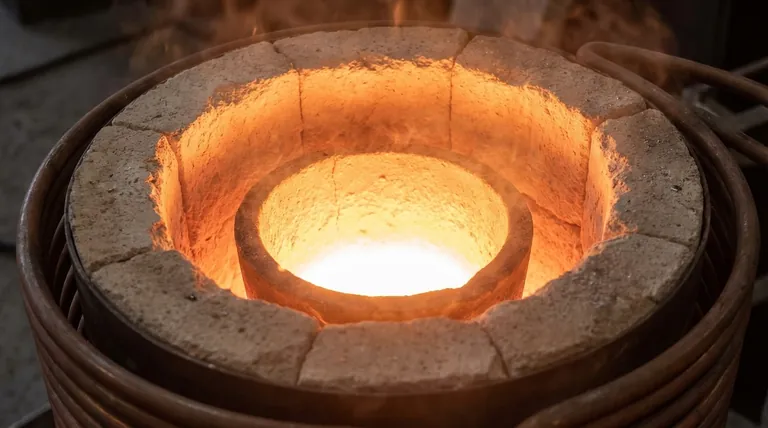
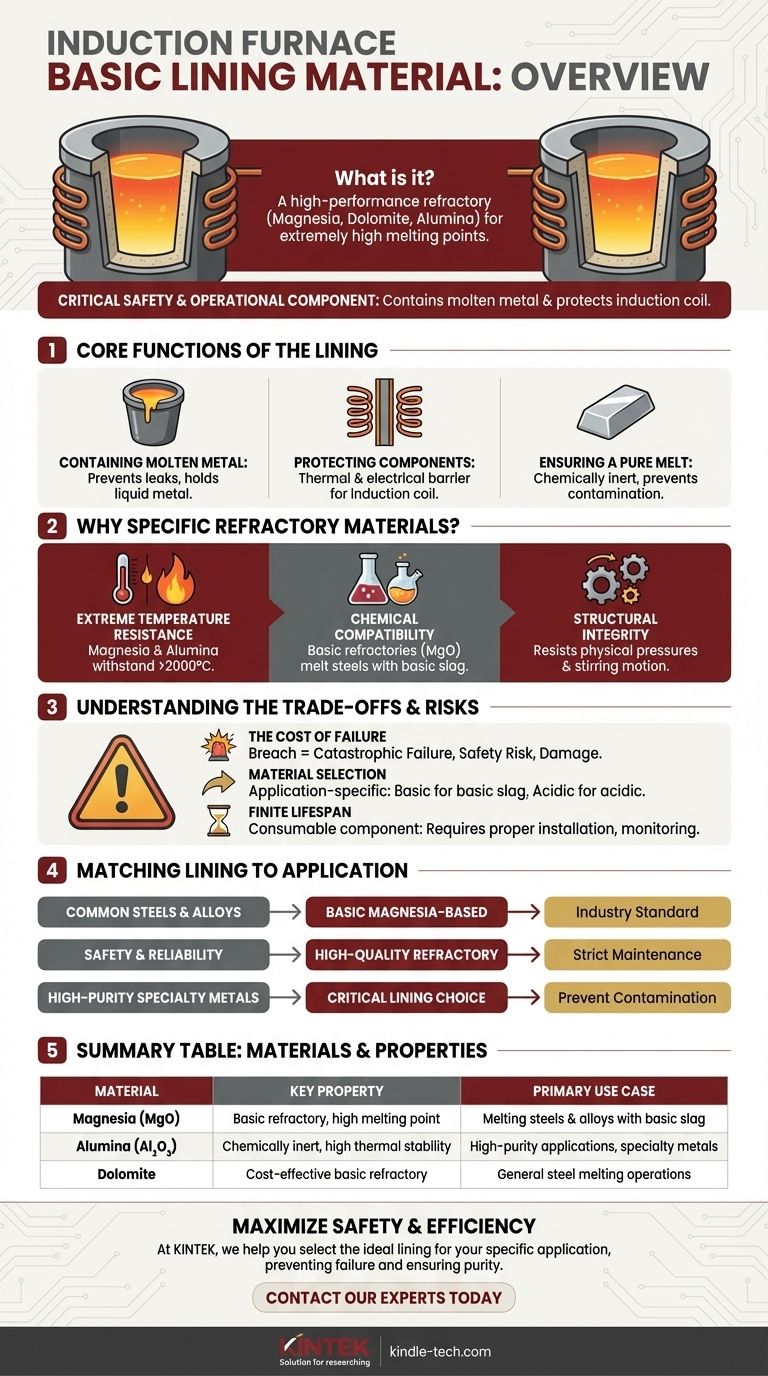
The basic lining material for an induction furnace is a high-performance refractory, most commonly composed of magnesia, dolomite, or alumina. These specific materials are chosen because they possess extremely high melting points and can maintain their structural integrity and chemical stability at the intense temperatures required for melting metals.

The furnace lining is not merely a container; it is a critical safety and operational component. Its primary purpose is to safely contain the molten metal while simultaneously protecting the furnace's vital induction coil from thermal and electrical damage.
What is the basic lining material for induction furnace? The Critical Choice for Safe & Efficient Melting

The Core Function of the Furnace Lining

To understand why specific materials are used, we must first appreciate the demanding role the lining plays. It is the most critical part of the induction furnace, serving multiple essential functions simultaneously.

Containing the Molten Metal

The most obvious function of the lining is to act as the crucible. It forms the vessel that holds the liquid metal, preventing it from leaking or breaking out.

Protecting Critical Components

The lining creates a thermal and electrical barrier between the superheated molten metal and the induction coil. A failure here would be catastrophic, destroying the coil and shutting down the furnace.

Ensuring a Pure Melt

The refractory material must be chemically inert with respect to the metal being melted. This ensures that the lining does not break down and contaminate the final alloy, which is crucial for high-purity applications.

Why Specific Refractory Materials Are Used

The term refractory simply means a material is resistant to decomposition by heat, pressure, or chemical attack. The choice of material is a deliberate engineering decision based on these properties.

Extreme Temperature Resistance

Materials like magnesia (MgO) and alumina (Al₂O₃) have melting points far exceeding those of the metals they are designed to contain. This thermal stability is the non-negotiable, primary requirement.

Chemical Compatibility

The "basic" in "basic lining" refers to its chemical nature. Basic refractories like magnesia are used to melt steels and other alloys that produce a basic slag, preventing a reactive breakdown of the lining itself.

Structural Integrity

The lining must be strong enough to withstand the physical pressures and stirring motion of the molten metal, which is agitated by the magnetic fields of the induction furnace.

Understanding the Trade-offs

While the concept seems straightforward, selecting and maintaining a lining involves critical considerations. An incorrect choice or poor maintenance leads directly to failure.

The Cost of Lining Failure

A breach in the lining is the single most dangerous failure mode for an induction furnace. It can lead to an explosion if molten metal comes into contact with the water-cooled induction coils, posing a severe safety risk and causing extensive equipment damage.

Material Selection is Not Universal

The choice of lining material is dictated by the application. While magnesia is a common basic lining, an acidic lining (like silica) would be used for melting metals that produce an acidic slag. Using the wrong type of lining will cause rapid chemical erosion and premature failure.

Finite Lifespan

No furnace lining lasts forever. It is a consumable component that slowly erodes with each melt cycle. Proper installation, sintering (the initial heating process), and ongoing monitoring are essential to maximize its life and operate safely.

Matching the Lining to the Application

The right material is always the one that provides the maximum safety and performance for the specific metal being processed.

  • If your primary focus is melting common steels and alloys: A basic magnesia-based lining is the industry standard for its chemical compatibility and high performance.
  • If your primary focus is safety and reliability: The selection of a high-quality refractory material and a strict maintenance schedule are the most important factors in preventing catastrophic failure.
  • If your primary focus is producing high-purity specialty metals: The choice of lining is critical to prevent contamination and ensure the final product meets its required chemical specifications.

Ultimately, the induction furnace lining is the foundational element that makes safe, clean, and efficient melting possible.

Summary Table:

Material Key Property Primary Use Case
Magnesia (MgO) Basic refractory, high melting point Melting steels and alloys with basic slag
Alumina (Al₂O₃) Chemically inert, high thermal stability High-purity applications, specialty metals
Dolomite Cost-effective basic refractory General steel melting operations

Maximize the safety and efficiency of your melting operations with the right furnace lining.

At KINTEK, we understand that the furnace lining is the heart of your induction furnace. Choosing the correct refractory material is critical for preventing catastrophic failure, protecting your equipment, and ensuring the purity of your final product. Whether you are melting common steels or high-purity specialty metals, our experts can help you select the ideal lining solution for your specific application.

Let KINTEK provide the reliable lab equipment and consumables your laboratory needs. Contact our experts today for a consultation on optimizing your furnace performance and safety.

Visual Guide
What is the basic lining material for induction furnace? The Critical Choice for Safe & Efficient Melting Visual Guide

Related Products

People Also Ask

Related Products

Non Consumable Vacuum Arc Induction Melting Furnace

Non Consumable Vacuum Arc Induction Melting Furnace

Explore the benefits of Non-Consumable Vacuum Arc Furnace with high melting point electrodes. Small, easy to operate & eco-friendly. Ideal for laboratory research on refractory metals & carbides.

600T Vacuum Induction Hot Press Furnace for Heat Treat and Sintering

600T Vacuum Induction Hot Press Furnace for Heat Treat and Sintering

Discover the 600T Vacuum Induction Hot Press Furnace, designed for high-temperature sintering experiments in vacuum or protected atmospheres. Its precise temperature and pressure control, adjustable working pressure, and advanced safety features make it ideal for nonmetal materials, carbon composites, ceramics, and metal powders.

Vacuum Arc Induction Melting Furnace

Vacuum Arc Induction Melting Furnace

Discover the power of Vacuum Arc Furnace for melting active & refractory metals. High-speed, remarkable degassing effect, and free of contamination. Learn more now!

Copper Foam

Copper Foam

Copper foam has good thermal conductivity and can be widely used for heat conduction and heat dissipation of motors/electrical appliances and electronic components.

Controlled Nitrogen Inert Hydrogen Atmosphere Furnace

Controlled Nitrogen Inert Hydrogen Atmosphere Furnace

KT-AH Hydrogen atmosphere furnace - induction gas furnace for sintering/annealing with built-in safety features, dual housing design, and energy-saving efficiency. Ideal for lab and industrial use.

Lab-Scale Vacuum Induction Melting Furnace

Lab-Scale Vacuum Induction Melting Furnace

Get precise alloy composition with our Vacuum Induction Melting Furnace. Ideal for aerospace, nuclear energy, and electronic industries. Order now for effective smelting and casting of metals and alloys.

High Temperature Alumina (Al2O3) Furnace Tube for Engineering Advanced Fine Ceramics

High Temperature Alumina (Al2O3) Furnace Tube for Engineering Advanced Fine Ceramics

High temperature alumina furnace tube combines the advantages of high hardness of alumina, good chemical inertness and steel, and has excellent wear resistance, thermal shock resistance and mechanical shock resistance.

Silicon Carbide SiC Thermal Heating Elements for Electric Furnace

Silicon Carbide SiC Thermal Heating Elements for Electric Furnace

Experience the advantages of Silicon Carbide (SiC) Heating Element: Long service life, high corrosion and oxidation resistance, fast heating speed, and easy maintenance. Learn more now!

Graphite Vacuum Furnace Bottom Discharge Graphitization Furnace for Carbon Materials

Graphite Vacuum Furnace Bottom Discharge Graphitization Furnace for Carbon Materials

Bottom-out graphitization furnace for carbon materials, ultra-high temperature furnace up to 3100°C, suitable for graphitization and sintering of carbon rods and carbon blocks. Vertical design, bottom discharging, convenient feeding and discharging, high temperature uniformity, low energy consumption, good stability, hydraulic lifting system, convenient loading and unloading.

Boron Nitride (BN) Ceramic Plate

Boron Nitride (BN) Ceramic Plate

Boron nitride (BN) ceramic plates do not use aluminum water to wet, and can provide comprehensive protection for the surface of materials that directly contact molten aluminum, magnesium, zinc alloys and their slag.

Molybdenum Disilicide (MoSi2) Thermal Elements Electric Furnace Heating Element

Molybdenum Disilicide (MoSi2) Thermal Elements Electric Furnace Heating Element

Discover the power of Molybdenum Disilicide (MoSi2) Heating Element for high-temperature resistance. Unique oxidation resistance with stable resistance value. Learn more about its benefits now!

Hexagonal Boron Nitride HBN Ceramic Ring

Hexagonal Boron Nitride HBN Ceramic Ring

Boron nitride ceramic (BN) rings are commonly used in high temperature applications such as furnace fixtures, heat exchangers and semiconductor processing.

Graphite Vacuum Furnace High Thermal Conductivity Film Graphitization Furnace

Graphite Vacuum Furnace High Thermal Conductivity Film Graphitization Furnace

The high thermal conductivity film graphitization furnace has uniform temperature, low energy consumption and can operate continuously.

Vacuum Heat Treat and Molybdenum Wire Sintering Furnace for Vacuum Sintering

Vacuum Heat Treat and Molybdenum Wire Sintering Furnace for Vacuum Sintering

A vacuum molybdenum wire sintering furnace is a vertical or bedroom structure, which is suitable for withdrawal, brazing, sintering and degassing of metal materials under high vacuum and high temperature conditions. It is also suitable for dehydroxylation treatment of quartz materials.

Large Vertical Graphite Vacuum Graphitization Furnace

Large Vertical Graphite Vacuum Graphitization Furnace

A large vertical high-temperature graphitization furnace is a type of industrial furnace used for the graphitization of carbon materials, such as carbon fiber and carbon black. It is a high-temperature furnace that can reach temperatures of up to 3100°C.

Engineering Advanced Fine Alumina Al2O3 Ceramic Rod Insulated for Industrial Applications

Engineering Advanced Fine Alumina Al2O3 Ceramic Rod Insulated for Industrial Applications

Insulated alumina rod is a fine ceramic material. Alumina rods have excellent electrical insulating properties, high chemical resistance and low thermal expansion.

High Temperature Wear-Resistant Alumina Al2O3 Plate for Engineering Advanced Fine Ceramics

High Temperature Wear-Resistant Alumina Al2O3 Plate for Engineering Advanced Fine Ceramics

High temperature wear-resistant insulating alumina plate has excellent insulation performance and high temperature resistance.

Ultra-High Temperature Graphite Vacuum Graphitization Furnace

Ultra-High Temperature Graphite Vacuum Graphitization Furnace

The ultra-high temperature graphitization furnace utilizes medium frequency induction heating in a vacuum or inert gas environment. The induction coil generates an alternating magnetic field, inducing eddy currents in the graphite crucible, which heats up and radiates heat to the workpiece, bringing it to the desired temperature. This furnace is primarily used for graphitization and sintering of carbon materials, carbon fiber materials, and other composite materials.

Vertical High Temperature Graphite Vacuum Graphitization Furnace

Vertical High Temperature Graphite Vacuum Graphitization Furnace

Vertical high temperature graphitization furnace for carbonization and graphitization of carbon materials up to 3100℃.Suitable for shaped graphitization of carbon fiber filaments and other materials sintered in a carbon environment.Applications in metallurgy, electronics, and aerospace for producing high-quality graphite products like electrodes and crucibles.

Horizontal High Temperature Graphite Vacuum Graphitization Furnace

Horizontal High Temperature Graphite Vacuum Graphitization Furnace

Horizontal Graphitization Furnace: This type of furnace is designed with the heating elements placed horizontally, allowing for uniform heating of the sample. It's well-suited for graphitizing large or bulky samples that require precise temperature control and uniformity.


Leave Your Message