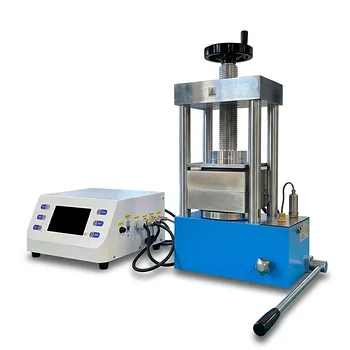
The primary benefit of using a cold isostatic press (CIP) for secondary treatment is the elimination of structural inconsistencies left by the initial sintering process. By applying high, uniform pressure, CIP specifically targets residual porosity and density gradients in TiC10/Cu-Al2O3 composites.
Core Takeaway: Initial hot press sintering applies pressure from one direction, often resulting in uneven density and hardness. Secondary treatment with a cold isostatic press solves this by applying isotropic pressure (from all sides), pushing the material density from 98.53% to 98.76% and ensuring uniform microhardness throughout the composite.
Overcoming Sintering Limitations
The Problem with Unidirectional Pressure
Primary hot press sintering typically relies on unidirectional pressure. While effective for initial consolidation, this method often creates a density gradient within the material.
Consequently, the composite may exhibit uneven hardness distributions, leaving some areas less dense and mechanically weaker than others.
The Power of Isotropic Pressure
The cold isostatic press addresses this by utilizing a liquid medium to apply pressure from all directions simultaneously.
For TiC10/Cu-Al2O3 composites, this involves subjecting the material to high pressures, such as 280 MPa. This multi-directional force corrects the imbalances created during the initial linear pressing stage.
Quantifiable Material Improvements
Eliminating Residual Pores
The specific goal of this secondary treatment is to close "closed pores" that survived the hot pressing stage.
By crushing these internal voids, the process removes weak points in the microstructure that could otherwise serve as crack initiation sites under stress.
Measurable Density Gains
While the composite is already dense after hot pressing, CIP squeezes out the final inefficiencies to approach theoretical density limits.
Data indicates this process can increase the relative density of TiC10/Cu-Al2O3 from 98.53% to 98.76%. While the percentage gain appears small, at these high levels, it represents a significant reduction in remaining porosity.
Uniform Microhardness
The most critical functional benefit is the homogenization of mechanical properties.
Because the density becomes uniform across the entire volume of the material, the microhardness becomes consistent, eliminating soft spots and ensuring predictable performance.
Understanding the Trade-offs
Incremental Gains vs. Process Complexity
It is important to note that CIP is a secondary treatment; the density gain (approx. 0.23%) is an optimization, not a transformation.
Manufacturers must evaluate if this marginal increase in density is strictly necessary for the application, as it adds an extra step and equipment requirement to the production line.
Equipment Requirements
Unlike Hot Isostatic Pressing (HIP) which uses gas at high temperatures, CIP uses liquid at lower temperatures.
While this avoids thermal complications, handling liquids at 280 MPa requires robust, specialized high-pressure safety equipment and maintenance protocols.
Making the Right Choice for Your Project
Deciding to implement secondary CIP treatment depends on the safety margins and performance requirements of your final component.
- If your primary focus is maximum reliability: Use CIP to eliminate microscopic voids and internal flaws that could lead to fatigue failure.
- If your primary focus is surface consistency: The improved microhardness uniformity is critical for parts that undergo precision machining or uneven wear.
This secondary treatment transforms a "good" sintered part into a highly reliable, uniform component suitable for critical applications.
Summary Table:
| Metric | Post-Hot Press Sintering | After CIP Secondary Treatment |
|---|---|---|
| Pressure Direction | Unidirectional (Linear) | Isotropic (All directions) |
| Relative Density | 98.53% | 98.76% |
| Microstructure | Contains residual closed pores | Uniform density; pores eliminated |
| Hardness Consistency | Gradient/Uneven distribution | Homogeneous microhardness |
| Primary Goal | Initial consolidation | Optimization and flaw removal |
Maximize Material Reliability with KINTEK Precision
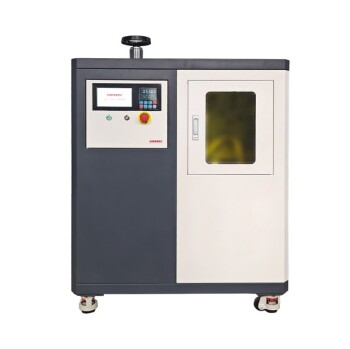
Achieve theoretical density and eliminate structural weaknesses in your advanced composites with KINTEK’s industry-leading cold isostatic presses. Whether you are working with TiC10/Cu-Al2O3 or other high-performance materials, our specialized isostatic systems and hydraulic presses provide the uniform pressure required for critical reliability.
Why choose KINTEK?
- Comprehensive Laboratory Range: From high-temperature furnaces and crushing systems to advanced battery research tools.
- Precision Engineering: Our CIP and HIP solutions are designed to handle extreme pressures (up to 280 MPa and beyond) with unmatched safety and consistency.
- Tailored Solutions: We supply essential consumables like PTFE, ceramics, and crucibles to support your entire workflow.
Don't settle for "good" when you can achieve excellence. Contact KINTEK today to discover how our high-pressure solutions can transform your material science projects!
Related Products
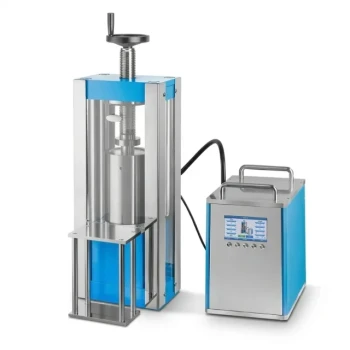
- Electric Split Lab Cold Isostatic Press CIP Machine for Cold Isostatic Pressing
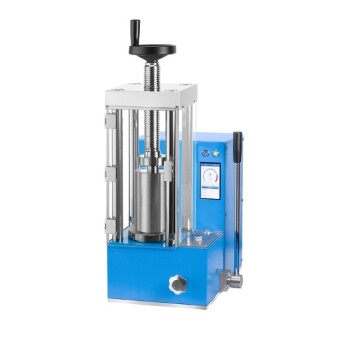
- Electric Lab Cold Isostatic Press CIP Machine for Cold Isostatic Pressing
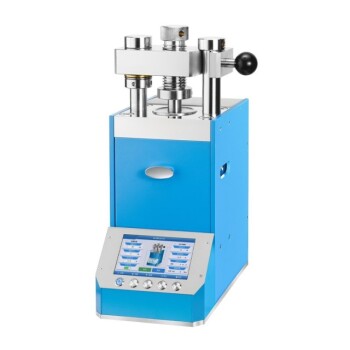
- Automatic Lab Cold Isostatic Press CIP Machine Cold Isostatic Pressing
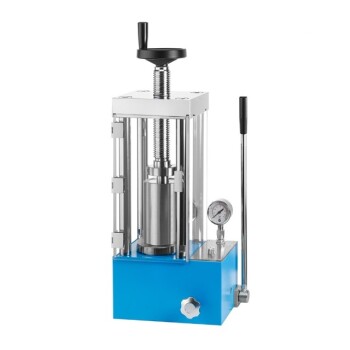
- Manual Cold Isostatic Pressing Machine CIP Pellet Press
- Warm Isostatic Press for Solid State Battery Research
People Also Ask
- How is isostatic pressing equipment utilized to integrate lithium metal anodes during solid-state battery assembly?
- How does isostatic pressing equipment enhance lithium metal anode contact? Optimize Your Solid-State Battery Assembly
- What is the meaning of isostatic pressing? Achieve Uniform Density in Complex Parts
- What is isostatic pressing method for ceramics? Achieve Uniform Density for Complex Parts
- What role does cold isostatic pressing play in the formation of feed rods for single crystal growth? Ensure Stability.