Knowledge What is the chemical solution deposition method also known as? Discover the Sol-Gel Process for Thin Films
Author avatar

Tech Team · Kintek Solution

Updated 1 week ago

What is the chemical solution deposition method also known as? Discover the Sol-Gel Process for Thin Films


In material science and engineering, the chemical solution deposition (CSD) method is most commonly known as the sol-gel method. This technique leverages a liquid chemical precursor to create a solid thin film on a substrate through a controlled chemical process, distinguishing it from vapor-based methods.

At its core, the CSD / sol-gel process is about transforming a specially designed liquid solution (the 'sol') into a solid, glass-like network (the 'gel') to produce high-quality, crystalline thin films in a simple and cost-effective manner.
What is the chemical solution deposition method also known as? Discover the Sol-Gel Process for Thin Films

Deconstructing Chemical Solution Deposition (CSD)

The name "sol-gel" perfectly describes the two primary stages of the process. It is a journey from a liquid solution to a solid-state material directly on a component's surface.

The Core Principle: A Liquid Precursor

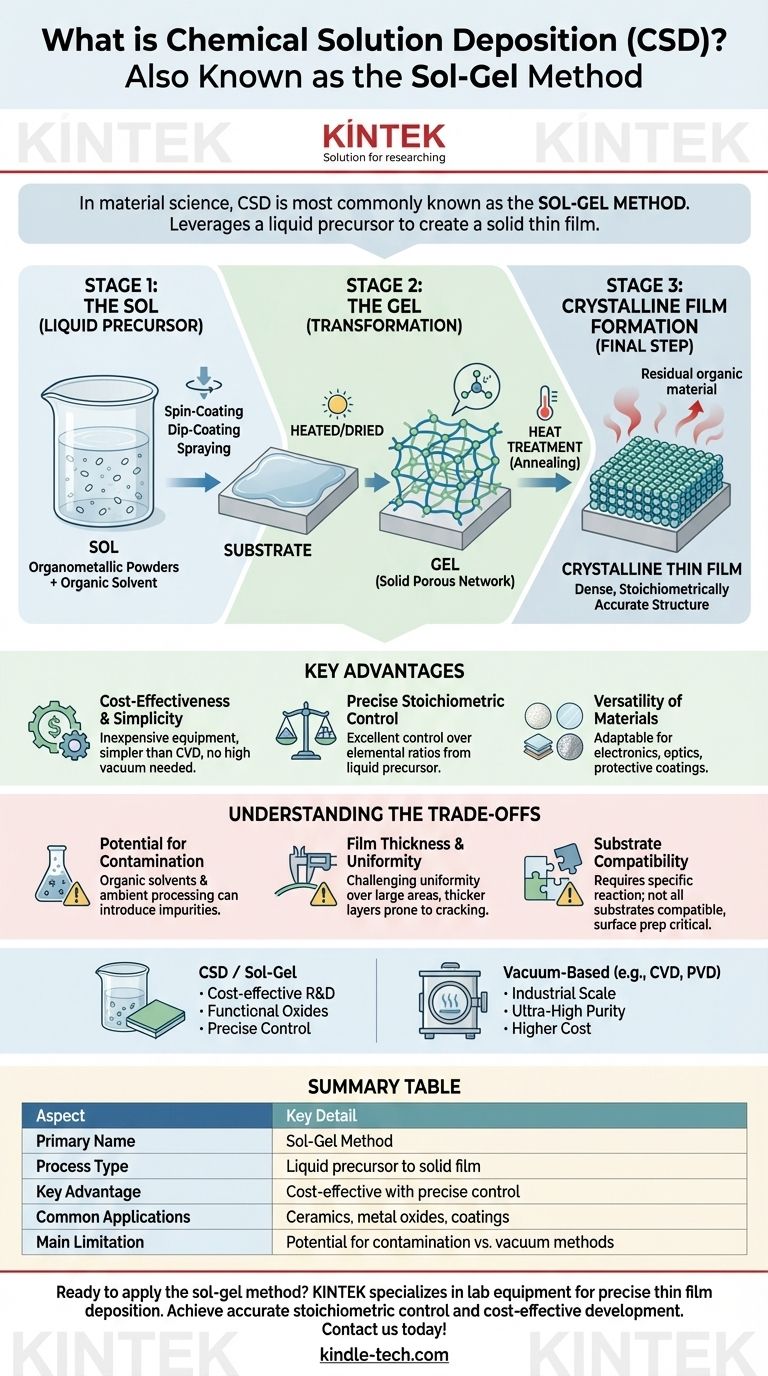
CSD begins with a liquid precursor, typically a solution containing organometallic powders dissolved in an organic solvent. This initial, stable liquid solution is referred to as the "sol."

The composition of this sol is meticulously controlled, as it directly dictates the elemental makeup of the final thin film.

The Transformation: From Sol to Gel

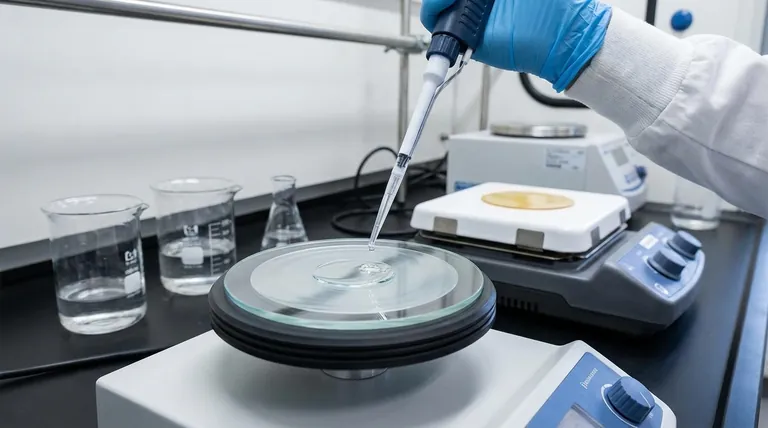
The sol is applied to a substrate using methods like spin-coating, dip-coating, or spraying. A chemical reaction is then initiated, often through heating or drying.

This causes the precursor molecules to link together, forming a solid, porous, three-dimensional network known as a "gel."

The Final Step: Crystalline Film Formation

After the gel is formed, it typically undergoes a heat treatment process (annealing). This step removes residual organic material and encourages the formation of a dense, crystalline structure.

The result is a stoichiometrically accurate crystalline film bonded to the substrate surface.

Key Advantages of the CSD / Sol-Gel Method

Engineers and researchers choose this method for several distinct benefits, especially when compared to more complex vacuum-based techniques like chemical vapor deposition (CVD).

Cost-Effectiveness and Simplicity

The equipment required for the sol-gel process is relatively inexpensive and simpler to operate. It does not require the high-vacuum chambers or complex gas-handling systems associated with CVD.

Precise Stoichiometric Control

Because the process starts with a liquid, chemists have excellent control over the ratios of different elements in the precursor solution. This precision is directly transferred to the final solid film, ensuring accurate chemical composition (stoichiometry).

Versatility of Materials

The sol-gel method is highly versatile and can be adapted to produce a wide range of materials, including ceramics, glass-ceramics, and metal oxides, for applications in electronics, optics, and protective coatings.

Understanding the Trade-offs

While powerful, the CSD / sol-gel method is not without its limitations. Objectivity requires acknowledging where other methods may be superior.

Potential for Contamination

The use of organic solvents and processing in an ambient environment can introduce impurities or defects into the film, which may be unacceptable for high-purity electronic applications.

Film Thickness and Uniformity

Achieving perfectly uniform films over large areas can be challenging. Furthermore, films produced via sol-gel are often thinner, and building up thick layers can lead to cracking and stress.

Substrate Compatibility

The process often relies on a specific reaction between the solution and the substrate surface. This means not all substrate materials are compatible, and surface preparation is critical for good adhesion and film quality.

Making the Right Choice for Your Goal

Selecting a deposition technique depends entirely on your project's constraints and desired outcome.

  • If your primary focus is cost-effective R&D or creating functional oxides: The CSD / sol-gel method provides an accessible and flexible pathway for producing high-quality films with precise chemical control.
  • If your primary focus is industrial-scale production of ultra-high-purity semiconductor films: A vacuum-based technique like chemical vapor deposition (CVD) or physical vapor deposition (PVD) will likely be a more reliable choice, despite the higher initial investment.

By understanding the principles behind the CSD / sol-gel method, you can effectively determine where this powerful technique fits within your material engineering toolkit.

Summary Table:

Aspect Key Detail
Primary Name Sol-Gel Method
Process Type Liquid precursor to solid film
Key Advantage Cost-effective with precise stoichiometric control
Common Applications Ceramics, metal oxides, protective coatings
Main Limitation Potential for contamination vs. vacuum methods

Ready to apply the sol-gel method in your lab? KINTEK specializes in lab equipment and consumables for precise thin film deposition. Our solutions help you achieve accurate stoichiometric control and cost-effective material development. Contact us today to optimize your CSD process with the right tools and expertise!

Visual Guide
What is the chemical solution deposition method also known as? Discover the Sol-Gel Process for Thin Films Visual Guide

Related Products

People Also Ask

Related Products

HFCVD Machine System Equipment for Drawing Die Nano-Diamond Coating

HFCVD Machine System Equipment for Drawing Die Nano-Diamond Coating

The nano-diamond composite coating drawing die uses cemented carbide (WC-Co) as the substrate, and uses the chemical vapor phase method ( CVD method for short ) to coat the conventional diamond and nano-diamond composite coating on the surface of the inner hole of the mold.

915MHz MPCVD Diamond Machine Microwave Plasma Chemical Vapor Deposition System Reactor

915MHz MPCVD Diamond Machine Microwave Plasma Chemical Vapor Deposition System Reactor

915MHz MPCVD Diamond Machine and its multi-crystal effective growth, the maximum area can reach 8 inches, the maximum effective growth area of single crystal can reach 5 inches. This equipment is mainly used for the production of large-size polycrystalline diamond films, the growth of long single crystal diamonds, the low-temperature growth of high-quality graphene, and other materials that require energy provided by microwave plasma for growth.

Laboratory Sterilizer Lab Autoclave Vertical Pressure Steam Sterilizer for Liquid Crystal Display Automatic Type

Laboratory Sterilizer Lab Autoclave Vertical Pressure Steam Sterilizer for Liquid Crystal Display Automatic Type

Liquid crystal display automatic vertical sterilizer is a safe, reliable and automatic control sterilization equipment, which is composed of heating system, microcomputer control system and overheating and overvoltage protection system.

Laboratory Sterilizer Lab Autoclave Pulse Vacuum Lifting Sterilizer

Laboratory Sterilizer Lab Autoclave Pulse Vacuum Lifting Sterilizer

The pulse vacuum lifting sterilizer is a state-of-the-art equipment for efficient and precise sterilization. It uses pulsating vacuum technology, customizable cycles, and a user-friendly design for easy operation and safety.

CVD Diamond Cutting Tool Blanks for Precision Machining

CVD Diamond Cutting Tool Blanks for Precision Machining

CVD Diamond Cutting Tools: Superior Wear Resistance, Low Friction, High Thermal Conductivity for Non-Ferrous Materials, Ceramics, Composites Machining

Laboratory Test Sieves and Sieving Machines

Laboratory Test Sieves and Sieving Machines

Precision lab test sieves & sieving machines for accurate particle analysis. Stainless steel, ISO-compliant, 20μm-125mm range. Request specs now!

Anti-Cracking Press Mold for Lab Use

Anti-Cracking Press Mold for Lab Use

The anti-cracking press mold is a specialized equipment designed for molding various shapes and sizes of film using high pressure and electric heating.

Vacuum Hot Press Furnace Machine for Lamination and Heating

Vacuum Hot Press Furnace Machine for Lamination and Heating

Experience clean and precise lamination with Vacuum Lamination Press. Perfect for wafer bonding, thin-film transformations, and LCP lamination. Order now!

Benchtop Laboratory Vacuum Freeze Dryer

Benchtop Laboratory Vacuum Freeze Dryer

Benchtop laboratory freeze dryer for efficient lyophilization of biological, pharmaceutical, and food samples. Features intuitive touchscreen, high-performance refrigeration, and durable design. Preserve sample integrity—consult now!

Benchtop Laboratory Freeze Dryer for Lab Use

Benchtop Laboratory Freeze Dryer for Lab Use

Premium benchtop laboratory freeze dryer for lyophilization, preserving samples with ≤ -60°C cooling. Ideal for pharmaceuticals & research.

Laboratory Vibratory Sieve Shaker Machine Slap Vibrating Sieve

Laboratory Vibratory Sieve Shaker Machine Slap Vibrating Sieve

KT-T200TAP is a slapping and oscillating sieving instrument for laboratory desktop use, with 300 rpm horizontal circular motion and 300 vertical slapping motions to simulate manual sieving to help sample particles pass through better.

Small Injection Molding Machine for Lab Use

Small Injection Molding Machine for Lab Use

The small injection molding machinehas fast and stable movements; good controllability and repeatability, super energy saving; the product can be automatically dropped and formed; the machine body is low, convenient for feeding, easy to maintain, and no height restrictions on the installation site.

Metallographic Specimen Mounting Machine for Laboratory Materials and Analysis

Metallographic Specimen Mounting Machine for Laboratory Materials and Analysis

Precision metallographic mounting machines for labs—automated, versatile, and efficient. Ideal for sample prep in research and quality control. Contact KINTEK today!

High Purity Zinc Foil for Battery Lab Applications

High Purity Zinc Foil for Battery Lab Applications

There are very few harmful impurities in the chemical composition of zinc foil, and the surface of the product is straight and smooth; it has good comprehensive properties, processability, electroplating colorability, oxidation resistance and corrosion resistance, etc.

Precision Machined Silicon Nitride (SiN) Ceramic Sheet for Engineering Advanced Fine Ceramics

Precision Machined Silicon Nitride (SiN) Ceramic Sheet for Engineering Advanced Fine Ceramics

Silicon nitride plate is a commonly used ceramic material in the metallurgical industry due to its uniform performance at high temperatures.

Graphite Vacuum Continuous Graphitization Furnace

Graphite Vacuum Continuous Graphitization Furnace

High-temperature graphitization furnace is a professional equipment for graphitization treatment of carbon materials. It is a key equipment for the production of high-quality graphite products. It has high temperature, high efficiency and uniform heating. It is suitable for various high-temperature treatments and graphitization treatments. It is widely used in metallurgy, electronics, aerospace, etc. industry.

Variable Speed Peristaltic Pump

Variable Speed Peristaltic Pump

KT-VSP Series Smart Variable Speed Peristaltic Pumps offer precise flow control for labs, medical, and industrial applications. Reliable, contamination-free liquid transfer.

High Energy Vibratory Laboratory Ball Mill Grinding Mill Single Tank Type

High Energy Vibratory Laboratory Ball Mill Grinding Mill Single Tank Type

High-energy vibration ball mill is a small desktop laboratory grinding instrument.It can be ball-milled or mixed with different particle sizes and materials by dry and wet methods.

Small Vacuum Heat Treat and Tungsten Wire Sintering Furnace

Small Vacuum Heat Treat and Tungsten Wire Sintering Furnace

The small vacuum tungsten wire sintering furnace is a compact experimental vacuum furnace specially designed for universities and scientific research institutes. The furnace features a CNC welded shell and vacuum piping to ensure leak-free operation. Quick-connect electrical connections facilitate relocation and debugging, and the standard electrical control cabinet is safe and convenient to operate.

Platinum Sheet Electrode for Laboratory and Industrial Applications

Platinum Sheet Electrode for Laboratory and Industrial Applications

Elevate your experiments with our Platinum Sheet Electrode. Crafted with quality materials, our safe and durable models can be tailored to fit your needs.


Leave Your Message