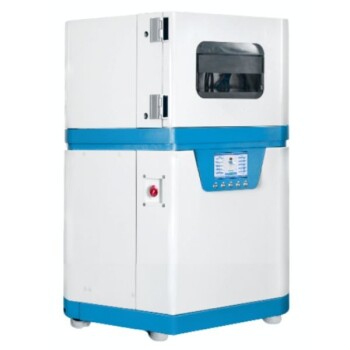
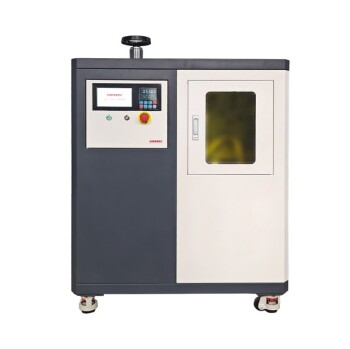
High-performance hot pressing acts as the critical consolidation step in manufacturing Membrane Electrode Assemblies (MEAs). It applies synchronized mechanical pressure and thermal energy to physically fuse the proton exchange membrane (PEM), catalyst layers, and often the gas diffusion layers (GDL) into a single cohesive unit. This process is mandatory for minimizing internal resistance and ensuring the structural integrity of the fuel cell or electrolyzer stack.
The Core Objective A hot press transforms distinct material layers into a unified electrochemical device. Its primary goal is to achieve interface fusion—eliminating microscopic gaps between the membrane and catalyst to maximize proton conductivity without physically damaging the delicate components.
The Mechanics of Interface Formation
Achieving Physical Bonding
The primary function of the hot press is to create a tight physical bond between the proton exchange membrane and the catalyst layers of the anode and cathode. By applying specific temperatures (such as 80°C or up to 120°C depending on the material) alongside precise pressure, the machine forces these layers into intimate contact.
Reducing Contact Resistance
Performance losses often stem from poor contact between layers. The synchronized action of heat and pressure minimizes interfacial contact resistance. This ensures that electrons and protons can move freely across the boundaries, significantly improving the overall efficiency of the assembly.
Facilitating Proton Transport
Beyond simple adhesion, the process establishes efficient proton transport channels. By optimizing the contact between catalyst particles and the membrane, the hot press ensures that protons generated at the anode can efficiently migrate through the electrolyte to the cathode.
Long-Term Stability and Durability
Enhancing Mechanical Integrity
An MEA must withstand harsh operating conditions without falling apart. The hot press creates a bond strong enough to prevent delamination or peeling during long-term operation. This mechanical stability is vital for the lifespan of the device.
Polymer Chain Rearrangement
For certain membrane materials, the application of heat and pressure facilitates the rearrangement of polymer chains. This molecular-level adjustment strengthens the interface, further securing the catalyst layer to the ion exchange membrane.
Understanding the Trade-offs
The Risk of Over-Compression
While pressure is necessary, excessive force can be catastrophic. "Crushing" the assembly can damage the porous structure of carbon paper gas diffusion layers or, worse, puncture the proton exchange membrane. A punctured membrane leads to internal short circuits and gas crossover, rendering the cell useless.
The Risk of Under-Compression
Conversely, insufficient pressure results in weak bonding. This leads to high ohmic losses (electrical resistance) and potential delamination effectively severing the electrochemical pathway needed for the cell to function.
Thermal Sensitivity
The temperature must be tuned precisely to the specific chemistry of the membrane (e.g., PFSA or Nafion). Deviating from the optimal thermal window can either fail to induce bonding or thermally degrade the polymer structure before the cell is even used.
Making the Right Choice for Your Goal
When configuring your hot pressing parameters, align them with your specific performance objectives:
- If your primary focus is Electrical Efficiency: Prioritize optimizing pressure uniformity to minimize contact resistance and reduce ohmic losses.
- If your primary focus is Long-Term Durability: Focus on precise thermal control to facilitate polymer chain rearrangement, ensuring the layers remain bonded under stress.
Ultimately, the high-performance hot press serves as the bridge between raw materials and a functional power source, determining both the efficiency and the lifespan of the final assembly.
Summary Table:
| Key Function | Primary Benefit | Critical Parameter |
|---|---|---|
| Interface Fusion | Minimizes interfacial contact resistance | Temperature (80°C - 120°C) |
| Physical Bonding | Prevents delamination and peeling | Precise Pressure Control |
| Proton Transport | Maximizes electrochemical efficiency | Dwell Time |
| Structural Integrity | Ensures long-term mechanical stability | Uniform Force Distribution |
Elevate Your Hydrogen Research with KINTEK Precision
Don’t let poor interface bonding compromise your fuel cell or electrolyzer performance. KINTEK specializes in advanced hydraulic presses (pellet, hot, and isostatic) engineered specifically for the delicate requirements of Membrane Electrode Assembly (MEA) production.
Our high-performance systems provide the synchronized thermal control and precise pressure needed to eliminate contact resistance without damaging your proton exchange membranes or gas diffusion layers. Whether you are scaling up battery research or perfecting catalyst layer integration, our comprehensive range of laboratory equipment—from high-temperature furnaces to electrolytic cells—is designed to drive your innovation forward.
Ready to achieve peak electrochemical performance? Contact our technical experts today to find the perfect hot press solution for your laboratory.
References
- Hyeongwoo Min, Young Soo Yoon. Enhanced Durability and Catalytic Performance of Pt–SnO<sub>2</sub>/Multi‐Walled Carbon Nanotube with Shifted d‐Band Center for Proton‐Exchange Membrane Fuel Cells. DOI: 10.1002/sstr.202300407
This article is also based on technical information from Kintek Solution Knowledge Base .
Related Products
- Automatic High Temperature Heated Hydraulic Press Machine with Heated Plates for Lab
- Manual High Temperature Heated Hydraulic Press Machine with Heated Plates for Lab
- Automatic Heated Hydraulic Press Machine with Heated Plates for Laboratory Hot Press
- Automatic Laboratory Heat Press Machine
- Vacuum Hot Press Furnace Machine for Lamination and Heating
People Also Ask
- What is a heated hydraulic press used for? Essential Tool for Curing, Molding, and Laminating
- Why is a heated hydraulic press used for warm pressing NASICON green tapes? Optimize Your Solid Electrolyte Density
- Why is a heated laboratory hydraulic press necessary for composite laminates? Achieve Void-Free Structural Integrity
- What is a hot hydraulic press? Harness Heat and Pressure for Advanced Manufacturing
- How is a heated hydraulic press used for Li-LLZO batteries? Optimize Interfacial Bonding with Thermal-Pressure