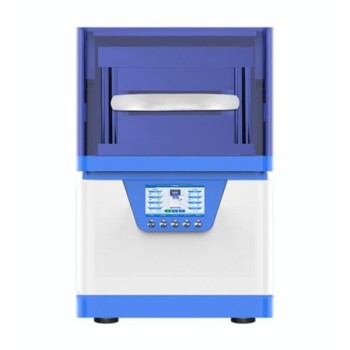
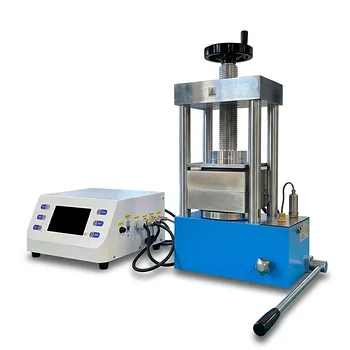
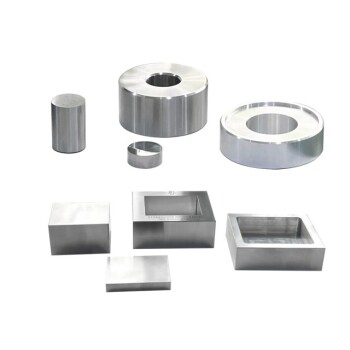
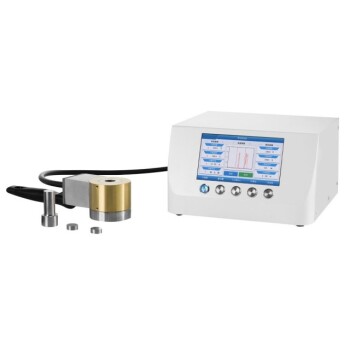
In the assembly of Proton Exchange Membrane Water Electrolyzer (PEMWE) devices, the primary function of a laboratory hot press is to unify discrete components into a cohesive Membrane Electrode Assembly (MEA). By subjecting the catalyst-coated titanium fiber felt (anode), the perfluorosulfonic acid membrane, and the cathode materials to precise thermal compression, the press eliminates gaps between layers. This ensures the intimate contact necessary for efficient electrochemical reactions and long-term device stability.
Core Takeaway: The laboratory hot press is the critical tool for minimizing electrical resistance and optimizing mass transfer. It transforms separate porous layers and membranes into a mechanically robust stack capable of sustaining high-performance electrolysis.
Optimizing Electrochemical Performance
The effectiveness of a PEMWE device relies heavily on the quality of the connections between its layers. The hot press addresses this by optimizing the microscopic interactions within the cell.
Reducing Contact Resistance
Loosely assembled components create high electrical resistance, which wastes energy as heat.
The hot press applies controlled pressure to force the titanium fiber felt anode and carbon-based gas diffusion layers into tight contact with the membrane. This significantly lowers interfacial contact resistance, allowing current to flow efficiently through the stack.
Maximizing the Triple-Phase Interface
Electrolysis occurs at the "triple-phase boundary," where the catalyst, the electrolyte (membrane), and the reactants meet.
Thermal compression facilitates molecular-level contact at this boundary. By bonding the catalyst layer directly to the proton exchange membrane and current collectors, the press ensures that mass transfer efficiency is optimized at the reaction sites.
Ensuring Mechanical and Structural Integrity
Beyond electrical performance, the hot press is essential for the physical durability of the electrolyzer stack.
Creating a Robust MEA
A PEMWE stack must withstand high internal pressures during operation.
The hot press enhances the mechanical strength of the MEA by bonding the porous transport layer (PTL) and gas diffusion layer (GDL) to the membrane. This creates a unified structure that is less prone to delamination or physical shifting under stress.
Hermetic Sealing
Proper encapsulation is vital to prevent leaks and ensure safety.
By applying heat and pressure simultaneously, the press activates sealing mechanisms (often thermoplastic gaskets). This ensures hermetic sealing of the internal electrolyte, maintaining structural integrity and preventing the escape of gases or fluids over the device's lifespan.
Understanding the Trade-offs
While hot pressing is essential, it requires a delicate balance of operational parameters. Mismanagement of these variables can damage the sensitive components.
The Risk of Over-Compression
Applying excessive pressure can crush the porous titanium fiber felt or the carbon GDL.
If these transport layers are compacted too tightly, the pathways for water and gas transport are restricted, choking the reaction. Furthermore, excessive force can puncture the thin proton exchange membrane, causing immediate short circuits.
Thermal Sensitivity
The temperature must be high enough to soften the membrane or binder for bonding, but not so high that it degrades the materials.
Inadequate heat results in poor adhesion and high resistance. Conversely, overheating can thermally degrade the perfluorosulfonic acid membrane, permanently reducing its ion-conducting capability.
Making the Right Choice for Your Goal
The specific parameters you choose for your hot press process should align with your primary assembly objectives.
- If your primary focus is maximizing energy efficiency: Prioritize pressure uniformity to minimize contact resistance, ensuring the lowest possible voltage drop across the cell.
- If your primary focus is long-term durability: Focus on precise temperature control to ensure a complete, hermetic bond that prevents delamination and leakage over time.
Ultimately, the laboratory hot press acts as the bridge between raw materials and a functional device, defining the efficiency and longevity of the final PEMWE system.
Summary Table:
| Feature | Function in PEMWE Assembly | Impact on Performance |
|---|---|---|
| Thermal Compression | Bonds catalyst layers to the membrane | Maximizes triple-phase interface efficiency |
| Pressure Application | Compresses GDL/PTL against the MEA | Minimizes interfacial contact resistance |
| Structural Bonding | Creates a cohesive, unified stack | Prevents delamination under high internal pressure |
| Sealing Activation | Heat-activates gaskets and seals | Ensures hermetic sealing to prevent gas/fluid leaks |
| Precision Control | Balances heat and pressure levels | Protects porous transport layers and membrane integrity |
Elevate Your Hydrogen Research with KINTEK Precision
Precision is the heartbeat of PEMWE development. At KINTEK, we specialize in the advanced laboratory equipment necessary to transform raw materials into high-performance energy solutions. Our premium hydraulic hot presses provide the exact thermal and pressure control required to manufacture robust Membrane Electrode Assemblies (MEAs) without compromising material integrity.
From high-temperature high-pressure reactors to specialized crushing, milling, and electrochemical tools, KINTEK offers a comprehensive portfolio designed for the most demanding research environments. Whether you are optimizing triple-phase boundaries or ensuring hermetic seals, our experts are here to provide the tools you need for success.
Ready to optimize your electrolysis stack? Contact our technical team today to find the perfect hot press solution for your lab.
References
- Hui Su, Qinghua Liu. Tensile straining of iridium sites in manganese oxides for proton-exchange membrane water electrolysers. DOI: 10.1038/s41467-023-44483-6
This article is also based on technical information from Kintek Solution Knowledge Base .
Related Products
- 30T 40T Split Automatic Heated Hydraulic Press Machine with Heated Plates for Laboratory Hot Press
- Electric Heated Hydraulic Vacuum Heat Press for Lab
- Heated Hydraulic Press Machine with Heated Plates Split Manual Laboratory Hot Press
- Automatic Heated Hydraulic Press Machine with Heated Plates for Laboratory Hot Press
- Automatic Laboratory Heat Press Machine
People Also Ask
- What are the advantages of using a laboratory hydraulic press for hot pressing? Achieve Peak Nano-Composite Density
- What are the core advantages of using a laboratory hot press to produce Bi2Se3? Achieve 93% Density & High Conductivity
- Why is a laboratory hydraulic hot press essential for high-density, additive-free Silicon Carbide? Unlock Pure SiC.
- How does a laboratory hydraulic hot press ensure the quality of PHBV/natural fiber composites? Expert Guide
- What is the function of a laboratory hydraulic hot press in the assembly of solid-state photoelectrochemical cells?