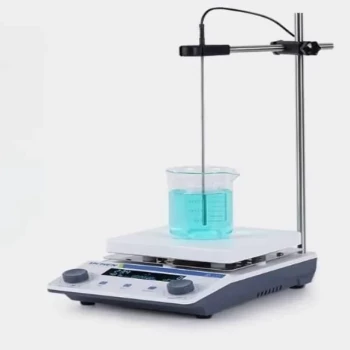
The primary function of a magnetic stirring heating device in this context is to establish a strictly controlled reaction environment. It simultaneously regulates thermal energy and physical mixing to ensure that precursors—specifically silver nitrate, oleylamine, and oleic acid—react uniformly. This dual capability is the determining factor in producing silver nanoparticles with the precise dimensions and consistency required for high-performance battery current collectors.
By maintaining precise temperatures (such as 130°C) and ensuring continuous reactant contact, this device guarantees the synthesis of nanoparticles with uniform morphology and a controlled size range of 20–50 nm, which is vital for reliable electrical conductivity.
The Mechanics of Synthesis Control
Precise Temperature Regulation
In chemical synthesis, temperature acts as the throttle for reaction rates. The magnetic stirring device maintains the reaction mixture at a specific set point, often around 130°C for this specific application.
Reliable heating ensures the chemical reduction of silver salts occurs at a predictable speed. Without this thermal stability, the nucleation of particles becomes erratic, leading to poor quality materials.
Continuous Homogenization
While heating drives the reaction, stirring ensures consistency. The device utilizes a rotating magnetic field to spin a stir bar within the vessel, creating continuous mixing kinetics.
This prevents the formation of "hot spots" or stagnant zones where precursors might settle. It ensures that the reducing agents and silver ions remain in constant, thorough contact throughout the process.
Management of Precursors
The synthesis relies on a specific blend of chemicals, including silver nitrate, oleylamine, and oleic acid. These components have different viscosities and densities.
The mechanical agitation from the stirrer forces these distinct ingredients into a homogeneous mixture. This uniformity is a prerequisite for the chemical reaction to proceed evenly across the entire volume of the liquid.
Impact on Nanoparticle Quality
Controlling Particle Size
For battery current collectors, the physical size of the silver particles is critical. The combined effect of steady heat and constant motion constrains the growth of these particles to a specific range, typically 20–50 nm.
If the mixing were uneven or the temperature fluctuated, some particles would grow too large while others remained too small. This device ensures a narrow size distribution, which is essential for the electrical performance of the final collector.
Maintaining Morphological Uniformity
Beyond size, the shape (morphology) of the nanoparticles must be consistent. The controlled environment allows the particles to form identical structures.
Uniform morphology improves the packing density and surface activity of the silver on the current collector. This leads to better conductivity and stability within the battery cell.
Understanding the Trade-offs
The Risk of Thermal Overshoot
While these devices are precise, they are not instant. There is often a delay between the heating element reaching temperature and the liquid inside reaching the same point.
Operators must be aware of potential thermal lag or overshoot, where the temperature briefly exceeds 130°C. This can unintentionally accelerate the reaction and alter particle size.
Mixing Limitations
Magnetic stirring is highly effective for fluids, but it has physical limits. If the precursor solution becomes too viscous during the reaction, the magnetic coupling may slip.
This results in inconsistent stirring speeds. In such cases, the mixing kinetics degrade, potentially ruining the uniformity of the batch.
Making the Right Choice for Your Goal
To achieve the best results in silver nanoparticle synthesis, consider your primary objective:
- If your primary focus is Electrical Conductivity: Prioritize the stability of the stirring mechanism to ensure a narrow size distribution (20-50 nm), as uniform particle sizes minimize electrical resistance.
- If your primary focus is Process Reproducibility: Prioritize thermal precision and calibration, ensuring the device can hold 130°C without significant fluctuation between different batches.
Success in synthesizing battery-grade nanomaterials relies not just on the chemistry, but on the rigorous mechanical control of the reaction environment.
Summary Table:
| Parameter | Role in Synthesis | Impact on Final Product |
|---|---|---|
| Temperature (130°C) | Regulates chemical reduction rates | Ensures predictable nucleation and growth |
| Stirring Kinetics | Prevents hot spots and settling | Guarantees narrow size distribution (20–50 nm) |
| Precursor Mixing | Homogenizes silver nitrate and acids | Maintains consistent chemical composition |
| Morphology Control | Maintains stable reaction environment | Improves packing density and conductivity |
Elevate Your Nanomaterial Synthesis with KINTEK
Precision is the backbone of battery research. KINTEK specializes in advanced laboratory equipment, including high-performance magnetic stirrers and heating solutions designed for rigorous chemical synthesis. Whether you are producing silver nanoparticles for current collectors or developing next-generation battery tools, our comprehensive range of homogenizers, shakers, and temperature-controlled reactors ensures process reproducibility and superior material quality.
Ready to optimize your lab’s efficiency and conductivity results? Contact KINTEK today for expert guidance and equipment solutions
Related Products
- Laboratory Small Constant Temperature Heated Magnetic Stirrer Heater and Stirrer
- Custom PTFE Teflon Parts Manufacturer for Magnetic Stirring Bar
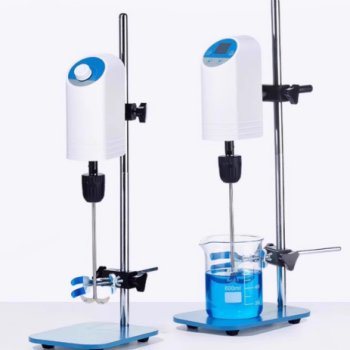
- High Performance Laboratory Stirrers for Diverse Applications
- Laboratory Scientific Electric Heating Blast Drying Oven
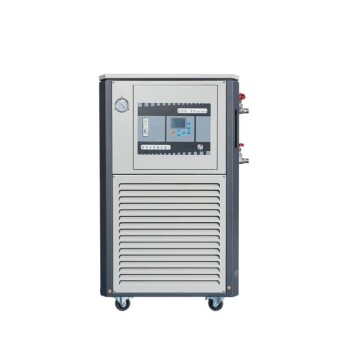
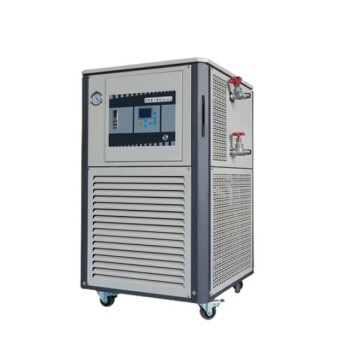
- 5L Heating Chilling Circulator Cooling Water Bath Circulator for High and Low Temperature Constant Temperature Reaction
People Also Ask
- What role does a magnetic stirrer with heating play in ZnO nanoparticle synthesis? Precision Control for Quality Results
- What role does a constant temperature heating magnetic stirrer play in MFC-HAp synthesis? Achieve Material Homogeneity
- What is the function of a laboratory magnetic stirrer in Ni–Cr–P electrodeposition? Optimize Ion Transport & Coating
- Why is a laboratory magnetic stirrer required for benzoic acid esters? Boost Reaction Speed & Yield with High RPM
- What role does a laboratory magnetic stirrer play in TiO2 and TiO2-Ag sol preparation? Master Chemical Kinetics