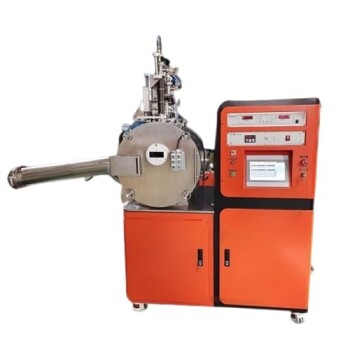
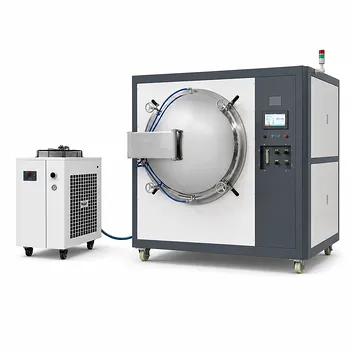
In the preparation of (Fe, Sn)-based alloy ingots, a vacuum arc furnace serves as the critical primary melting tool used to fuse raw elements into a high-purity, chemically uniform master alloy. By utilizing a high-energy electric arc in an oxygen-free environment, it ensures that active elements like iron and tin reach their melting points without oxidizing, while repeated melting cycles guarantee that the final ingot has a consistent atomic distribution throughout its structure.
Core Takeaway: The vacuum arc furnace is essential for producing high-quality (Fe, Sn) master ingots because it combines extreme thermal energy with a controlled atmosphere to prevent contamination and ensure perfect compositional homogeneity.
Achieving Thermal Precision and Material Purity
High-Energy Arc Melting
The furnace utilizes a high-energy electric arc to generate the extreme temperatures necessary to melt high-purity raw elements like iron. This localized heat is intense enough to ensure that all components, regardless of their individual melting points, transition into a fully molten state for thorough mixing.
Atmospheric Control and Oxidation Prevention
Operating under a vacuum or a high-purity argon atmosphere is vital when working with (Fe, Sn)-based alloys. This controlled environment effectively prevents the oxidation of active elements like iron and tin, which would otherwise degrade the alloy's quality and alter its intended chemical properties.
The Role of Non-Consumable Electrodes
Many vacuum arc furnaces employ a non-consumable tungsten electrode that remains stable during the melting process. This setup is crucial because it provides the necessary heat without melting the electrode itself, thereby avoiding the introduction of impurities into the (Fe, Sn) melt.
Ensuring Compositional Homogeneity
Multiple Melting Cycles
A single melt is rarely sufficient to achieve a uniform mixture at the atomic level. The furnace allows for multiple repeated melting cycles, which are necessary to ensure the compositional homogeneity of the alloy ingot.
The Flip-Remelting Technique
To eliminate localized variations in chemistry, the process often involves flipping the ingot and remelting it several times. This mechanical intervention ensures that the elements are distributed evenly from the top to the bottom of the ingot, providing a reliable base material for subsequent research or manufacturing.
Water-Cooled Copper Crucibles
The use of water-cooled copper crucibles allows the molten alloy to be contained without reacting with the container walls. This rapid cooling capability, combined with the arc's heat, facilitates a clean melt that serves as an ideal master alloy for downstream processes like rapid solidification.
Understanding the Trade-offs and Limitations
Energy Intensity and Throughput
While the vacuum arc furnace provides unparalleled purity, it is a highly energy-intensive process. The need for multiple remelting cycles and high-vacuum maintenance means that production is often slower and more costly compared to traditional induction melting.
Equipment Complexity
Maintaining the vacuum seals and managing the high-voltage arc requires specialized technical expertise. Any minor leak in the vacuum system can lead to the immediate contamination of the (Fe, Sn) alloy, potentially ruining the entire batch of high-purity raw materials.
Physical Scale Constraints
Laboratory-scale vacuum arc furnaces are typically designed for small "button" ingots. Scaling this process up to industrial volumes requires significantly more complex "Vacuum Arc Remelting" (VAR) systems, which change the cooling dynamics and may impact the microstructure of the alloy.
How to Apply This to Your Project
Selecting the Right Process Path
- If your primary focus is high-purity research: Utilize multiple flip-remelting cycles (at least 3-5 times) to ensure your (Fe, Sn) samples have a perfectly uniform microstructure for analysis.
- If your primary focus is rapid solidification (e.g., melt spinning): Use the vacuum arc furnace strictly as a "master alloy" preparation step to ensure the initial chemistry is precise before moving to the induction-based spinning phase.
- If your primary focus is preventing contamination: Ensure the use of a non-consumable tungsten electrode and a high-purity argon purge to maintain the integrity of sensitive elements like Tin.
By mastering the vacuum arc melting process, you establish the precise chemical foundation necessary for any advanced metallurgical study or high-performance alloy application.
Summary Table:
| Feature | Function in (Fe, Sn) Preparation | Key Benefit |
|---|---|---|
| High-Energy Arc | Generates intense localized heat | Melts high-melting-point iron (Fe) efficiently |
| Vacuum/Argon Atmosphere | Eliminates oxygen during the melt | Prevents oxidation of active Sn and Fe elements |
| Tungsten Electrode | Non-consumable heat source | Ensures zero contamination from the electrode |
| Water-Cooled Crucible | Rapid cooling & non-reactive containment | Prevents alloy reaction with container walls |
| Flip-Remelting | Repeatedly mixes the ingot | Achieves perfect atomic-level homogeneity |
Elevate Your Alloy Research with KINTEK Precision
Achieving the perfect chemical foundation for your (Fe, Sn)-based alloys requires equipment that offers uncompromising purity and control. KINTEK specializes in high-performance laboratory solutions, providing a comprehensive range of high-temperature furnaces (vacuum, induction melting, atmosphere, and muffle) designed to meet the rigorous demands of modern metallurgy.
Whether you are preparing master alloys or conducting rapid solidification studies, our portfolio supports every step of your workflow—from crushing and milling systems and hydraulic presses for sample prep to high-temperature high-pressure reactors, centrifuges, and essential ceramic crucibles.
Partner with KINTEK for reliable results and expert support.
Contact Our Specialists Today to Find Your Ideal Melting Solution!
References
- Peitian Wang, Matthew A. Willard. Development of an (Fe, Sn)-Based Nanocrystalline Soft Magnetic Alloy. DOI: 10.2139/ssrn.4340790
This article is also based on technical information from Kintek Solution Knowledge Base .
Related Products
- Vacuum Arc Induction Melting Furnace
- Non Consumable Vacuum Arc Induction Melting Furnace
- Vacuum Induction Melting Spinning System Arc Melting Furnace
- Vacuum Hot Press Furnace Heated Vacuum Press Machine Tube Furnace
- Vacuum Sealed Continuous Working Rotary Tube Furnace Rotating Tube Furnace
People Also Ask
- How do vacuum induction or arc melting furnaces facilitate the synthesis of U-Al-C MAX phases? Precision Heat & Purity
- What core role does a Vacuum Induction Melting furnace play in nickel-free steel production? Achieve High-Purity Alloys
- What is the function of a vacuum arc melting furnace? Prepare High-Purity Alx(CrFeNi)1-x High-Entropy Alloys
- What is the function of vacuum arc melting equipment? Creating High-Purity Ferrochrome (CrFe) Alloys
- What is the primary function of a vacuum arc melting furnace in RHEA preparation? Achieving Extreme Thermal Fusion