Knowledge Resources What is the function of a crucible furnace? A Guide to Controlled Melting for Casting and Alloying
Author avatar

Tech Team · Kintek Solution

Updated 2 months ago

What is the function of a crucible furnace? A Guide to Controlled Melting for Casting and Alloying


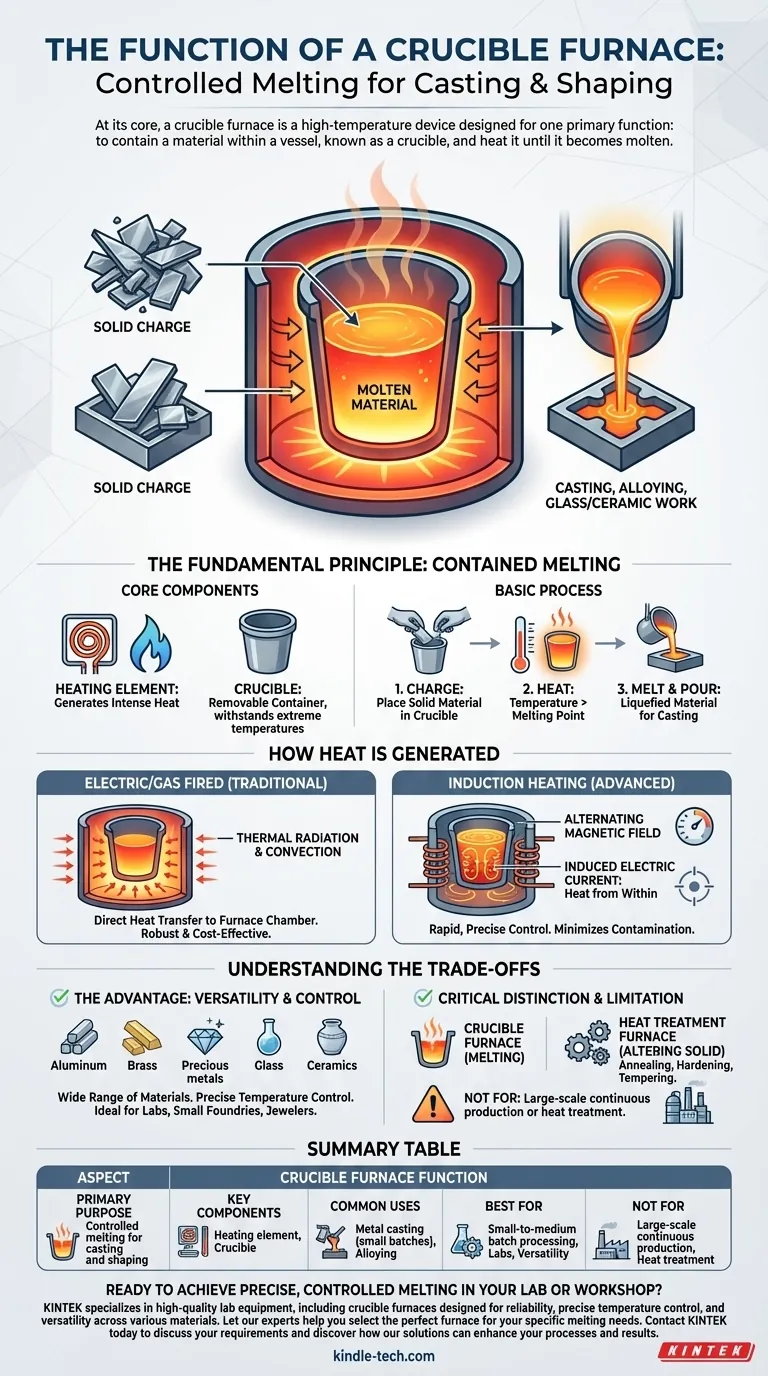
At its core, a crucible furnace is a high-temperature device designed for one primary function: to contain a material within a vessel, known as a crucible, and heat it until it becomes molten. This process is fundamental for applications requiring the liquid form of a substance, most commonly for casting metals, creating alloys, or working with materials like glass and ceramics.

The essential purpose of a crucible furnace is to perform controlled melting. While other furnaces alter solid materials through heat treatment, the crucible furnace's role is specifically to transform solids into a liquid state for pouring and shaping.

What is the function of a crucible furnace? A Guide to Controlled Melting for Casting and Alloying

The Fundamental Principle: Contained Melting

The function of a crucible furnace is defined by its two key parts working in concert. Its design is elegantly simple and focused on achieving and maintaining a material's melting point.

The Core Components

A crucible furnace consists of a heating element and a crucible. The heating element, powered by electricity or gas, generates the intense heat required for melting.

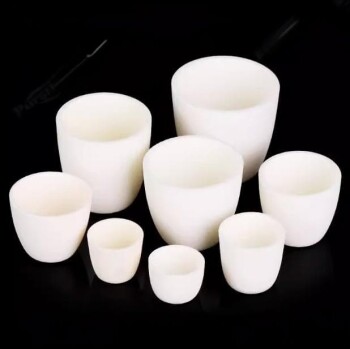
The crucible is the removable container that holds the charge material. It is made from refractory materials like graphite, silicon carbide, or clay, which can withstand extreme temperatures without reacting with the substance being melted.

The Basic Process

The operation is straightforward. A solid material, such as metal scrap, ingots, or powder, is placed inside the crucible. The furnace is activated, and the heating element transfers thermal energy to the crucible and its contents.

The temperature is raised above the material's melting point and held there until the entire charge is liquefied. This molten material can then be poured into a mold to create a cast part.

How the Heat is Generated

While the goal is always melting, the method of generating heat can differ, which impacts the furnace's efficiency and application.

Electric Resistance or Gas Fired

The most common method involves electric resistance coils or gas burners that directly heat the furnace chamber. Heat is transferred to the crucible through a combination of thermal radiation and convection. This is a robust and cost-effective approach for many applications.

Induction Heating

A more advanced method is induction heating. In these furnaces, an electrical coil generates a powerful alternating magnetic field around the crucible.

This magnetic field induces a strong electric current directly within the conductive metal charge inside the crucible, causing it to heat up and melt rapidly from the inside out. This method offers excellent temperature control and minimizes contamination.

Understanding the Trade-offs

A crucible furnace is a versatile tool, but it is not a universal solution. Understanding its advantages and limitations is key to using it correctly.

The Advantage: Versatility and Control

Crucible furnaces are prized for their ability to melt a wide range of materials, from aluminum and brass to precious metals, glass, and ceramics. Their relatively compact size and precise temperature control make them ideal for laboratories, small foundries, jewelers, and artists.

The Critical Distinction: Melting vs. Heat Treatment

A common point of confusion is comparing a crucible furnace to a heat treatment furnace (like a vacuum furnace). A crucible furnace's function is melting a material for casting.

A heat treatment furnace, by contrast, is used to alter the physical and chemical properties of a solid material through controlled heating and cooling cycles, such as annealing (softening), quenching (hardening), or tempering. While some advanced furnaces can do both, their primary purposes are distinct.

The Limitation: Batch Size

Crucible furnaces are inherently batch-process tools and are generally used for small-to-medium volumes. They are not suited for the continuous, large-scale production seen in industrial operations that use equipment like blast furnaces.

Making the Right Choice for Your Goal

Selecting the right thermal equipment depends entirely on your intended outcome.

  • If your primary focus is casting, alloying, or melting small batches: A standard gas or electric crucible furnace is your ideal tool due to its directness and simplicity.
  • If your primary focus is altering the properties of solid metal parts (e.g., hardening a blade): You need a dedicated heat treatment furnace, not a crucible furnace.
  • If your primary focus is high-purity melting with rapid, precise control: An induction crucible furnace is the superior choice for minimizing contamination and maximizing efficiency.

Ultimately, the function of a crucible furnace is to provide a controlled environment for turning solid into liquid.

Summary Table:

Aspect Crucible Furnace Function
Primary Purpose Controlled melting of materials for casting and shaping
Key Components Heating element (electric/gas/induction) and a removable crucible
Common Uses Metal casting (jewelry, small foundries), alloying, glass/ceramic work
Best For Small-to-medium batch processing, labs, and applications requiring versatility
Not For Large-scale continuous production or heat treatment of solid parts (e.g., annealing)

Ready to achieve precise, controlled melting in your lab or workshop?

Whether you're casting metals, creating alloys, or working with advanced materials, having the right equipment is crucial for success. KINTEK specializes in high-quality lab equipment, including crucible furnaces designed for reliability, precise temperature control, and versatility across various materials.

Let our experts help you select the perfect furnace for your specific melting needs. Contact KINTEL today to discuss your requirements and discover how our solutions can enhance your processes and results.

Visual Guide
What is the function of a crucible furnace? A Guide to Controlled Melting for Casting and Alloying Visual Guide

Related Products

People Also Ask

Related Products

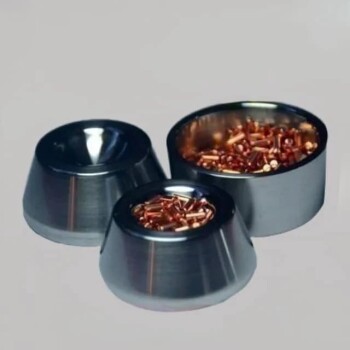
Electron Beam Evaporation Coating Gold Plating Tungsten Molybdenum Crucible for Evaporation

Electron Beam Evaporation Coating Gold Plating Tungsten Molybdenum Crucible for Evaporation

These crucibles act as containers for the gold material evaporated by the electron evaporation beam while precisely directing the electron beam for precise deposition.

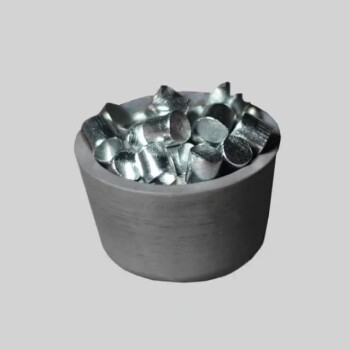
High Purity Pure Graphite Crucible for Evaporation

High Purity Pure Graphite Crucible for Evaporation

Vessels for high temperature applications, where materials are kept at extremely high temperatures to evaporate, allowing thin films to be deposited on substrates.

Electron Beam Evaporation Coating Oxygen-Free Copper Crucible and Evaporation Boat

Electron Beam Evaporation Coating Oxygen-Free Copper Crucible and Evaporation Boat

Electron Beam Evaporation Coating Oxygen-Free Copper Crucible enables precise co-deposition of various materials. Its controlled temperature and water-cooled design ensure pure and efficient thin film deposition.

Engineering Advanced Fine Ceramics Alumina Al2O3 Crucible With Lid Cylindrical Laboratory Crucible

Engineering Advanced Fine Ceramics Alumina Al2O3 Crucible With Lid Cylindrical Laboratory Crucible

Cylindrical Crucibles Cylindrical crucibles are one of the most common crucible shapes, suitable for melting and processing a wide variety of materials, and are easy to handle and clean.

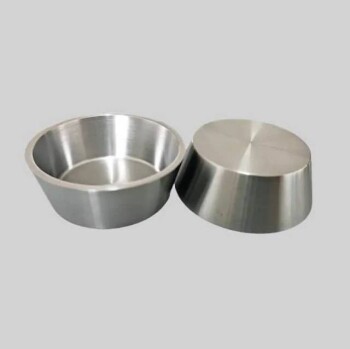
E Beam Crucibles Electron Gun Beam Crucible for Evaporation

E Beam Crucibles Electron Gun Beam Crucible for Evaporation

In the context of electron gun beam evaporation, a crucible is a container or source holder used to contain and evaporate the material to be deposited onto a substrate.

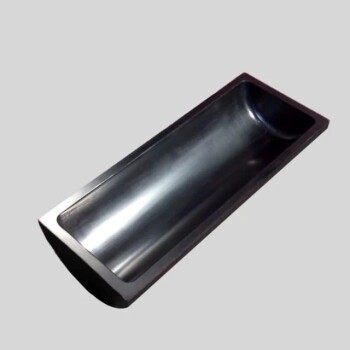
Carbon Graphite Boat -Laboratory Tube Furnace with Cover

Carbon Graphite Boat -Laboratory Tube Furnace with Cover

Covered Carbon Graphite Boat Laboratory Tube Furnaces are specialized vessels or vessels made of graphite material designed to withstand extreme high temperatures and chemically aggressive environments.

Electron Beam Evaporation Coating Conductive Boron Nitride Crucible BN Crucible

Electron Beam Evaporation Coating Conductive Boron Nitride Crucible BN Crucible

High-purity and smooth conductive boron nitride crucible for electron beam evaporation coating, with high temperature and thermal cycling performance.

Arc-Shaped Alumina Ceramic Crucible High Temperature Resistant for Engineering Advanced Fine Ceramics

Arc-Shaped Alumina Ceramic Crucible High Temperature Resistant for Engineering Advanced Fine Ceramics

In the journey of scientific exploration and industrial production, every detail is crucial. Our arc-shaped alumina ceramic crucibles, with their excellent high temperature resistance and stable chemical properties, have become a powerful assistant in laboratories and industrial fields. They are made of high-purity alumina materials and manufactured through precision processes to ensure excellent performance in extreme environments.

Evaporation Boat for Organic Matter

Evaporation Boat for Organic Matter

The evaporation boat for organic matter is an important tool for precise and uniform heating during the deposition of organic materials.

High Temperature Muffle Oven Furnace for Laboratory Debinding and Pre Sintering

High Temperature Muffle Oven Furnace for Laboratory Debinding and Pre Sintering

KT-MD High temperature debinding and pre-sintering furnace for ceramic materials with various molding processes. Ideal for electronic components such as MLCC and NFC.

1200℃ Split Tube Furnace with Quartz Tube Laboratory Tubular Furnace

1200℃ Split Tube Furnace with Quartz Tube Laboratory Tubular Furnace

KT-TF12 split tube furnace: high-purity insulation, embedded heating wire coils, and max. 1200C. Widely used for new materials and chemical vapour deposition.

Graphite Vacuum Furnace High Thermal Conductivity Film Graphitization Furnace

Graphite Vacuum Furnace High Thermal Conductivity Film Graphitization Furnace

The high thermal conductivity film graphitization furnace has uniform temperature, low energy consumption and can operate continuously.

Non Consumable Vacuum Arc Induction Melting Furnace

Non Consumable Vacuum Arc Induction Melting Furnace

Explore the benefits of Non-Consumable Vacuum Arc Furnace with high melting point electrodes. Small, easy to operate & eco-friendly. Ideal for laboratory research on refractory metals & carbides.

Laboratory Muffle Oven Furnace Bottom Lifting Muffle Furnace

Laboratory Muffle Oven Furnace Bottom Lifting Muffle Furnace

Efficiently produce batches with excellent temperature uniformity using our Bottom Lifting Furnace. Features two electric lifting stages and advanced temperature control up to 1600℃.

1700℃ Controlled Atmosphere Furnace Nitrogen Inert Atmosphere Furnace

1700℃ Controlled Atmosphere Furnace Nitrogen Inert Atmosphere Furnace

KT-17A Controlled atmosphere furnace: 1700℃ heating, vacuum sealing technology, PID temperature control, and versatile TFT smart touch screen controller for laboratory and industrial use.

Ultra-High Temperature Graphite Vacuum Graphitization Furnace

Ultra-High Temperature Graphite Vacuum Graphitization Furnace

The ultra-high temperature graphitization furnace utilizes medium frequency induction heating in a vacuum or inert gas environment. The induction coil generates an alternating magnetic field, inducing eddy currents in the graphite crucible, which heats up and radiates heat to the workpiece, bringing it to the desired temperature. This furnace is primarily used for graphitization and sintering of carbon materials, carbon fiber materials, and other composite materials.

1700℃ Muffle Oven Furnace for Laboratory

1700℃ Muffle Oven Furnace for Laboratory

Get superior heat control with our 1700℃ Muffle Furnace. Equipped with intelligent temperature microprocessor, TFT touch screen controller & advanced insulation materials for precise heating up to 1700C. Order now!

Controlled Nitrogen Inert Hydrogen Atmosphere Furnace

Controlled Nitrogen Inert Hydrogen Atmosphere Furnace

KT-AH Hydrogen atmosphere furnace - induction gas furnace for sintering/annealing with built-in safety features, dual housing design, and energy-saving efficiency. Ideal for lab and industrial use.

Dental Porcelain Zirconia Sintering Ceramic Furnace Chairside with Transformer

Dental Porcelain Zirconia Sintering Ceramic Furnace Chairside with Transformer

Experience top-notch sintering with Chairside Sintering Furnace with Transformer. Easy to operate, noise-free pallet, and automatic temperature calibration. Order now!

Graphite Vacuum Furnace Bottom Discharge Graphitization Furnace for Carbon Materials

Graphite Vacuum Furnace Bottom Discharge Graphitization Furnace for Carbon Materials

Bottom-out graphitization furnace for carbon materials, ultra-high temperature furnace up to 3100°C, suitable for graphitization and sintering of carbon rods and carbon blocks. Vertical design, bottom discharging, convenient feeding and discharging, high temperature uniformity, low energy consumption, good stability, hydraulic lifting system, convenient loading and unloading.


Leave Your Message