Knowledge What is the lamination process? A Guide to Combining Materials for Superior Performance
Author avatar

Tech Team · Kintek Solution

Updated 6 days ago

What is the lamination process? A Guide to Combining Materials for Superior Performance


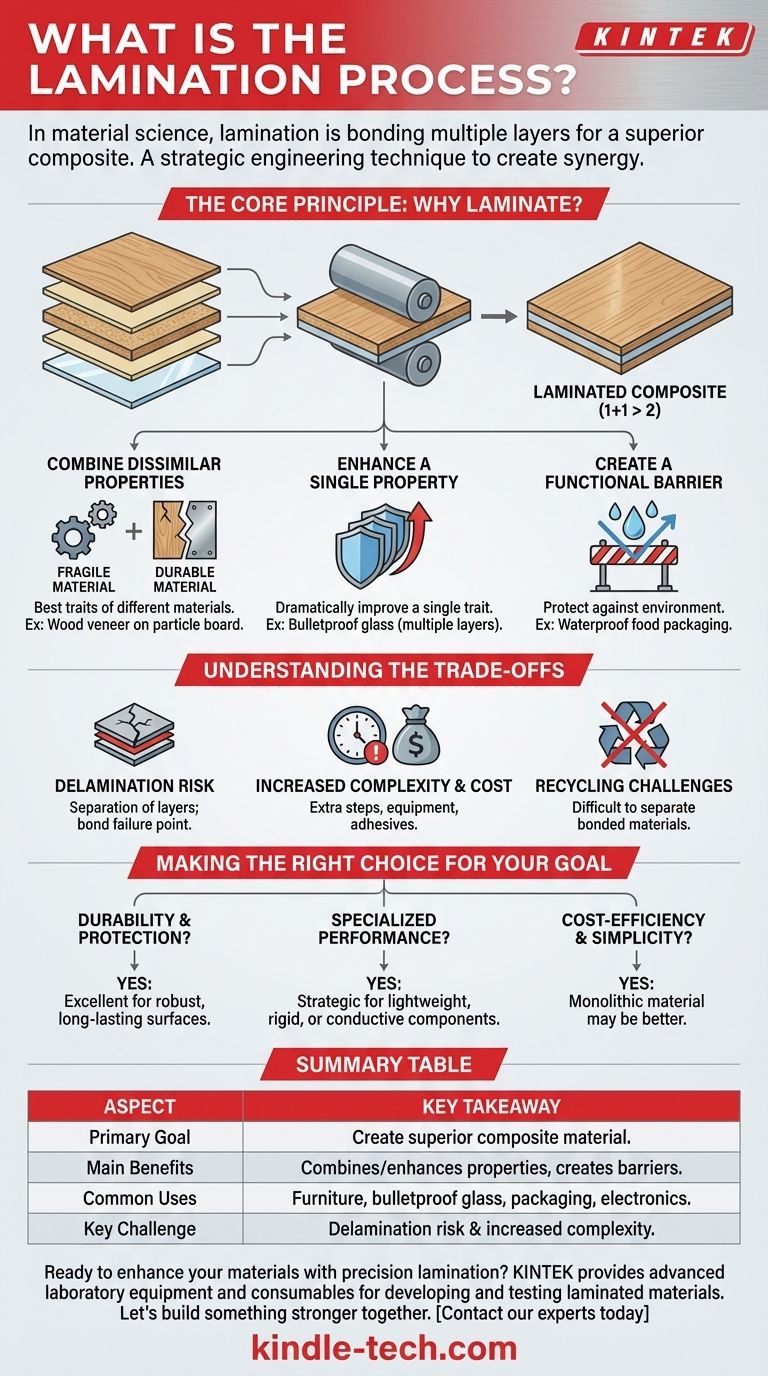
In material science and manufacturing, lamination is the process of bonding two or more layers of material together to create a single, improved composite sheet or object. The fundamental goal is to combine the distinct properties of different layers—such as strength, appearance, or stability—into a final product that is superior to any of its individual components.

Lamination is not simply about stacking materials; it's a strategic engineering technique used to create a new, composite material that is functionally greater than the sum of its parts. It allows designers to overcome the limitations of a single material by layering others with it.

The Core Principle: Why Laminate?

The decision to laminate a material is driven by the need to achieve a specific performance characteristic that a single material cannot provide on its own. The process is about creating synergy between layers.

Combining Dissimilar Properties

The most common reason for lamination is to combine the best traits of different materials. A thin, brittle material can be laminated with a flexible, durable one to create a final product that is both strong and resilient.

For example, a decorative wood veneer (which is fragile) can be laminated onto a core of particle board (which is stable but unattractive) to create a piece of furniture that is both beautiful and structurally sound.

Enhancing a Single Property

Sometimes, lamination involves layering the same material repeatedly. This is often done to dramatically enhance a single property, such as impact resistance.

Bulletproof glass is a perfect example. It consists of multiple layers of glass laminated with a clear polymer like polyvinyl butyral (PVB). A single, thick sheet of glass would shatter on impact, but the laminated layers absorb and distribute the energy, preventing penetration.

Creating a Functional Barrier

Lamination is highly effective for creating a barrier against environmental factors. By bonding a non-porous layer, like a plastic film, to a porous one, like paper, you can make the material waterproof, airtight, or resistant to grease.

This is the principle behind food packaging that keeps products fresh, restaurant menus that can be wiped clean, and floor coverings that resist stains and moisture.

Understanding the Trade-offs

While powerful, lamination is a specific engineering choice with its own set of challenges that must be considered.

The Risk of Delamination

The single greatest weakness of a laminated material is delamination—the separation of its constituent layers. This can be caused by a failure of the adhesive, exposure to moisture or heat, or physical stress. The bond between layers is the most common point of failure.

Increased Complexity and Cost

Lamination is an additional manufacturing step. It requires specialized equipment, adhesives, and process controls (for heat, pressure, and curing time), all of which add complexity and cost to the final product. For simple applications, a single monolithic material is almost always cheaper.

Recycling and Environmental Challenges

Composite materials created through lamination are notoriously difficult to recycle. Because they are made of different materials permanently bonded together (e.g., plastic and aluminum foil in a juice pouch), separating them for recycling is often economically or technically unfeasible.

Making the Right Choice for Your Goal

Deciding whether to use a laminated material depends entirely on your project's specific requirements for performance, cost, and longevity.

  • If your primary focus is durability and protection: Lamination is an excellent choice for creating robust, long-lasting surfaces that can withstand wear, moisture, or UV exposure.
  • If your primary focus is specialized performance: Use lamination to strategically combine properties, such as creating lightweight-yet-rigid structural components or integrating conductive layers within electronics like circuit boards.
  • If your primary focus is cost-efficiency and simplicity: A single, monolithic material may be a better choice, as lamination adds manufacturing expense and complexity that may not be justified.

Ultimately, lamination empowers engineers and designers to create materials with precision, overcoming inherent limitations by combining the best attributes of multiple layers.
What is the lamination process? A Guide to Combining Materials for Superior Performance

Summary Table:

Aspect Key Takeaway
Primary Goal Create a composite material superior to its individual layers.
Main Benefits Combines dissimilar properties, enhances single properties, creates functional barriers.
Common Uses Furniture, bulletproof glass, food packaging, electronics.
Key Challenge Risk of delamination and increased manufacturing complexity.

Ready to enhance your materials with precision lamination?

At KINTEK, we specialize in providing the advanced laboratory equipment and consumables needed to develop, test, and perfect laminated materials. Whether you're working on high-performance composites, durable packaging, or innovative electronics, our solutions help you achieve superior bonding and reliable results.

Let's build something stronger together. Contact our experts today to discuss your project needs!

Visual Guide
What is the lamination process? A Guide to Combining Materials for Superior Performance Visual Guide

Related Products

People Also Ask

Related Products

Vacuum Hot Press Furnace Machine for Lamination and Heating

Vacuum Hot Press Furnace Machine for Lamination and Heating

Experience clean and precise lamination with Vacuum Lamination Press. Perfect for wafer bonding, thin-film transformations, and LCP lamination. Order now!

Laboratory Hydraulic Press Split Electric Lab Pellet Press

Laboratory Hydraulic Press Split Electric Lab Pellet Press

Efficiently prepare samples with a split electric lab press - available in various sizes and ideal for material research, pharmacy, and ceramics. Enjoy greater versatility and higher pressure with this portable and programmable option.

Laboratory Hydraulic Press Lab Pellet Press Machine for Glove Box

Laboratory Hydraulic Press Lab Pellet Press Machine for Glove Box

Controlled environment lab press machine for glove box. Specialized equipment for material pressing and shaping with high precision digital pressure gauge.

Warm Isostatic Press for Solid State Battery Research

Warm Isostatic Press for Solid State Battery Research

Discover the advanced Warm Isostatic Press (WIP) for semiconductor lamination. Ideal for MLCC, hybrid chips, and medical electronics. Enhance strength and stability with precision.

Automatic Laboratory Heat Press Machine

Automatic Laboratory Heat Press Machine

Precision automatic heat press machines for labs—ideal for material testing, composites, and R&D. Customizable, safe, and efficient. Contact KINTEK today!

Warm Isostatic Press WIP Workstation 300Mpa for High Pressure Applications

Warm Isostatic Press WIP Workstation 300Mpa for High Pressure Applications

Discover Warm Isostatic Pressing (WIP) - A cutting-edge technology that enables uniform pressure to shape and press powdered products at a precise temperature. Ideal for complex parts and components in manufacturing.

Manual Heated Hydraulic Press Machine with Heated Plates for Laboratory Hot Press

Manual Heated Hydraulic Press Machine with Heated Plates for Laboratory Hot Press

The Manual Heat Press is a versatile piece of equipment suitable for a variety of applications, operated by a manual hydraulic system that applies controlled pressure and heat to the material placed on the piston.

Double Plate Heating Press Mold for Lab

Double Plate Heating Press Mold for Lab

Discover precision in heating with our Double Plate Heating Mold, featuring high-quality steel and uniform temperature control for efficient lab processes. Ideal for various thermal applications.

Laboratory Manual Hydraulic Pellet Press for Lab Use

Laboratory Manual Hydraulic Pellet Press for Lab Use

Efficient Manure Lab Hydraulic Press with Safety Cover for sample preparation in material research, pharmacy, and electronic industries. Available in 15T to 60T.

Heated Hydraulic Press Machine with Heated Plates Split Manual Laboratory Hot Press

Heated Hydraulic Press Machine with Heated Plates Split Manual Laboratory Hot Press

Efficiently prepare your samples with our Split Manual Heated Lab Press. With a pressure range up to 40T and heating plates up to 300°C, it's perfect for various industries.

Automatic Heated Hydraulic Press Machine with Heated Plates for Laboratory Hot Press

Automatic Heated Hydraulic Press Machine with Heated Plates for Laboratory Hot Press

The Automatic High Temperature Heat Press is a sophisticated hydraulic hot press designed for efficient temperature control and product quality processing.

Electric Lab Cold Isostatic Press CIP Machine for Cold Isostatic Pressing

Electric Lab Cold Isostatic Press CIP Machine for Cold Isostatic Pressing

Produce dense, uniform parts with improved mechanical properties with our Electric Lab Cold Isostatic Press. Widely used in material research, pharmacy, and electronic industries. Efficient, compact, and vacuum-compatible.

Manual High Temperature Heated Hydraulic Press Machine with Heated Plates for Lab

Manual High Temperature Heated Hydraulic Press Machine with Heated Plates for Lab

The High Temperature Hot Press is a machine specifically designed for pressing, sintering and processing materials in a high temperature environment. It is capable of operating in the range of hundreds of degrees Celsius to thousands of degrees Celsius for a variety of high temperature process requirements.

Automatic High Temperature Heated Hydraulic Press Machine with Heated Plates for Lab

Automatic High Temperature Heated Hydraulic Press Machine with Heated Plates for Lab

The High Temperature Hot Press is a machine specifically designed for pressing, sintering and processing materials in a high temperature environment. It is capable of operating in the range of hundreds of degrees Celsius to thousands of degrees Celsius for a variety of high temperature process requirements.

Automatic Laboratory Hydraulic Press for XRF & KBR Pellet Press

Automatic Laboratory Hydraulic Press for XRF & KBR Pellet Press

Fast and easy xrf sample pellet preparation with KinTek Automatic Lab Pellet Press. Versatile and accurate results for X-ray fluorescence analysis.

Infrared Heating Quantitative Flat Plate Press Mold

Infrared Heating Quantitative Flat Plate Press Mold

Discover advanced infrared heating solutions with high-density insulation and precise PID control for uniform thermal performance in various applications.

Laboratory Hydraulic Press Lab Pellet Press for Button Battery

Laboratory Hydraulic Press Lab Pellet Press for Button Battery

Efficiently prepare samples with our 2T Button Battery Press. Ideal for material research labs and small-scale production. Small footprint, lightweight, and vacuum-compatible.

Heated Hydraulic Press Machine with Integrated Manual Heated Plates for Lab Use

Heated Hydraulic Press Machine with Integrated Manual Heated Plates for Lab Use

Efficiently process heat-pressing samples with our Integrated Manual Heated Lab Press. With a heating range up to 500°C, it's perfect for various industries.

Rubber Vulcanizer Vulcanizing Machine Plate Vulcanizing Press for Lab

Rubber Vulcanizer Vulcanizing Machine Plate Vulcanizing Press for Lab

The Plate vulcanizing press is a kind of equipment used in the production of rubber products, mainly used for the vulcanization of rubber products. Vulcanization is a key step in rubber processing.

Manual Cold Isostatic Pressing Machine CIP Pellet Press

Manual Cold Isostatic Pressing Machine CIP Pellet Press

Lab Manual Isostatic Press is a high-efficient equipment for sample preparation widely used in material research, pharmacy, ceramics, and electronic industries. It allows for precision control of the pressing process and can work in a vacuum environment.


Leave Your Message