Knowledge vacuum induction melting furnace What is the lining material for an induction furnace? A Guide to High-Performance Refractories
Author avatar

Tech Team · Kintek Solution

Updated 2 months ago

What is the lining material for an induction furnace? A Guide to High-Performance Refractories


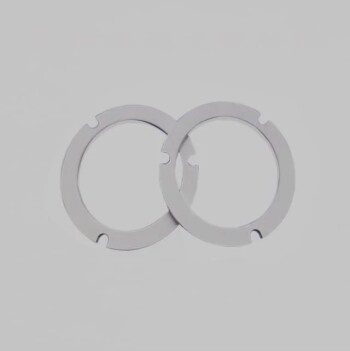
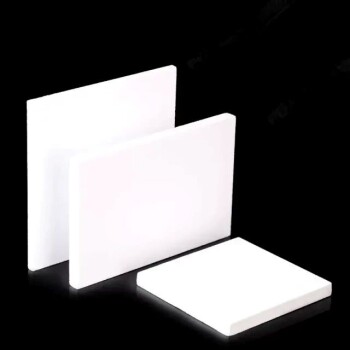
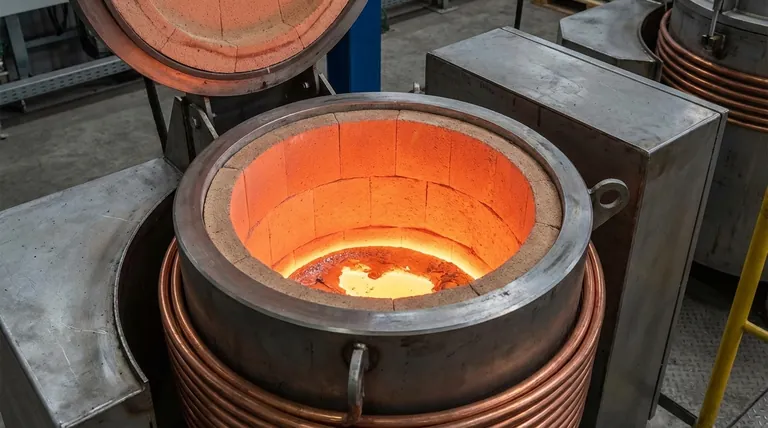
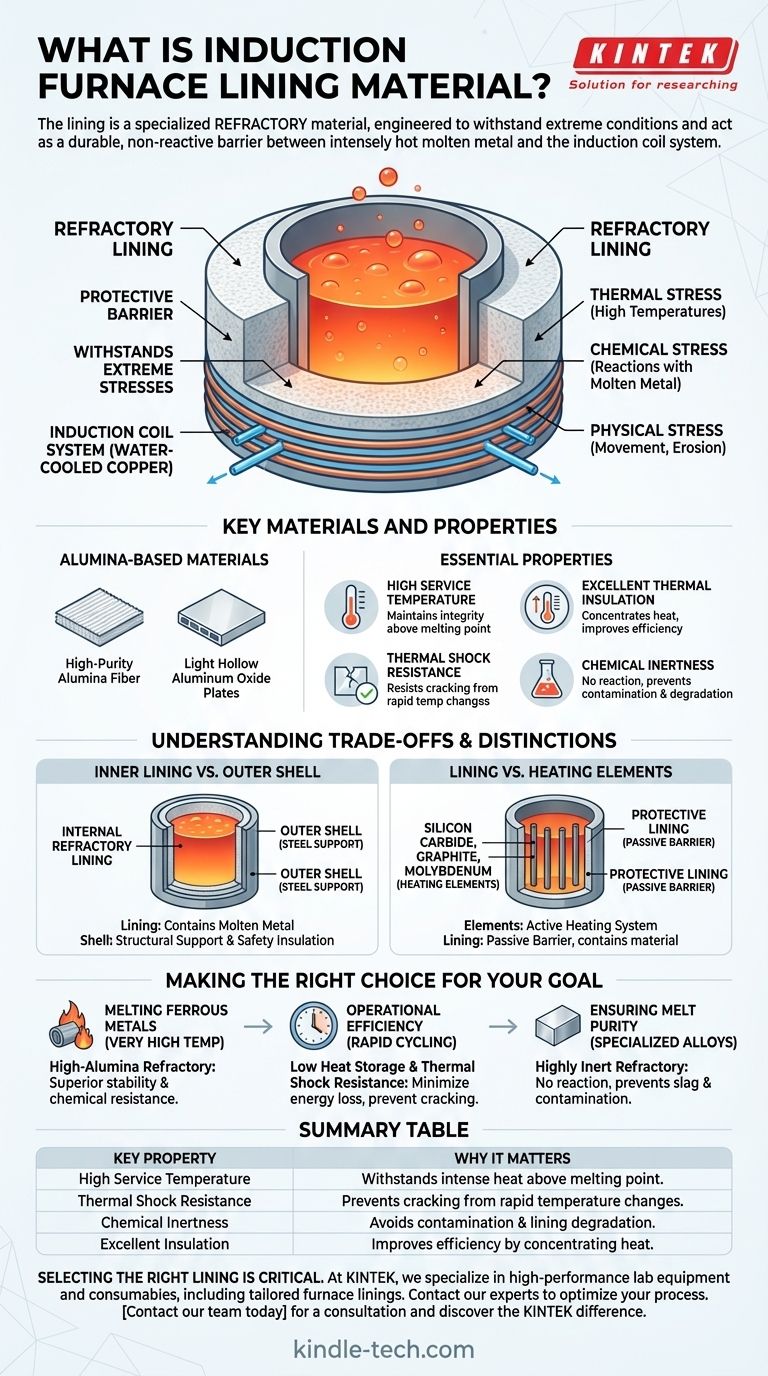
In an induction furnace, the lining is made from a specialized category of materials known as refractories. These are engineered materials, such as high-purity alumina or other refractory plates, designed to withstand extreme conditions. The lining's most critical function is to act as a durable, non-reactive barrier between the intensely hot molten metal and the furnace's vital induction coil system.

The choice of an induction furnace lining is not about simple insulation. It is a critical engineering decision to select a specific refractory material that can endure immense thermal, chemical, and physical stress to protect the core components of the furnace and ensure the purity of the melt.
What is the lining material for an induction furnace? A Guide to High-Performance Refractories

The Core Function of the Refractory Lining

The lining is arguably one of the most important components in an induction furnace, serving as the first and last line of defense during operation. Its performance directly impacts safety, efficiency, and product quality.

A Protective Barrier

The primary role of the lining is to contain the molten metal and protect the induction coil. Direct contact between the molten charge and the water-cooled copper coil would be catastrophic, and the refractory lining prevents this.

Withstanding Extreme Stresses

The lining material is constantly subjected to a combination of forces. It must endure intense thermal stress from high temperatures, chemical stress from potential reactions with the molten metal, and physical stress from the movement and erosion of the charge.

Key Materials and Their Properties

While the general term is "refractory," specific material choices are based on the intended application, particularly the type of metal being melted (ferrous or non-ferrous).

Alumina-Based Materials

For many applications, materials like high-purity alumina fiber and light hollow aluminum oxide plates are used. These are valued for their high performance and reliability under heat.

Essential Material Properties

The effectiveness of a lining is defined by a few key characteristics:

  • High Service Temperature: The material must maintain its structural integrity well above the melting point of the metal.
  • Excellent Thermal Insulation: Good insulation keeps the heat concentrated in the melt, improving energy efficiency and protecting external components.
  • Thermal Shock Resistance: The lining must resist cracking or spalling when subjected to the rapid temperature changes inherent in furnace operation.
  • Chemical Inertness: A quality lining will not react with the molten metal. This prevents contamination of the final product and avoids degradation of the lining itself, a common cause of slag.

Understanding the Trade-offs and Distinctions

It is easy to confuse the different components of a furnace system. Clarifying their distinct roles is essential for understanding the overall design.

Inner Lining vs. Outer Shell

The internal refractory lining is completely different from the furnace's outer shell. The shell is typically made of high-quality steel and is designed for structural support, while its own insulation layer is meant to keep the exterior safe to the touch.

Lining vs. Heating Elements

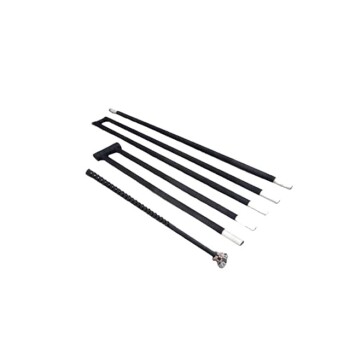
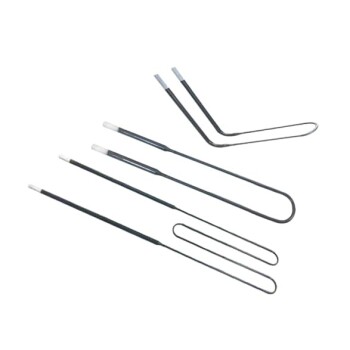
In some furnace designs, materials like silicon carbide rods, graphite, or molybdenum strips are used. It is important to recognize that these are typically heating elements, not the protective lining that contains the molten material. The lining is the passive barrier, while the elements are part of the active heating system.

Making the Right Choice for Your Goal

The selection of a lining material is dictated by the specific operational goal. The properties of the refractory must be matched to the demands of the process.

  • If your primary focus is melting ferrous metals at very high temperatures: You require a high-alumina refractory known for its superior high-temperature stability and chemical resistance.
  • If your primary focus is operational efficiency and rapid cycling: A lining with low heat storage capacity and excellent thermal shock resistance is crucial to minimize energy loss and prevent cracking.
  • If your primary focus is ensuring melt purity for specialized alloys: The key is selecting a highly inert refractory that will not react with your specific metal charge or contribute to slag formation.

Ultimately, the right lining material is a carefully engineered choice that directly impacts the safety, efficiency, and quality of your melting operations.

Summary Table:

Key Property Why It Matters for the Lining
High Service Temperature Withstands intense heat well above the metal's melting point.
Thermal Shock Resistance Prevents cracking from rapid temperature changes during operation.
Chemical Inertness Avoids contaminating the melt and prevents lining degradation.
Excellent Insulation Improves energy efficiency by concentrating heat in the melt.

Selecting the right refractory lining is critical for your furnace's performance and safety. At KINTEK, we specialize in high-performance lab equipment and consumables, including furnace linings tailored for your specific application—whether you're melting ferrous metals, prioritizing efficiency, or ensuring ultimate melt purity. Our experts can help you choose the ideal material to protect your investment and optimize your process. Contact our team today for a consultation and discover the KINTEK difference in reliability and support.

Visual Guide
What is the lining material for an induction furnace? A Guide to High-Performance Refractories Visual Guide

Related Products

People Also Ask

Related Products

Non Consumable Vacuum Arc Induction Melting Furnace

Non Consumable Vacuum Arc Induction Melting Furnace

Explore the benefits of Non-Consumable Vacuum Arc Furnace with high melting point electrodes. Small, easy to operate & eco-friendly. Ideal for laboratory research on refractory metals & carbides.

Copper Foam

Copper Foam

Copper foam has good thermal conductivity and can be widely used for heat conduction and heat dissipation of motors/electrical appliances and electronic components.

600T Vacuum Induction Hot Press Furnace for Heat Treat and Sintering

600T Vacuum Induction Hot Press Furnace for Heat Treat and Sintering

Discover the 600T Vacuum Induction Hot Press Furnace, designed for high-temperature sintering experiments in vacuum or protected atmospheres. Its precise temperature and pressure control, adjustable working pressure, and advanced safety features make it ideal for nonmetal materials, carbon composites, ceramics, and metal powders.

Vacuum Arc Induction Melting Furnace

Vacuum Arc Induction Melting Furnace

Discover the power of Vacuum Arc Furnace for melting active & refractory metals. High-speed, remarkable degassing effect, and free of contamination. Learn more now!

Silicon Carbide SiC Thermal Heating Elements for Electric Furnace

Silicon Carbide SiC Thermal Heating Elements for Electric Furnace

Experience the advantages of Silicon Carbide (SiC) Heating Element: Long service life, high corrosion and oxidation resistance, fast heating speed, and easy maintenance. Learn more now!

High Temperature Alumina (Al2O3) Furnace Tube for Engineering Advanced Fine Ceramics

High Temperature Alumina (Al2O3) Furnace Tube for Engineering Advanced Fine Ceramics

High temperature alumina furnace tube combines the advantages of high hardness of alumina, good chemical inertness and steel, and has excellent wear resistance, thermal shock resistance and mechanical shock resistance.

Controlled Nitrogen Inert Hydrogen Atmosphere Furnace

Controlled Nitrogen Inert Hydrogen Atmosphere Furnace

KT-AH Hydrogen atmosphere furnace - induction gas furnace for sintering/annealing with built-in safety features, dual housing design, and energy-saving efficiency. Ideal for lab and industrial use.

Lab-Scale Vacuum Induction Melting Furnace

Lab-Scale Vacuum Induction Melting Furnace

Get precise alloy composition with our Vacuum Induction Melting Furnace. Ideal for aerospace, nuclear energy, and electronic industries. Order now for effective smelting and casting of metals and alloys.

Graphite Vacuum Furnace Bottom Discharge Graphitization Furnace for Carbon Materials

Graphite Vacuum Furnace Bottom Discharge Graphitization Furnace for Carbon Materials

Bottom-out graphitization furnace for carbon materials, ultra-high temperature furnace up to 3100°C, suitable for graphitization and sintering of carbon rods and carbon blocks. Vertical design, bottom discharging, convenient feeding and discharging, high temperature uniformity, low energy consumption, good stability, hydraulic lifting system, convenient loading and unloading.

Boron Nitride (BN) Ceramic Plate

Boron Nitride (BN) Ceramic Plate

Boron nitride (BN) ceramic plates do not use aluminum water to wet, and can provide comprehensive protection for the surface of materials that directly contact molten aluminum, magnesium, zinc alloys and their slag.

Molybdenum Disilicide (MoSi2) Thermal Elements Electric Furnace Heating Element

Molybdenum Disilicide (MoSi2) Thermal Elements Electric Furnace Heating Element

Discover the power of Molybdenum Disilicide (MoSi2) Heating Element for high-temperature resistance. Unique oxidation resistance with stable resistance value. Learn more about its benefits now!

Hexagonal Boron Nitride HBN Ceramic Ring

Hexagonal Boron Nitride HBN Ceramic Ring

Boron nitride ceramic (BN) rings are commonly used in high temperature applications such as furnace fixtures, heat exchangers and semiconductor processing.

Graphite Vacuum Furnace High Thermal Conductivity Film Graphitization Furnace

Graphite Vacuum Furnace High Thermal Conductivity Film Graphitization Furnace

The high thermal conductivity film graphitization furnace has uniform temperature, low energy consumption and can operate continuously.

Vacuum Heat Treat and Molybdenum Wire Sintering Furnace for Vacuum Sintering

Vacuum Heat Treat and Molybdenum Wire Sintering Furnace for Vacuum Sintering

A vacuum molybdenum wire sintering furnace is a vertical or bedroom structure, which is suitable for withdrawal, brazing, sintering and degassing of metal materials under high vacuum and high temperature conditions. It is also suitable for dehydroxylation treatment of quartz materials.

High Temperature Wear-Resistant Alumina Al2O3 Plate for Engineering Advanced Fine Ceramics

High Temperature Wear-Resistant Alumina Al2O3 Plate for Engineering Advanced Fine Ceramics

High temperature wear-resistant insulating alumina plate has excellent insulation performance and high temperature resistance.

Engineering Advanced Fine Alumina Al2O3 Ceramic Rod Insulated for Industrial Applications

Engineering Advanced Fine Alumina Al2O3 Ceramic Rod Insulated for Industrial Applications

Insulated alumina rod is a fine ceramic material. Alumina rods have excellent electrical insulating properties, high chemical resistance and low thermal expansion.

Large Vertical Graphite Vacuum Graphitization Furnace

Large Vertical Graphite Vacuum Graphitization Furnace

A large vertical high-temperature graphitization furnace is a type of industrial furnace used for the graphitization of carbon materials, such as carbon fiber and carbon black. It is a high-temperature furnace that can reach temperatures of up to 3100°C.

Ultra-High Temperature Graphite Vacuum Graphitization Furnace

Ultra-High Temperature Graphite Vacuum Graphitization Furnace

The ultra-high temperature graphitization furnace utilizes medium frequency induction heating in a vacuum or inert gas environment. The induction coil generates an alternating magnetic field, inducing eddy currents in the graphite crucible, which heats up and radiates heat to the workpiece, bringing it to the desired temperature. This furnace is primarily used for graphitization and sintering of carbon materials, carbon fiber materials, and other composite materials.

Hexagonal Boron Nitride HBN Spacer Cam Profile and Various Spacer Types

Hexagonal Boron Nitride HBN Spacer Cam Profile and Various Spacer Types

Hexagonal boron nitride (HBN) gaskets are made from hot-pressed boron nitride blanks. Mechanical properties similar to graphite, but with excellent electrical resistance.

Vertical High Temperature Graphite Vacuum Graphitization Furnace

Vertical High Temperature Graphite Vacuum Graphitization Furnace

Vertical high temperature graphitization furnace for carbonization and graphitization of carbon materials up to 3100℃.Suitable for shaped graphitization of carbon fiber filaments and other materials sintered in a carbon environment.Applications in metallurgy, electronics, and aerospace for producing high-quality graphite products like electrodes and crucibles.


Leave Your Message