Knowledge lab furnace accessories What is the lining of a furnace made of? Key Materials for Extreme Heat Containment
Author avatar

Tech Team · Kintek Solution

Updated 2 months ago

What is the lining of a furnace made of? Key Materials for Extreme Heat Containment


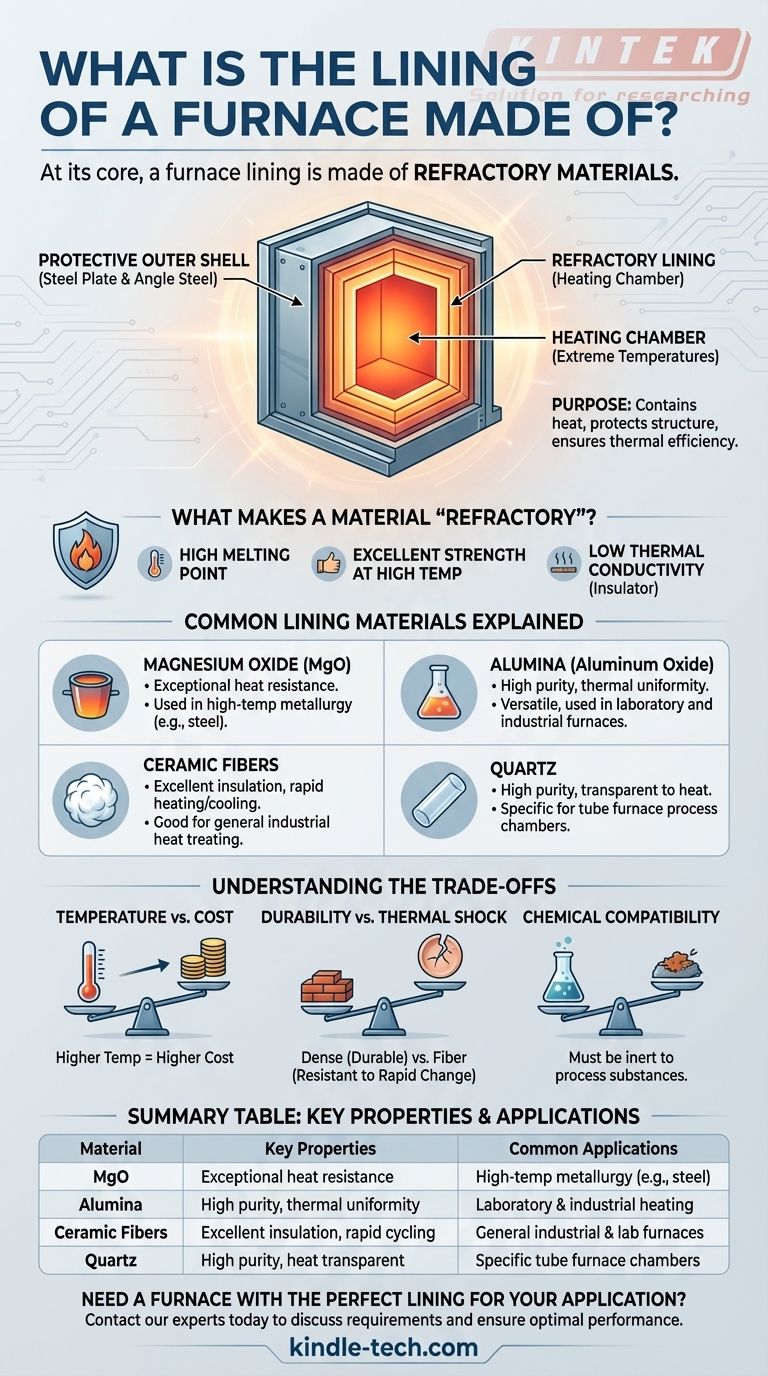
At its core, a furnace lining is made of refractory materials. These are specialized substances, most commonly magnesium oxide (MgO), alumina (aluminum oxide), and various ceramic fibers, chosen specifically for their ability to resist extreme heat and maintain their structural integrity at very high temperatures.

The specific material used for a furnace lining is not a one-size-fits-all solution. The choice is a critical engineering decision dictated by the furnace's maximum operating temperature, its intended application, and the need to balance durability with thermal efficiency.
What is the lining of a furnace made of? Key Materials for Extreme Heat Containment

The Purpose of Refractory Materials

The lining is the functional heart of a furnace's heating chamber. It must contain extreme temperatures while protecting the furnace's external structure. This requires materials with a unique set of properties.

What Makes a Material "Refractory"?

A refractory is a material that is chemically and physically stable at high temperatures. These materials are the only viable option for containing processes that can reach thousands of degrees.

Their key characteristics include high melting points, excellent strength at high temperatures, and low thermal conductivity, which makes them effective insulators.

Common Lining Materials Explained

Different furnace types and applications call for different refractory materials.

  • Magnesium Oxide (MgO): Often found in furnaces for steel manufacturing, MgO is prized for its exceptionally high resistance to heat.
  • Alumina (Aluminum Oxide): This is a highly versatile material used in many laboratory and industrial furnaces, such as tube furnaces. It can be found as high-purity fiber, light hollow plates, or as the core material for the heating tube itself.
  • Ceramic Fibers: These materials, often based on alumina, provide excellent thermal insulation. Their low heat storage capacity allows for rapid heating and cooling cycles without cracking or degrading.
  • Quartz: In certain tube furnaces, a high-purity quartz tube serves as the process chamber. While the chamber is surrounded by other insulating refractories, the quartz tube is the component directly containing the heat and the sample.

How the Lining Integrates into Furnace Construction

The lining doesn't exist in isolation. It works as part of a system to provide structural integrity, thermal containment, and operational efficiency.

The Protective Outer Shell

The entire furnace assembly is housed within a heavy-duty outer shell, typically fabricated from welded angle steel and high-quality steel plate. This shell provides the primary structural support and a cool, safe exterior.

Forming the Heating Chamber

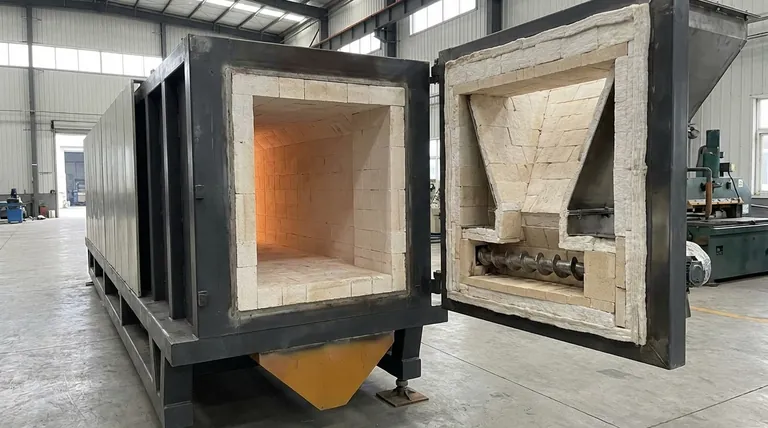
The refractory lining sits inside the steel shell and forms the actual heating chamber. In a box furnace, this might be a brick-like construction. In a tube furnace, the heating chamber is often a cylinder made of alumina ceramic fiber that surrounds the central process tube.

The Critical Role of Insulation

The primary function of the lining is to keep the heat inside the chamber. This ensures the furnace can reach and maintain its target temperature efficiently and protects the outer shell and surrounding environment from the extreme internal heat.

Understanding the Trade-offs

Selecting a furnace lining involves balancing competing priorities. No single material is perfect for every situation.

Temperature vs. Cost

As a general rule, materials capable of withstanding higher temperatures are more expensive. High-purity alumina or specialized refractory alloys cost significantly more than standard ceramic fibers.

Durability vs. Thermal Shock

Dense, brick-like refractories can be very durable against physical wear. However, they can be brittle and prone to cracking during rapid temperature changes (thermal shock). Lighter ceramic fibers excel at resisting thermal shock but may be less resistant to physical abrasion.

Chemical Compatibility

The lining material must be chemically inert to the substances being heated inside the furnace. An incompatible lining can contaminate the sample or be corroded by the process, leading to premature furnace failure.

Making the Right Choice for Your Goal

The ideal lining is determined entirely by the furnace's intended use.

  • If your primary focus is high-temperature metallurgy (e.g., steel): Your furnace will likely rely on robust materials like magnesium oxide (MgO) for maximum heat containment.
  • If your primary focus is controlled laboratory research: You will encounter high-purity alumina, ceramic fibers, and quartz tubes, which provide excellent thermal uniformity and a clean environment.
  • If your primary focus is general industrial heat treating: Vacuum-formed ceramic fiber linings offer an effective balance of insulation, rapid cycling, and cost-efficiency.

Ultimately, the furnace lining is a critical component where the material is precisely engineered to meet the extreme demands of its specific application.

Summary Table:

Material Key Properties Common Applications
Magnesium Oxide (MgO) Exceptional heat resistance High-temperature metallurgy (e.g., steel)
Alumina (Aluminum Oxide) High purity, thermal uniformity, versatile Laboratory tube furnaces, industrial heating
Ceramic Fibers Excellent insulation, rapid heating/cooling General industrial heat treating, lab furnaces
Quartz High purity, transparent to heat Specific tube furnace process chambers

Need a Furnace with the Perfect Lining for Your Application?

The right refractory lining is critical for your process's success, whether you're in high-temperature research, metallurgy, or industrial heat treatment. KINTEK specializes in providing laboratory equipment with precisely engineered furnace linings tailored to your specific needs for temperature, durability, and chemical compatibility.

Contact our experts today to discuss your requirements and ensure you get a furnace that delivers optimal performance, efficiency, and longevity.

Visual Guide
What is the lining of a furnace made of? Key Materials for Extreme Heat Containment Visual Guide

Related Products

People Also Ask

Related Products

Vacuum Heat Treat Furnace with Ceramic Fiber Liner

Vacuum Heat Treat Furnace with Ceramic Fiber Liner

Vacuum furnace with polycrystalline ceramic fiber insulation liner for excellent heat insulation and uniform temperature field. Choose from 1200℃ or 1700℃ max. working temperature with high vacuum performance and precise temperature control.

Rotary Tube Furnace Split Multi Heating Zone Rotating Tube Furnace

Rotary Tube Furnace Split Multi Heating Zone Rotating Tube Furnace

Multi zone rotary furnace for high-precision temperature control with 2-8 independent heating zones. Ideal for lithium ion battery electrode materials and high-temperature reactions. Can work under vacuum and controlled atmosphere.

Graphite Vacuum Furnace High Thermal Conductivity Film Graphitization Furnace

Graphite Vacuum Furnace High Thermal Conductivity Film Graphitization Furnace

The high thermal conductivity film graphitization furnace has uniform temperature, low energy consumption and can operate continuously.

High Temperature Muffle Oven Furnace for Laboratory Debinding and Pre Sintering

High Temperature Muffle Oven Furnace for Laboratory Debinding and Pre Sintering

KT-MD High temperature debinding and pre-sintering furnace for ceramic materials with various molding processes. Ideal for electronic components such as MLCC and NFC.

Horizontal High Temperature Graphite Vacuum Graphitization Furnace

Horizontal High Temperature Graphite Vacuum Graphitization Furnace

Horizontal Graphitization Furnace: This type of furnace is designed with the heating elements placed horizontally, allowing for uniform heating of the sample. It's well-suited for graphitizing large or bulky samples that require precise temperature control and uniformity.

Ultra-High Temperature Graphite Vacuum Graphitization Furnace

Ultra-High Temperature Graphite Vacuum Graphitization Furnace

The ultra-high temperature graphitization furnace utilizes medium frequency induction heating in a vacuum or inert gas environment. The induction coil generates an alternating magnetic field, inducing eddy currents in the graphite crucible, which heats up and radiates heat to the workpiece, bringing it to the desired temperature. This furnace is primarily used for graphitization and sintering of carbon materials, carbon fiber materials, and other composite materials.

Controlled Nitrogen Inert Hydrogen Atmosphere Furnace

Controlled Nitrogen Inert Hydrogen Atmosphere Furnace

KT-AH Hydrogen atmosphere furnace - induction gas furnace for sintering/annealing with built-in safety features, dual housing design, and energy-saving efficiency. Ideal for lab and industrial use.

1200℃ Split Tube Furnace with Quartz Tube Laboratory Tubular Furnace

1200℃ Split Tube Furnace with Quartz Tube Laboratory Tubular Furnace

KT-TF12 split tube furnace: high-purity insulation, embedded heating wire coils, and max. 1200C. Widely used for new materials and chemical vapour deposition.

Laboratory Muffle Oven Furnace Bottom Lifting Muffle Furnace

Laboratory Muffle Oven Furnace Bottom Lifting Muffle Furnace

Efficiently produce batches with excellent temperature uniformity using our Bottom Lifting Furnace. Features two electric lifting stages and advanced temperature control up to 1600℃.

Mesh belt controlled atmosphere furnace

Mesh belt controlled atmosphere furnace

Discover our KT-MB mesh belt sintering furnace - perfect for high-temperature sintering of electronic components & glass insulators. Available for open air or controlled atmosphere environments.

Graphite Vacuum Furnace Bottom Discharge Graphitization Furnace for Carbon Materials

Graphite Vacuum Furnace Bottom Discharge Graphitization Furnace for Carbon Materials

Bottom-out graphitization furnace for carbon materials, ultra-high temperature furnace up to 3100°C, suitable for graphitization and sintering of carbon rods and carbon blocks. Vertical design, bottom discharging, convenient feeding and discharging, high temperature uniformity, low energy consumption, good stability, hydraulic lifting system, convenient loading and unloading.

Vacuum Heat Treat and Molybdenum Wire Sintering Furnace for Vacuum Sintering

Vacuum Heat Treat and Molybdenum Wire Sintering Furnace for Vacuum Sintering

A vacuum molybdenum wire sintering furnace is a vertical or bedroom structure, which is suitable for withdrawal, brazing, sintering and degassing of metal materials under high vacuum and high temperature conditions. It is also suitable for dehydroxylation treatment of quartz materials.

Vacuum Sealed Continuous Working Rotary Tube Furnace Rotating Tube Furnace

Vacuum Sealed Continuous Working Rotary Tube Furnace Rotating Tube Furnace

Experience efficient material processing with our vacuum-sealed rotary tube furnace. Perfect for experiments or industrial production, equipped with optional features for controlled feeding and optimized results. Order now.

Copper Foam

Copper Foam

Copper foam has good thermal conductivity and can be widely used for heat conduction and heat dissipation of motors/electrical appliances and electronic components.

Vacuum Heat Treat Sintering Brazing Furnace

Vacuum Heat Treat Sintering Brazing Furnace

A vacuum brazing furnace is a type of industrial furnace used for brazing, a metalworking process that joins two pieces of metal using a filler metal that melts at a lower temperature than the base metals. Vacuum brazing furnaces are typically used for high-quality applications where a strong, clean joint is required.

Graphite Vacuum Continuous Graphitization Furnace

Graphite Vacuum Continuous Graphitization Furnace

High-temperature graphitization furnace is a professional equipment for graphitization treatment of carbon materials. It is a key equipment for the production of high-quality graphite products. It has high temperature, high efficiency and uniform heating. It is suitable for various high-temperature treatments and graphitization treatments. It is widely used in metallurgy, electronics, aerospace, etc. industry.

Vertical Laboratory Tube Furnace

Vertical Laboratory Tube Furnace

Elevate your experiments with our Vertical Tube Furnace. Versatile design allows for operation under various environments and heat treatment applications. Order now for precise results!

Vacuum Heat Treat and Pressure Sintering Furnace for High Temperature Applications

Vacuum Heat Treat and Pressure Sintering Furnace for High Temperature Applications

Vacuum pressure sintering furnaces are designed for high temperature hot pressing applications in metal and ceramic sintering. Its advanced features ensure precise temperature control, reliable pressure maintenance, and a robust design for seamless operation.

2200 ℃ Graphite Vacuum Heat Treat Furnace

2200 ℃ Graphite Vacuum Heat Treat Furnace

Discover the power of the KT-VG Graphite Vacuum Furnace - with a maximum working temperature of 2200℃, it's perfect for vacuum sintering of various materials. Learn more now.

Multi Heating Zones CVD Tube Furnace Machine Chemical Vapor Deposition Chamber System Equipment

Multi Heating Zones CVD Tube Furnace Machine Chemical Vapor Deposition Chamber System Equipment

KT-CTF14 Multi Heating Zones CVD Furnace - Precise Temperature Control and Gas Flow for Advanced Applications. Max temp up to 1200℃, 4 channels MFC mass flow meter, and 7" TFT touch screen controller.


Leave Your Message