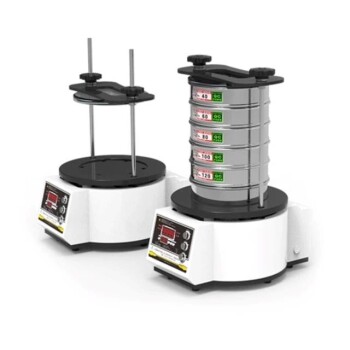
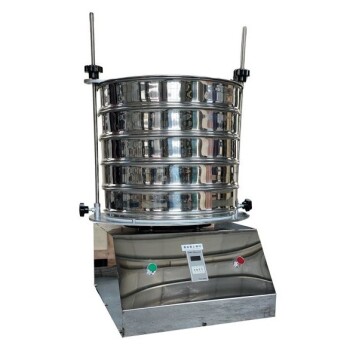
The primary purpose of using a 200-mesh standard sieve is to standardize coal samples into a fine powder with a particle size strictly less than 75 µm. By filtering the sample to this specific dimension, you ensure the coal possesses a high specific surface area. This physical characteristic is a prerequisite for achieving uniform heating, which is critical for the validity of subsequent combustion experiments.
The use of a 200-mesh sieve is a critical control measure to guarantee that heat transfer does not skew your results. By ensuring a high specific surface area, you enable uniform heating that yields representative ignition and burnout data during Thermogravimetric Analysis (TGA).
The Mechanics of Sample Preparation
Defining the 75 µm Threshold
The 200-mesh designation refers to a specific screen size that allows only particles smaller than 75 µm to pass through.
In coal combustion studies, this is the industry benchmark for defining "fine coal powder." It eliminates larger, irregular chunks that would behave unpredictably under thermal stress.
Maximizing Specific Surface Area
Reducing the particle size to this threshold significantly increases the sample's specific surface area.
This maximizes the amount of coal material directly exposed to the heat source and the oxidizing atmosphere. A higher surface area is necessary to facilitate immediate and consistent chemical reactions during testing.
Why Uniformity Dictates Data Quality
Ensuring Uniform Heating
The most critical advantage of the <75 µm specification is the achievement of uniform heating across the entire sample mass.
When particles are small and consistent, thermal energy penetrates the sample evenly. This prevents the formation of temperature gradients, where the outside of a particle might react faster than its core.
Enhancing TGA and Pilot-Scale Precision
Uniform heating is directly responsible for the accuracy of data collected during Thermogravimetric Analysis (TGA) and pilot-scale trials.
Without this uniformity, metrics regarding ignition points and burnout characteristics would be unreliable. The 200-mesh standard ensures that the data reflects the coal's true chemical properties rather than physical heat transfer limitations.
Understanding the Implications of Improper Sizing
The Consequence of Coarse Particles
If a sieve coarser than 200-mesh is used, or if the sieving process is bypassed, the sample will likely contain particles larger than 75 µm.
Larger particles suffer from uneven heating, leading to delayed ignition or incomplete burnout measurements. This introduces a variable into the experiment that distorts the true combustion characteristics of the coal.
Making the Right Choice for Your Goal
To ensure your combustion studies yield defensible data, apply the sieving standard based on your specific analytical needs:
- If your primary focus is TGA (Thermogravimetric Analysis): Strict adherence to the 200-mesh (<75 µm) standard is mandatory to prevent thermal gradients from skewing your kinetic data.
- If your primary focus is obtaining representative burnout data: Use the 200-mesh sieve to maximize surface area, ensuring the sample fully reacts during the testing window.
Standardizing your particle size is the first and most vital step in reducing experimental error in coal characterization.
Summary Table:
| Feature | 200-Mesh Sieve Specification | Impact on Coal Combustion Study |
|---|---|---|
| Particle Size | < 75 µm | Ensures industry-standard fine powder consistency |
| Surface Area | High Specific Surface Area | Maximizes exposure to heat and oxidizing atmospheres |
| Thermal Behavior | Uniform Heating | Prevents temperature gradients for accurate kinetic data |
| Analytical Goal | Standardized Preparation | Essential for reliable TGA, ignition, and burnout metrics |
Elevate Your Sample Preparation with KINTEK Precision
Reliable coal combustion data begins with uncompromising sample preparation. KINTEK specializes in high-performance crushing and milling systems, sieving equipment, and 200-mesh standard sieves designed to help researchers achieve the precise 75 µm threshold required for uniform heating and accurate Thermogravimetric Analysis (TGA).
Beyond sample prep, our comprehensive laboratory portfolio includes:
- High-Temperature Furnaces: Muffle, tube, and vacuum furnaces for controlled thermal testing.
- Material Processing: Hydraulic presses, high-pressure reactors, and specialized ceramics/cruibles.
- Research Consumables: PTFE products and high-purity electrodes for advanced energy studies.
Don't let improper particle sizing skew your results. Partner with KINTEK for durable, high-precision tools that guarantee defensible data. Contact our laboratory experts today to find the perfect equipment for your workflow!
References
- Minghao Wang, Jingyu Guan. Research on Oxy-Fuel Combustion Characteristics of Two Typical Chinese Coals. DOI: 10.3390/pr11071933
This article is also based on technical information from Kintek Solution Knowledge Base .
Related Products
- Vibratory Sieve Shaker Machine Dry Three-Dimensional Vibrating Sieve
- Laboratory Vibratory Sieve Shaker Machine Slap Vibrating Sieve
- Custom PTFE Teflon Parts Manufacturer for PTFE Mesh F4 Sieve
- Three-dimensional electromagnetic sieving instrument
- Laboratory Test Sieves and Sieving Machines
People Also Ask
- How is a vibratory sieve shaker used in the particle size analysis of mechanically alloyed powders? Expert Guide
- Why use a vibratory sieve shaker for PET powder? Achieve Precise Particle Size Control for Chemical Research
- What is the principle of vibratory sieve shaker? Achieve Accurate Particle Size Analysis
- What is the function of a vibratory sieve shaker? Achieve Precise Particle Size Analysis
- What is the use of vibratory sieve shaker? Achieve Precise Particle Size Analysis for Your Lab