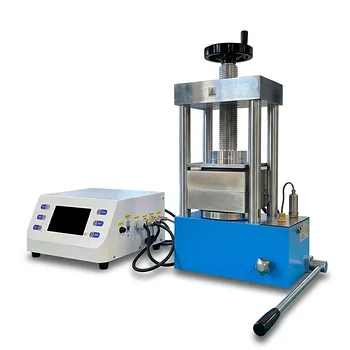
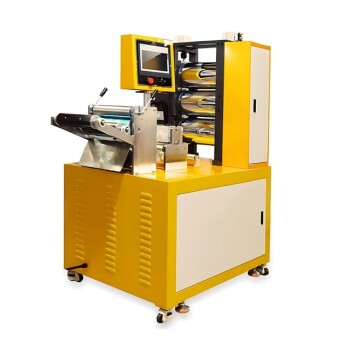
The primary purpose of using a roller press (or calendar press) is to apply precisely controlled mechanical pressure to coated electrode sheets, compacting the material to a specific target density. This process transforms a loose mixture of active materials into a cohesive, uniform layer, setting the physical foundation for the battery's ultimate performance.
By compressing the electrode material, the roller press maximizes physical contact between active particles and the current collector. This directly reduces electrical resistance and increases volumetric energy density, ensuring efficient energy storage and transmission.
The Mechanics of Electrode Optimization
To understand the critical nature of the roller press, one must look beyond simple flattening. The process fundamentally alters the microstructure of the electrode to balance energy density with conductivity.
Enhancing Volumetric Energy Density
The most immediate goal of calendaring is compaction. The press targets a specific density, such as 3.0 g per cubic centimeter, to pack as much active material as possible into a limited space.
By reducing the porosity of the coating, you significantly increase the volumetric energy density. This ensures that the battery stores the maximum amount of energy relative to its physical size.
Minimizing Contact Resistance
A loose electrode coating suffers from poor electrical connectivity. The roller press forces active particles into tight contact with one another and, crucially, with the current collector.
This mechanical interlocking drastically reduces contact resistance. Lower resistance means less energy is lost as heat during operation, leading to a more efficient battery system.
Improving Ionic Transport Efficiency
In composite electrodes containing electrolyte powders, physical proximity is vital. The press ensures tight physical contact between active particles and electrolyte particles.
This intimacy is essential for the efficiency of lithium-ion transport within the electrode. Without sufficient compression, the gaps between particles would hinder the movement of ions, degrading performance.
Ensuring Uniformity
Precision is key in manufacturing. Supplementary data indicates that these presses are used to create sheets of uniform thickness, such as 0.2 mm.
Uniformity prevents "hot spots" of current density during battery operation. It ensures that the electrochemical reactions occur evenly across the entire surface of the electrode sheet.
Understanding the Trade-offs
While compression is necessary, it requires a delicate balance. It is not simply a matter of applying maximum pressure.
The Risk of Over-Compression
Applying too much pressure can crush the active material particles or the conductive lattice. If the structure is too dense, it may close off the pores entirely, preventing the electrolyte from permeating the structure effectively.
The Risk of Under-Compression
Conversely, insufficient pressure leaves the electrode too porous. This results in weak adhesion to the current collector and high internal resistance, which will severely limit the battery's power output.
Making the Right Choice for Your Goal
The specific parameters of your roller press operation should be dictated by the performance metrics you value most.
- If your primary focus is High Energy Density: Prioritize higher compression to maximize the amount of active material per unit of volume (aiming for targets like 3.0 g/cc).
- If your primary focus is High Power/Rate Capability: Maintain slightly higher porosity to ensure optimal ion transport channels and electrolyte permeability.
- If your primary focus is Manufacturing Consistency: Focus on the precision of the gap control to ensure uniform thickness (e.g., 0.2 mm) across the entire sheet length.
The roller press is the defining tool that converts a chemical mixture into a functional, high-efficiency electronic component.
Summary Table:
| Feature | Optimization Goal | Impact on Performance |
|---|---|---|
| Material Compaction | Target Density (e.g., 3.0 g/cc) | Maximizes Volumetric Energy Density |
| Mechanical Contact | Reduce Particle Gaps | Minimizes Electrical Resistance & Heat Loss |
| Microstructure | Balance Porosity | Ensures Efficient Lithium-Ion Transport |
| Thickness Control | Uniformity (e.g., 0.2 mm) | Prevents Current Hot Spots & Enhances Consistency |
Elevate Your Battery Research with KINTEK Precision
Unlock the full potential of your energy storage solutions with KINTEK’s advanced laboratory equipment. Whether you are refining L*LS cathode sheets or developing next-generation solid-state batteries, our precision hydraulic presses, crushing and milling systems, and specialized battery research tools provide the control you need to achieve optimal material density and performance.
From high-performance roller presses to essential consumables like PTFE products and ceramics, KINTEK is your dedicated partner in materials science. Let our experts help you select the right tools to reduce resistance and maximize efficiency in your lab.
Ready to optimize your electrode manufacturing? Contact KINTEK Today to Get a Quote!
Related Products
- High Purity Gold Platinum Copper Iron Metal Sheets
- Manual Lab Heat Press
- Small Lab Rubber Calendering Machine
- Automatic Laboratory Hydraulic Pellet Press Machine for Lab Use
People Also Ask
- What general precaution should be taken regarding the electrolyte? Ensure Your Gold & Platinum Electrodes Stay Inert
- What are the guidelines for using gold or platinum sheets during an experiment? Ensure Precise and Reliable Results
- What is the purity of the gold and platinum sheets used for experiments? Ensuring 99.99% Purity for Reliable Results
- What substances should be avoided to prevent damage to gold or platinum sheets? Protect Your Precious Metals
- What are the main maintenance and care instructions for gold and platinum sheets? Ensure Longevity and Pristine Performance