Knowledge What is the process of rotary kiln? Achieve Precise Industrial Material Transformation
Author avatar

Tech Team · Kintek Solution

Updated 5 days ago

What is the process of rotary kiln? Achieve Precise Industrial Material Transformation


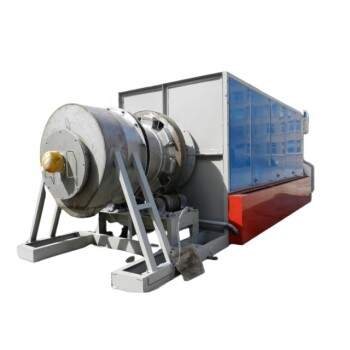
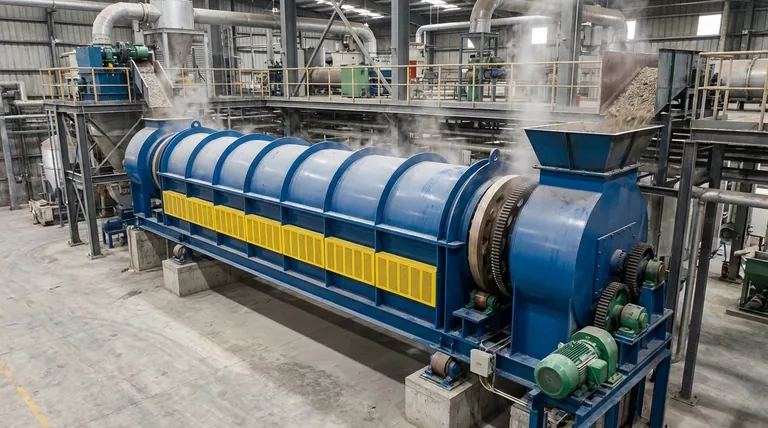
At its core, the rotary kiln process involves continuously feeding material into the upper end of a large, rotating, and slightly inclined cylinder. As the kiln rotates, the material tumbles and gradually moves down toward the lower end due to gravity. This tumbling action ensures the material is uniformly exposed to extremely high temperatures, which drives specific chemical reactions or physical changes to produce a final, transformed product.

The fundamental principle of a rotary kiln is using mechanical motion—rotation and inclination—to achieve highly controlled and uniform thermal processing of materials on a continuous, industrial scale.
What is the process of rotary kiln? Achieve Precise Industrial Material Transformation

The Core Mechanics: How a Rotary Kiln Works

A rotary kiln is not a single component but a system, with the rotating drum, or reactor, at its heart. Understanding how material moves through this system is key to understanding the process.

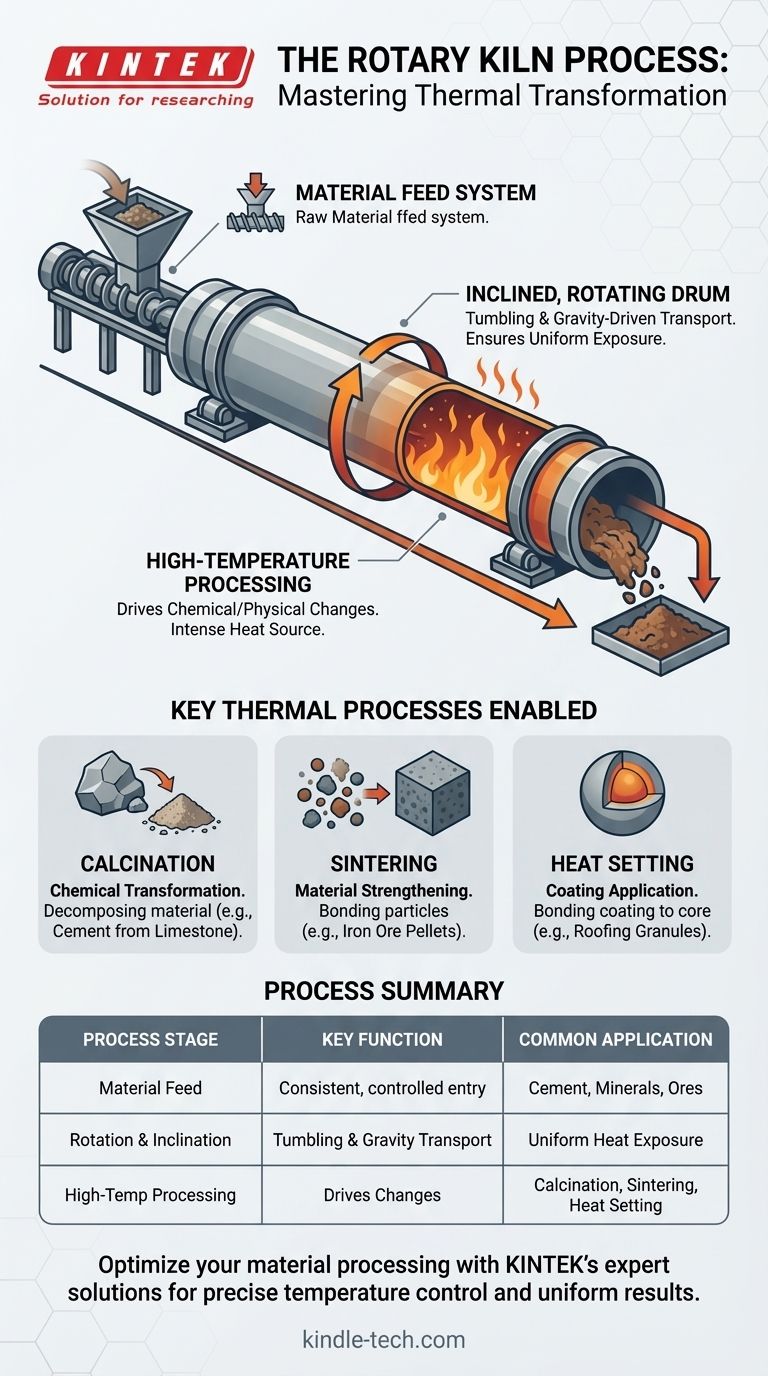
The Material Feed System

Material enters the kiln through a feed chute or screw feeder at the elevated end. This system is designed for a consistent, quantitative flow of feedstock. The design is often robust and made from heat-resistant alloys to prevent material build-up and withstand high temperatures.

The Inclined, Rotating Drum

The kiln itself is a long cylinder positioned at a slight horizontal angle. This inclination is critical, as it uses gravity to move the material from the feed end to the discharge end.

The rotation of the drum serves a dual purpose: it tumbles the material, ensuring every particle is evenly exposed to the heat source, and it helps transport the material down the length of the kiln.

High-Temperature Processing

The primary function of the kiln is to create an ultra-high temperature environment. This intense heat is the catalyst for the entire process, providing the necessary energy for various thermodynamic or kinetic reactions to occur within the material bed.

Key Thermal Processes Enabled by the Kiln

The versatility of the rotary kiln comes from its ability to facilitate a wide range of thermal processes by controlling temperature, atmosphere, and retention time.

Calcination (Chemical Transformation)

Calcination is a process that uses high heat to drive chemical reactions, often by decomposing a material. The most common example is heating limestone to produce lime and carbon dioxide, a foundational step in manufacturing cement.

Sintering (Material Strengthening)

Sintering involves heating a material to a temperature just below its melting point. This causes the particles to bond and fuse, which significantly increases the material's strength and density. This is frequently used for iron ore pelletizing and creating high-strength proppants for the oil and gas industry.

Heat Setting (Coating Application)

In heat setting, a core mineral is coated with another material. The kiln heats the materials so the coating becomes viscous and securely bonds to the core. This technique is essential in manufacturing roofing granules, where colored pigments are fused onto a granite base.

Other Critical Functions

The controlled environment of a rotary kiln also makes it ideal for other functions, including drying, organic combustion, incineration of waste, and reduction roasting to change the chemical state of metals.

Understanding the Engineering Considerations

A rotary kiln's effectiveness is not accidental; it is the result of precise engineering tailored to a specific material and desired outcome.

The Importance of Correct Sizing

Sizing a rotary kiln is a complex task that combines thermal analysis, chemical engineering, and practical experience. There is no one-size-fits-all solution.

Designers must determine the ideal diameter and length of the kiln based on critical factors to ensure the process goals are met efficiently and effectively.

Key Sizing Factors

The final dimensions of a kiln depend on a balance of variables. These include the required capacity (how much material needs to be processed), the retention time (how long the material must stay in the kiln), the maximum feed rate, and the specific chemical and physical properties of the material being processed.

Matching the Process to Your Goal

The specific thermal function you employ depends entirely on your end goal for the material.

  • If your primary focus is chemical decomposition to create a new compound: Calcination is the core process, as seen in cement manufacturing.
  • If your primary focus is to increase the strength and density of a material: Sintering is the method for bonding particles together, essential for products like iron ore pellets.
  • If your primary focus is to apply a durable, heat-fused coating: Heat setting provides the controlled environment to bond one material to another, like in roofing granules.

Ultimately, the rotary kiln process is a powerful and adaptable thermal tool, engineered to meet a vast range of industrial material transformation needs.

Summary Table:

Process Stage Key Function Common Industrial Application
Material Feed Consistent, controlled entry of feedstock Cement, minerals, ores
Rotation & Inclination Tumbling and gravity-driven transport Ensures uniform heat exposure
High-Temperature Processing Drives chemical/physical changes Calcination, sintering, heat setting

Optimize your material processing with KINTEK's expert solutions. Whether you're involved in calcination, sintering, or heat setting, our specialized lab equipment and consumables are designed to meet the rigorous demands of industrial thermal transformation. Let our team help you achieve precise temperature control and uniform results. Contact us today to discuss how we can support your laboratory's specific needs!

Visual Guide
What is the process of rotary kiln? Achieve Precise Industrial Material Transformation Visual Guide

Related Products

People Also Ask

Related Products

Electric Rotary Kiln Pyrolysis Furnace Plant Machine Calciner Small Rotary Kiln Rotating Furnace

Electric Rotary Kiln Pyrolysis Furnace Plant Machine Calciner Small Rotary Kiln Rotating Furnace

Electric rotary kiln - precisely controlled, it's ideal for calcination and drying of materials like lithium cobalate, rare earths, and non-ferrous metals.

Electric Rotary Kiln Small Rotary Furnace for Activated Carbon Regeneration

Electric Rotary Kiln Small Rotary Furnace for Activated Carbon Regeneration

Revitalize your activated carbon with KinTek's Electric Regeneration Furnace. Achieve efficient and cost-effective regeneration with our highly automated rotary kiln and intelligent thermal controller.

Laboratory Vacuum Tilt Rotary Tube Furnace Rotating Tube Furnace

Laboratory Vacuum Tilt Rotary Tube Furnace Rotating Tube Furnace

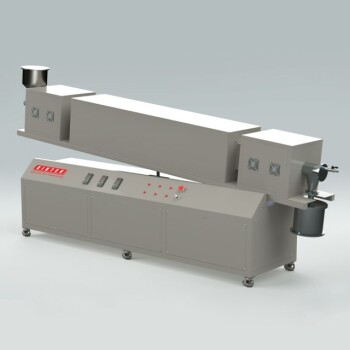
Discover the versatility of Laboratory Rotary Furnace: Ideal for calcination, drying, sintering, and high-temperature reactions. Adjustable rotating and tilting functions for optimal heating. Suitable for vacuum and controlled atmosphere environments. Learn more now!

Vacuum Sealed Continuous Working Rotary Tube Furnace Rotating Tube Furnace

Vacuum Sealed Continuous Working Rotary Tube Furnace Rotating Tube Furnace

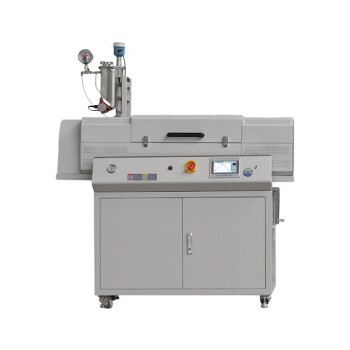
Experience efficient material processing with our vacuum-sealed rotary tube furnace. Perfect for experiments or industrial production, equipped with optional features for controlled feeding and optimized results. Order now.

Laboratory Muffle Oven Furnace Bottom Lifting Muffle Furnace

Laboratory Muffle Oven Furnace Bottom Lifting Muffle Furnace

Efficiently produce batches with excellent temperature uniformity using our Bottom Lifting Furnace. Features two electric lifting stages and advanced temperature control up to 1600℃.

1800℃ Muffle Oven Furnace for Laboratory

1800℃ Muffle Oven Furnace for Laboratory

KT-18 muffle furnace with Japan Al2O3 polycrystalline fibe and Silicon Molybdenum heating element, up to 1900℃, PID temperature control and 7" smart touch screen. Compact design, low heat loss, and high energy efficiency. Safety interlock system and versatile functions.

High Temperature Muffle Oven Furnace for Laboratory Debinding and Pre Sintering

High Temperature Muffle Oven Furnace for Laboratory Debinding and Pre Sintering

KT-MD High temperature debinding and pre-sintering furnace for ceramic materials with various molding processes. Ideal for electronic components such as MLCC and NFC.

1700℃ Muffle Oven Furnace for Laboratory

1700℃ Muffle Oven Furnace for Laboratory

Get superior heat control with our 1700℃ Muffle Furnace. Equipped with intelligent temperature microprocessor, TFT touch screen controller & advanced insulation materials for precise heating up to 1700C. Order now!

1700℃ Laboratory Quartz Tube Furnace with Alumina Tube Tubular Furnace

1700℃ Laboratory Quartz Tube Furnace with Alumina Tube Tubular Furnace

Looking for a high-temperature tube furnace? Check out our 1700℃ Tube Furnace with Alumina Tube. Perfect for research and industrial applications up to 1700C.

Vertical Laboratory Quartz Tube Furnace Tubular Furnace

Vertical Laboratory Quartz Tube Furnace Tubular Furnace

Elevate your experiments with our Vertical Tube Furnace. Versatile design allows for operation under various environments and heat treatment applications. Order now for precise results!

Vacuum Heat Treat Sintering Brazing Furnace

Vacuum Heat Treat Sintering Brazing Furnace

A vacuum brazing furnace is a type of industrial furnace used for brazing, a metalworking process that joins two pieces of metal using a filler metal that melts at a lower temperature than the base metals. Vacuum brazing furnaces are typically used for high-quality applications where a strong, clean joint is required.

Laboratory Quartz Tube Furnace Tubular RTP Heating Furnace

Laboratory Quartz Tube Furnace Tubular RTP Heating Furnace

Get lightning-fast heating with our RTP Rapid Heating Tube Furnace. Designed for precise, high-speed heating and cooling with convenient sliding rail and TFT touch screen controller. Order now for ideal thermal processing!

1200℃ Split Tube Furnace with Quartz Tube Laboratory Tubular Furnace

1200℃ Split Tube Furnace with Quartz Tube Laboratory Tubular Furnace

KT-TF12 split tube furnace: high-purity insulation, embedded heating wire coils, and max. 1200C. Widely used for new materials and chemical vapour deposition.

Ultra-High Temperature Graphite Vacuum Graphitization Furnace

Ultra-High Temperature Graphite Vacuum Graphitization Furnace

The ultra-high temperature graphitization furnace utilizes medium frequency induction heating in a vacuum or inert gas environment. The induction coil generates an alternating magnetic field, inducing eddy currents in the graphite crucible, which heats up and radiates heat to the workpiece, bringing it to the desired temperature. This furnace is primarily used for graphitization and sintering of carbon materials, carbon fiber materials, and other composite materials.

Graphite Vacuum Continuous Graphitization Furnace

Graphite Vacuum Continuous Graphitization Furnace

High-temperature graphitization furnace is a professional equipment for graphitization treatment of carbon materials. It is a key equipment for the production of high-quality graphite products. It has high temperature, high efficiency and uniform heating. It is suitable for various high-temperature treatments and graphitization treatments. It is widely used in metallurgy, electronics, aerospace, etc. industry.

Spark Plasma Sintering Furnace SPS Furnace

Spark Plasma Sintering Furnace SPS Furnace

Discover the benefits of Spark Plasma Sintering Furnaces for rapid, low-temperature material preparation. Uniform heating, low cost & eco-friendly.

Vacuum Heat Treat and Molybdenum Wire Sintering Furnace for Vacuum Sintering

Vacuum Heat Treat and Molybdenum Wire Sintering Furnace for Vacuum Sintering

A vacuum molybdenum wire sintering furnace is a vertical or bedroom structure, which is suitable for withdrawal, brazing, sintering and degassing of metal materials under high vacuum and high temperature conditions. It is also suitable for dehydroxylation treatment of quartz materials.

600T Vacuum Induction Hot Press Furnace for Heat Treat and Sintering

600T Vacuum Induction Hot Press Furnace for Heat Treat and Sintering

Discover the 600T Vacuum Induction Hot Press Furnace, designed for high-temperature sintering experiments in vacuum or protected atmospheres. Its precise temperature and pressure control, adjustable working pressure, and advanced safety features make it ideal for nonmetal materials, carbon composites, ceramics, and metal powders.

Vacuum Hot Press Furnace Heated Vacuum Press Machine Tube Furnace

Vacuum Hot Press Furnace Heated Vacuum Press Machine Tube Furnace

Reduce forming pressure & shorten sintering time with Vacuum Tube Hot Press Furnace for high-density, fine-grain materials. Ideal for refractory metals.

1200℃ Controlled Atmosphere Furnace Nitrogen Inert Atmosphere Furnace

1200℃ Controlled Atmosphere Furnace Nitrogen Inert Atmosphere Furnace

Discover our KT-12A Pro Controlled atmosphere furnace - high precision, heavy duty vacuum chamber, versatile smart touch screen controller, and excellent temperature uniformity up to 1200C. Ideal for both laboratory and industrial application.


Leave Your Message