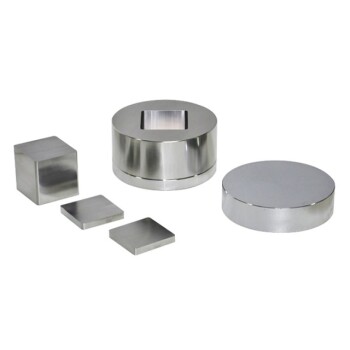
The primary purpose of specialized molding and pressure systems is to establish structural homogeneity. By compressing raw material mixtures into precise geometric forms, these systems eliminate uneven pore distribution within the green body. This process creates the essential physical baseline required to achieve a specific uniform bulk density, typically ranging from 0.87 to 1.32 g/cm³, during the subsequent sintering process.
The core objective of this process is to secure a defect-free foundation before thermal processing begins. By ensuring precise particle packing and geometry, you mitigate the risk of deformation and ensure the structural integrity of the final refractory product.
Establishing Physical Integrity
Precision Geometry Control
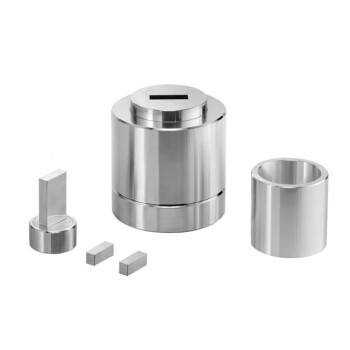
Specialized dies allow for the creation of exact geometric shapes, such as cylinders with specific dimensions (e.g., 80mm diameter by 100mm height).
This consistency is critical for standardizing performance across large production batches.
Eliminating Internal Defects
The application of controlled force is necessary to eliminate uneven pore distribution.
Without this compression, the green body would likely contain internal voids or air pockets that compromise the material's structural density.
The Mechanics of Particle Rearrangement
Overcoming Mechanical Friction
To form a dense body, pressure must be applied to overcome the mechanical friction between raw material particles.
This forcing action compels the particles to rearrange, ensuring tight contact between powder grains rather than a loose association.
Enhancing Green Strength
A dense, tightly packed arrangement significantly significantly boosts the green strength of the material.
High green strength ensures the cylinder is robust enough to be handled, moved, and processed without crumbling or losing its shape prior to sintering.
Pre-Sintering and Thermal Considerations
Foundation for Uniform Density
The molding process is the determining factor for the final bulk density.
It establishes a uniform density target—often between 0.87 and 1.32 g/cm³—which is locked in during the final sintering phase.
Facilitating Heat Transfer
Tight particle contact creates efficient heat transfer paths within the material.
This connectivity is vital for processes relying on the self-sustained propagation of combustion waves or uniform thermal distribution during synthesis.
Understanding the Trade-offs
The Risk of Density Variations
Inconsistent pressure application can lead to significant density variations within a single cylinder.
These inconsistencies frequently result in warping, cracking, or uneven shrinkage once the material enters the high-stress sintering environment.
Deformation Potentials
If the green body lacks sufficient density or uniformity, it becomes highly prone to deformation.
A poorly molded structure may collapse or distort when subjected to the thermal loads of synthesis, rendering the final product unusable.
Making the Right Choice for Your Goal
To optimize your refractory preparation, you must align your pressure settings with your specific material requirements.
- If your primary focus is Structural Integrity: Prioritize pressure settings that maximize particle rearrangement to eliminate internal voids and boost green strength.
- If your primary focus is Thermal Consistency: Ensure the molding process achieves high relative density to establish uniform heat transfer paths for the sintering or combustion phase.
Precise control over the molding phase is not merely about shaping the object; it is the definitive factor in predicting the reliability of the final refractory product.
Summary Table:
| Key Feature | Benefit | Typical Outcome |
|---|---|---|
| Structural Homogeneity | Eliminates uneven pores & internal voids | Defect-free foundation |
| Precision Geometry | Standardizes dimensions (e.g., 80x100mm) | Batch-to-batch consistency |
| Particle Rearrangement | Overcomes mechanical friction | High green strength for handling |
| Uniform Bulk Density | Targets 0.87 - 1.32 g/cm³ | Reduced warping during sintering |
| Heat Transfer Paths | Enhances thermal connectivity | Uniform heat distribution in synthesis |
Elevate Your Material Preparation with KINTEK Precision
Achieving the perfect green body requires more than just pressure—it requires precision. KINTEK specializes in advanced laboratory equipment, offering high-performance hydraulic presses (pellet, hot, and isostatic) and crushing and milling systems designed to eliminate density variations and structural defects.
Whether you are working on refractory synthesis or battery research, our comprehensive range of high-temperature furnaces and molding solutions ensures your materials maintain structural integrity from forming to sintering. Contact KINTEK today to discover how our specialized equipment can optimize your laboratory’s workflow and guarantee the reliability of your final products.
References
- Do Quang Minh, Hoc Thang Nguyen. Development of Refractory Synthesized from Waste Ceramic Fiber and Chamotte. DOI: 10.37591/jopc.v8i2.4293
This article is also based on technical information from Kintek Solution Knowledge Base .
Related Products
- XRF & KBR plastic ring lab Powder Pellet Pressing Mold for FTIR
- Anti-Cracking Press Mold for Lab Use
- No Demolding Lab Infrared Press Mold for Laboratory Applications
- Lab Infrared Press Mold
- Special Shape Press Mold for Lab
People Also Ask
- What is the purpose of using a mold for pellet pressing when preparing catalyst test samples? Ensure Data Consistency
- How does the selection of a pressure mold affect the performance of all-solid-state batteries? Expert Pelletizing Guide
- What is the pressed powder pellet method? A Guide to Accurate FTIR Sample Preparation
- What is the XRF method of sampling? Achieve Accurate Elemental Analysis with Proper Sample Prep
- What is the XRF pressed pellet method? A Fast, Cost-Effective Sample Prep Guide